An ashwagandha powder label is refreshingly short, and three lines tell you what you are buying: the ingredients list, the nutrition panel per 100g and the organic mark. In plain terms: Organic Ashwagandha Powder is one ingredient, organic ashwagandha powder (100%), the whole milled root rather than an extract, certified organic and vegan, with 29g of fibre and 0.6g of fat per 100g, in 250g, 500g and 1kg resealable pouches [2]. This guide explains what the plant is, what the pouch declares, how to mix the powder into food and drinks, and compares it with our extract capsules so you can choose between the whole root and a standardised extract.

Organic Ashwagandha Powder at a glance
Suits you if you want the whole root rather than an extract, certified organic, to stir into drinks and food, and you would rather measure your own spoonful than take a capsule.
Serving and amount: the pouch states no serving size; its figures are per 100g: 290kcal, 29g fibre, 3.4g protein, 0.6g fat, 0.10g salt. You are getting the whole milled root, with nothing added and nothing taken out.
Format: single-ingredient powder in a resealable pouch; 'High Fibre' and 'Low Fat' are printed on the pouch front, and the panel figures meet the register's conditions for both [3].
Price per gram: 500g £15.99 (3.2p a gram), 1kg £24.99 (2.5p), 250g £15.99 (6.4p), at the time of writing.
ORGANIC ASHWAGANDHA POWDER · 500G
£15.99 · 500g · one ingredient: organic ashwagandha powder (100%) · whole milled root · certified organic · vegan · 29g fibre and 0.6g fat per 100g
SHOP NOW
Which Ashwagandha Is Right for You?
If you want the whole root rather than an extract
Choose the powder. It is the dried root milled to a powder, nothing added and nothing taken out, so what the label declares is the food itself: one ingredient, and the nutrition figures per 100g [2]. An extract concentrates the root and prints a ratio, whereas the powder gives you the whole root.
If you cook, blend or make warm drinks
Choose the powder. The label's usage line is to add it to water, juice, shakes or smoothies [2]; it also goes into warm milk, porridge and flapjack mixes, and the mixing ideas below show how. A capsule gives you a fixed amount; a powder gives you a spoon and the choice of how much.
If you want a declared withanolide figure and a fixed daily amount
Choose the extract capsules. Ashwagandha Extract 10,000mg declares 500mg of a 20:1 root extract standardised to 5% withanolides, 25mg per capsule, one a day, 120 capsules for £12.99; the 5,000mg capsules are the same extract at half the strength for £9.99 [2]. Our ashwagandha capsules guide explains the ratio and the standardisation and compares the three strengths.
If you want certified organic in a capsule
Choose KSM-66 or the Organic Complex. Organic Ashwagandha KSM-66 1650mg is a branded, organic-certified root extract at 5% withanolides, three capsules a day, 90 for £12.99 or 180 for £19.99. Organic Ashwagandha Complex 7055mg is the closest capsule to the powder: organic root powder plus a KSM-66 12:1 extract, with organic turmeric and black pepper, three a day, 90 for £8.99 [2].
ORGANIC ASHWAGANDHA POWDER · 250G, 500G AND 1KG
£15.99 for 250g · £15.99 for 500g · £24.99 for 1kg · one ingredient · certified organic · vegan · resealable pouch
SHOP NOW
What does the powder's label declare?
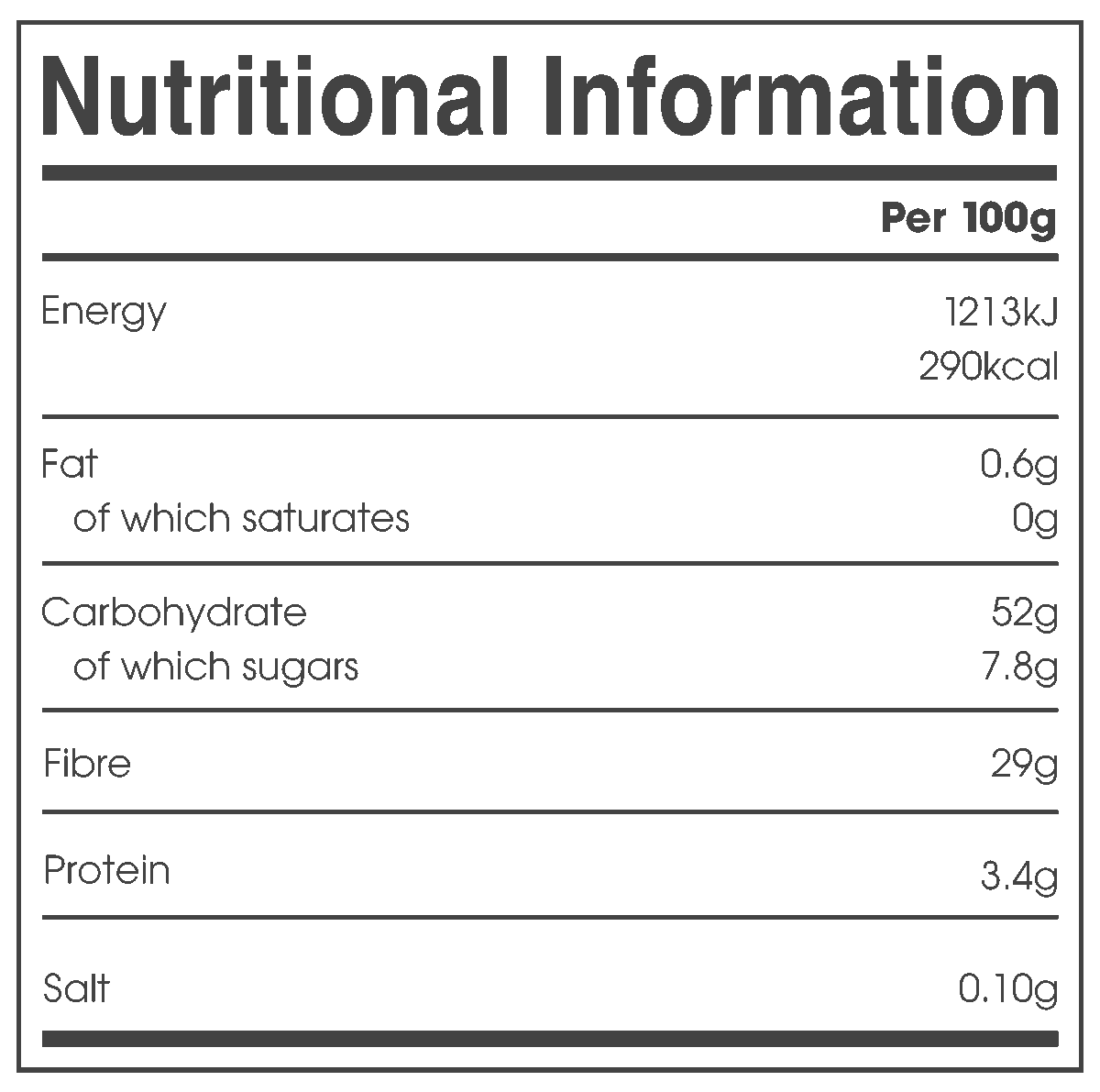
The nutritional information panel on the pouch gives its figures per 100g, and the panel is the same on all three sizes [2]:
• Energy 1213kJ / 290kcal
• Fat 0.6g, of which saturates 0g
• Carbohydrate 52g, of which sugars 7.8g
• Fibre 29g
• Protein 3.4g
• Salt 0.10g
Ingredients: organic ashwagandha powder (100%) [2]. That is the whole list: no fillers, binders, flow agents or capsule shell, because there is no capsule.
High fibre and low fat, as printed on the pouch front. These are nutrition claims, and the GB register sets a condition for each: 'high fibre' may be used where a food contains at least 6g of fibre per 100g, and 'low fat' where it contains no more than 3g of fat per 100g [3]. The panel declares 29g of fibre and 0.6g of fat, so both are earned.
£15.99 ÷ 500g = 3.2p a gram · £24.99 ÷ 1,000g = 2.5p a gram · £15.99 ÷ 250g = 6.4p a gram. Fibre 29g per 100g against the register's 6g line for 'high fibre'; fat 0.6g against its 3g line for 'low fat'.
Organic Ashwagandha Powder, nutrition panel and prices [2]
The organic mark. The pouch front carries the EU organic leaf with the control-body code SK-BIO-003 and the words 'non-EU agriculture', which tell you the root was grown outside the EU and the certification is held in the EU [2]. Organic certification covers how the plant was grown and processed.
Why there is no ratio or percentage on this label. An extract label prints a ratio such as 20:1 (20 parts of dried root concentrated to 1 part of extract) and, if standardised, a withanolide percentage, so that 500mg of extract can be read as 10,000mg of root and 25mg of withanolides. A whole root powder has not been concentrated, so there is nothing to convert: 100g of powder is 100g of root. If you want the ratio maths worked through, our capsules guide does it line by line [2].
How does the powder compare with our extract capsules?
A powder and an extract cannot be compared by milligrams of withanolides, because only the extract declares them. What you can compare is what each label states: whole root or extract, the ratio and percentage where there is one, the ingredients list, organic or not, and the price per gram or per serving. The table applies that to our range; prices are at the time of writing.
Whole milled root · one ingredient · nothing added, nothing taken out · per 100g: 290kcal, 29g fibre, 0.6g fat
Choose if you want the whole root to mix into food and drinks · certified organic · vegan · £15.99: 3.2p a gram
Same powder, same panel per 100g
Choose if you use it daily and want the lowest price per gram · certified organic · vegan · £24.99: 2.5p a gram
Same powder, same panel per 100g
Choose if you want to try a smaller pouch first · certified organic · vegan · £15.99: 6.4p a gram, the same price as the 500g at the time of writing
1 capsule · 500mg of 20:1 root extract = 10,000mg root · 5% = 25mg withanolides · 2.5mg BioPerine · hypromellose shell
Choose if you want a fixed daily amount with the highest withanolide figure per capsule in our range · vegan · £12.99 for 120 servings: 11p a serving
3 capsules · 1,650mg of organic KSM-66 root extract · 5% = 82.5mg withanolides · 5mg organic black pepper extract · hypromellose shell
Choose if you want certified organic and a declared withanolide figure in one product · vegan · £12.99 for 30 servings: 43p a serving (180 capsules: £19.99, 33p)
3 capsules · organic root powder + organic KSM-66 12:1 extract (5% withanolides) · organic turmeric and black pepper · hypromellose shell
Choose if you want the root powder in a capsule with an organic extract alongside it · vegan · £8.99 for 30 servings: 30p a serving
Two things stand out. The three pouches are the same powder with the same panel, so the choice between them is only price per gram, and the 1kg is the cheapest gram while the 250g costs the same as the 500g at the time of writing. And the Organic Complex is the only capsule that contains the root powder itself; every other capsule is an extract with a declared withanolide figure.
How do you use ashwagandha powder in food and drinks?
Start with the label line: add the powder to water, juice, shakes or smoothies [2]. The pouch does not state a serving size in grams, so start with a small spoonful. The powder disperses rather than dissolves, and it has an earthy, slightly bitter taste, so it goes well with something sweet or spiced:
• Smoothies: blend a small spoonful with banana, dates, oats or nut butter.
• Warm drinks: make a paste with a little warm dairy or plant milk first, then whisk in the rest with cinnamon, ginger or cardamom.
• Food: stir it into porridge, flapjack mixes or date-and-nut balls.
Two habits stop clumping: add the powder before the liquid, and use a dry spoon so no moisture gets into the pouch.
What is ashwagandha root powder made from?
Ashwagandha, botanically Withania somnifera, is an evergreen shrub of the nightshade family (Solanaceae) that grows to about a metre tall, with small green-yellow flowers and orange-red berries held inside a papery husk, which is why it is also called winter cherry. It is native to India, where most commercial crops are grown, and the root is the part used; its other nickname, Indian ginseng, is a naming habit only, as it is not related to Panax ginseng [1]. After harvest the roots are washed and dried, then either milled into a powder or extracted to concentrate the withanolides, the root's naturally occurring marker compounds [1]. This product is the milled root; our ashwagandha gummies guide covers the extract in a chewable.
The powder sits in our Herbal Powders range and our Ashwagandha range, alongside the extract capsules, the organic KSM-66 capsules, the tablets and the gummies.
How to store ashwagandha powder
Storage, in the label's words: store in a cool, dry place out of direct sunlight [2]. A dried root powder keeps well sealed in its resealable pouch, away from steam and heat.
LOOKING FOR ORGANIC ASHWAGANDHA ROOT POWDER?
One ingredient, organic ashwagandha powder (100%): the whole milled root, certified organic, vegan, 29g of fibre and 0.6g of fat per 100g, in 250g, 500g and 1kg resealable pouches. You can choose the 500g pouch for £15.99 (3.2p a gram) or the 1kg for £24.99 (2.5p a gram), at the time of writing.
SHOP ASHWAGANDHA POWDER
Organic Ashwagandha Powder FAQs
1. What is organic ashwagandha powder made from?
The dried, milled root of Withania somnifera, a shrub of the nightshade family, and nothing else: the ingredients list reads organic ashwagandha powder (100%). It is a whole root powder rather than an extract: nothing concentrated and nothing taken out.
2. How much ashwagandha powder should I take a day?
Rather than a serving size in grams, the pouch suggests adding the powder to water, juice, shakes or smoothies [2]. A small spoonful is a good place to begin. Our ashwagandha capsule labels say they are not intended for children, or for pregnant or breastfeeding women, and ask you to consult a doctor first if you have a medical condition or take any medication [2].
3. What do ‘high fibre’ and ‘low fat’ on the pouch mean?
They are nutrition claims with a condition set in the GB register: ‘high fibre’ needs at least 6g of fibre per 100g, and ‘low fat’ no more than 3g of fat per 100g. The panel declares 29g of fibre and 0.6g of fat per 100g, so both conditions are met.
4. Is organic ashwagandha powder vegan, and what does the organic mark mean?
Yes: it is one plant ingredient with nothing added. The EU organic leaf on the pouch front, with the code SK-BIO-003 and the words non-EU agriculture, means the root was grown to organic rules outside the EU and certified by an EU control body. The certification covers growing and processing.
5. Does ashwagandha powder dissolve, and what does it taste like?
It disperses rather than dissolves, so a smoothie or a paste made with a little warm milk works better than a glass of water. The taste is earthy and slightly bitter, which is why the mixing ideas above pair it with banana, dates, cinnamon, ginger or cardamom.
6. Ashwagandha powder or capsules: what is the difference on the label?
The powder is the whole milled root, one ingredient, with nutrition per 100g and no withanolide figure. An extract capsule declares a ratio and, if standardised, a withanolide percentage: our 10,000mg capsule is 500mg of 20:1 extract at 5%, 25mg of withanolides. If you want a declared figure and a fixed daily amount, choose a capsule; if you want the food itself to mix into meals, choose the powder.
7. Does ashwagandha have an authorised health claim in the UK?
No. The Great Britain Nutrition and Health Claims Register is the only list of what a UK food may claim, and it has no entry for ashwagandha or Withania somnifera [3]. The high fibre and low fat lines on the pouch are nutrition claims about the food.
Choose Organic Ashwagandha Powder if you want the whole root, one ingredient, certified organic, to mix into drinks and food; the 1kg pouch is the lowest price per gram at 2.5p.
Choose Ashwagandha Extract 10,000mg Capsules if you want a fixed daily amount with a declared withanolide figure, 25mg per capsule.
Choose Organic Ashwagandha KSM-66 1650mg if you want certified organic and a declared withanolide figure in one capsule.
Choose Organic Ashwagandha Complex 7055mg if you want the root powder in a capsule, with an organic extract alongside it, at 30p a day.
References
Checked against the product label and the GB Nutrition and Health Claims Register, September 2026.
[1] Mikulska P, Malinowska M, Ignacyk M, et al. Ashwagandha (Withania somnifera): Current Research on the Health-Promoting Activities: A Narrative Review. Pharmaceutics 2023;15(4):1057 (cited for botany, name, plant part and processing only). PMC. View Source
[2] Alpha01. Organic Ashwagandha Powder 500g: nutritional information panel per 100g, pouch front (organic mark, high fibre, low fat), ingredients, suggested use, storage and price; and the 250g and 1kg pouches, Ashwagandha Extract 10,000mg and 5,000mg capsules, Organic KSM-66 1650mg (90 and 180) and Organic Ashwagandha Complex 7055mg. Accessed 2026-09-17. View Source
[3] Department of Health and Social Care. Great Britain nutrition and health claims (NHC) register, GOV.UK (no entry for ashwagandha or Withania somnifera; conditions of use for the nutrition claims high fibre and low fat). Accessed 2026-09-17. View Source


