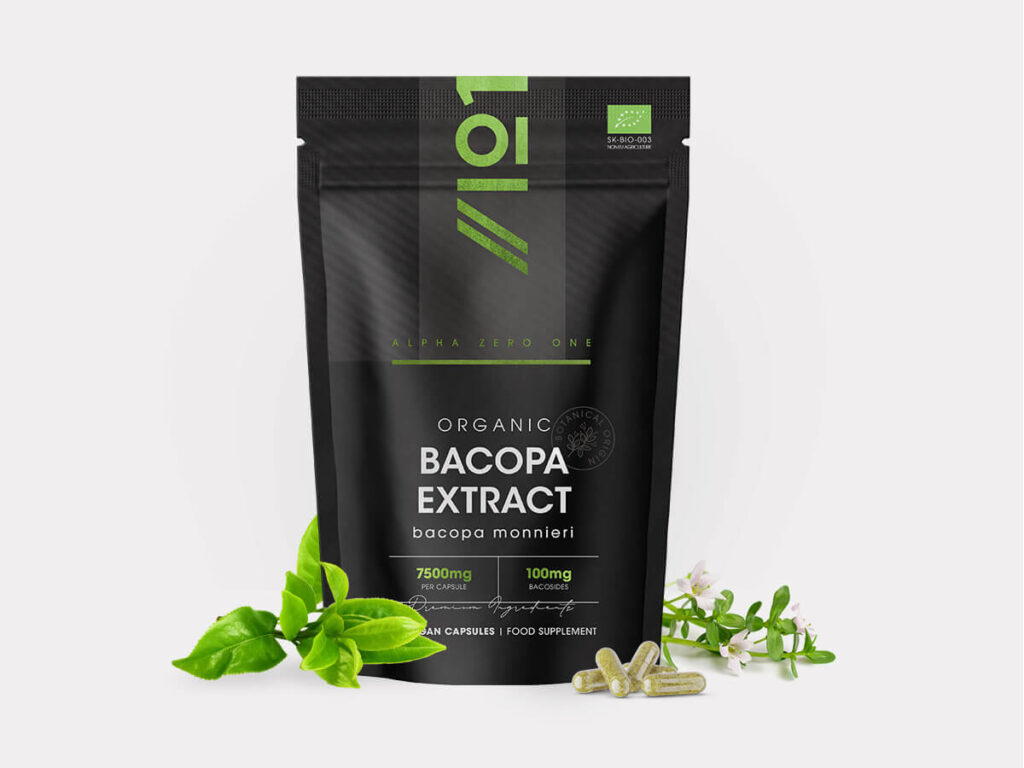
A bacopa label can print 7,500mg on the front of a pouch whose capsules each weigh well under a gram, and the label does not always explain how. In plain terms: Organic Bacopa Extract 7500mg holds 500mg of certified organic Bacopa monnieri extract at a 15:1 ratio, standardised to 20% bacosides, which is 100mg per capsule, one a day, 90 capsules for £9.99 [3]. This guide explains what the ratio and the bacoside figure mean, compares our 7,500mg and 15,000mg capsules and the loose powder side by side, and shows the simple maths behind each label, so you can choose the right pouch for your routine.
Checked against the product label and the GB Nutrition and Health Claims Register, September 2026.
Organic Bacopa Extract at a glance
Suits you if you want a standardised, certified organic Bacopa monnieri extract in one vegan capsule a day, with the bacoside figure printed on the panel.
Serving and amount: 1 capsule a day = 500mg of organic 15:1 extract, expressed on the label as 7,500mg of Bacopa monnieri, providing 100mg of bacosides; no NRV established, because a Nutrient Reference Value (the daily amount UK labels use for vitamins and minerals) exists only for those nutrients.
Format: hypromellose (plant-derived, vegan) capsule; three ingredients; a 90-capsule pouch is 90 days.
Price per serving: £9.99 for 90 servings, 11p a day, at the time of writing; the 15,000mg capsule is £14.99 for 60 servings, 25p a day.
ORGANIC BACOPA EXTRACT 7500MG · 90 VEGAN CAPSULES
£9.99 · 90 servings · 1 capsule a day · 500mg of organic 15:1 extract · 20% bacosides (100mg) · hypromellose shell
SHOP NOW
Which Bacopa Is Right for You?
If you are choosing between 7,500mg and 15,000mg
Choose on the bacoside figure, not the headline. Both capsules hold the same 500mg of organic extract; what differs is the ratio and the standardisation. Organic Bacopa Extract 7500mg, 90 Capsules is a 15:1 extract standardised to 20% bacosides, 100mg per capsule, £9.99 for 90 days, 11p a day [3]. Organic Bacopa Extract 15,000mg, 60 Capsules is a 30:1 extract standardised to 50% bacosides, 250mg per capsule, two and a half times as much, £14.99 for 60 days, 25p a day [4]. Choose 7,500mg if 100mg of bacosides a day is the figure you want; choose 15,000mg if you want 250mg in the same single capsule.
If you want one pouch to last three months
The 7,500mg pouch is 90 days from one pack. The label direction is one capsule daily with water and the pouch holds 90 capsules; the 15,000mg pouch holds 60, so it is two months.
If you follow a vegan diet or want certified organic
Both capsules give you both. The extract is certified organic, with the organic leaf and the control code SK-BIO-003 printed on the pouch front, the shell is vegan hypromellose and the only other ingredient is organic brown rice flour [3].
If you would rather use a powder than a capsule
Organic Bacopa Monnieri Powder 250g is a single ingredient, the milled whole herb rather than an extract. You stir a quarter teaspoon (1g) into water, juice, shakes or smoothies, and the 250g pack gives you 250 servings for £15.99, 6p a day.
If you are comparing brands by the label
Three numbers must agree with each other. Herb equivalent ÷ ratio = extract weight, and extract weight × standardisation = milligrams of bacosides. A label that prints a herb-equivalent figure with no ratio or no percentage beside it is telling you less, and one that says only brahmi without the botanical name Bacopa monnieri is not telling you which plant it is.
ORGANIC BACOPA EXTRACT 7500MG · 90 VEGAN CAPSULES
£9.99 · 90 servings · 1 capsule a day · 500mg of organic 15:1 extract = 7,500mg of Bacopa monnieri · 20% bacosides (100mg) · hypromellose shell · 11p a day
SHOP NOW
What do 15:1 and 100mg bacosides mean on a bacopa label?
The nutrition panel on the 7,500mg pouch says: serving size 1 capsule; servings per container 90; organic Bacopa monnieri (from 15:1 extract) 7,500mg, providing 100mg bacosides; no NRV established [3]. Three numbers, and each one can be worked out from the others.

15:1 is the extract ratio. It means fifteen parts of dried herb were concentrated down to one part of extract, so every gram of extract stands for 15 grams of bacopa. Turn it round and the 7,500mg on the label is a herb equivalent, not the weight of the capsule: 7,500mg ÷ 15 = 500mg of actual extract in each capsule. A capsule cannot hold seven and a half grams of anything; it holds half a gram of concentrate that was made from seven and a half grams of herb.
7,500mg of herb ÷ 15 = 500mg of extract in each capsule · 500mg × 20% = 100mg of bacosides. The 15,000mg capsule: 15,000mg ÷ 30 = 500mg of extract · 500mg × 50% = 250mg of bacosides. Same extract weight, different strength; the bacoside line is the one to compare.
Organic Bacopa Extract 7500mg and 15,000mg, nutrition panels [3]
20% bacosides is the standardisation. When a laboratory standardises bacopa, the marker it measures is a group of saponins in the plant called bacosides [6]. Standardisation means the extract is prepared so that a stated percentage of that marker is guaranteed in every batch: 20% of 500mg is 100mg, which is exactly the providing 100mg bacosides line on the panel. The 15,000mg capsule is standardised to 50%, so 250mg [4]. Without a percentage, a herb-equivalent figure tells you how much plant went in but nothing about what came out.
The rest of the ingredients list is short. Organic Bacopa Monnieri 15:1 Extract (20% Bacosides), Capsule Shell (Hypromellose), Organic Brown Rice Flour [3]; the 15,000mg capsule reads the same except for the extract line, Organic Bacopa Monnieri 30:1 Extract (50% Bacosides) [4]. Brown rice flour is the carrier that bulks half a gram of extract into a fillable capsule; there is no gelatin and no other herb.
How to compare bacopa capsules and powder by the label
Every bacopa label breaks down into the same five steps: check the botanical name; find the extract weight per capsule; divide the herb equivalent by the ratio if only the equivalent is printed; multiply the extract weight by the standardisation percentage for milligrams of bacosides; and divide the pack price by the number of servings. The table applies them to our range and to any other product you will meet; prices are at the time of writing.
500mg of 15:1 extract → 7,500mg of Bacopa monnieri · 20% bacosides = 100mg
Choose if you want 100mg of bacosides a day and a 90-day pouch · hypromellose shell · £9.99 for 90 servings: 11p a day
500mg of 30:1 extract → 15,000mg of Bacopa monnieri · 50% bacosides = 250mg
Choose if you want 250mg of bacosides in one capsule · hypromellose shell · £14.99 for 60 servings: 25p a day
1g (¼ teaspoon) of milled whole herb per serving · no ratio, no bacoside percentage · 250 servings
Choose if you want the herb itself to stir into drinks · single ingredient · £15.99 for 250 servings: 6p a day
Any other bacopa capsule or tablet
Herb equivalent ÷ ratio = extract weight (no ratio means the figure is herb or powder weight, not extract) · % × extract weight = mg bacosides (no % means the bacoside content is not declared)
Check that its label names Bacopa monnieri and prints all three numbers · hypromellose or cellulose shell = vegan, gelatin = animal-derived · pack price ÷ servings = price per day
A worked contrast shows why the ratio and the percentage matter more than the headline: 500mg of plain bacopa powder with no ratio is 500mg of herb; 500mg of a 15:1 extract at 20% is 100mg of bacosides; and 500mg of a 30:1 extract at 50% is 250mg. All three capsules weigh about the same.
What is Bacopa monnieri?
Bacopa (Bacopa monnieri) is a low, creeping perennial herb that roots at its nodes and often forms dense mats of small, rather fleshy leaves at the edges of freshwater and brackish pools and streams [5]. It belongs to the plantain family (Plantaginaceae) and is native to India, where one of its names is brahmi, and across southern and south-east Asia, Australia, Africa and the warmer parts of the Americas [1].
In India the whole aerial plant is cut, dried and either milled into a powder or extracted with water or alcohol to concentrate the bacosides. Because the name brahmi is also used for Centella asiatica, the plant sold as gotu kola, the botanical name on the label is what tells the two apart.
Organic Bacopa Extract sits in our herbal supplements range alongside the other single-herb capsules and powders we sell.
How to take bacopa extract capsules: one a day with water
The label direction for both strengths, in its words: take 1 capsule daily with water [3][4]. The label does not specify a time of day or whether to take the capsule with food, so either is consistent with the directions; with 90 capsules in the 7,500mg pouch that is 90 days from one pack, and 60 days from the 15,000mg pouch.
The capsules are not intended for children, or for anyone who is pregnant or breastfeeding; if you have a medical condition or take medication, check with your doctor first. Storage: store in a cool, dry place out of direct sunlight; keep out of reach of young children [3].
Both pouch fronts carry the organic leaf with the control code SK-BIO-003, the words vegan capsules and food supplement, and a botanical origin seal; the pouches reseal, so keep them closed between uses, away from steam and heat, and use the capsules before the date printed on the pack.
READY TO TRY ORGANIC BACOPA EXTRACT?
500mg of certified organic 15:1 Bacopa monnieri extract per capsule, standardised to 20% bacosides (100mg), in a vegan hypromellose shell: one a day, 90 servings for £9.99 at the time of writing. If you want 250mg of bacosides in one capsule, the 15,000mg strength is £14.99 for 60 servings, 25p a day.
SHOP BACOPA EXTRACT
Bacopa Extract FAQs
1. What does 7500mg or 15,000mg on the label mean?
They are herb-equivalent figures, not the weight of the capsule. Each capsule contains 500mg of extract; multiplying 500mg by the extract ratio gives the equivalent weight of dried herb, so 500mg × 15 = 7,500mg and 500mg × 30 = 15,000mg. What differs in practice is the bacoside content: 100mg in the 7,500mg capsule and 250mg in the 15,000mg capsule, the figures declared on the panels.
2. How many bacopa capsules a day, and how long does a pouch last?
The label direction for both strengths is one capsule daily with water. The 7,500mg pouch holds 90 capsules, so it lasts 90 days; the 15,000mg pouch holds 60 capsules, so it lasts 60 days. The label does not specify a time of day or whether to take the capsule with food, so either is consistent with the directions.
3. Is bacopa the same as brahmi?
Brahmi is the name used in India for Bacopa monnieri, but the same name is also used for a different plant, Centella asiatica, sold as gotu kola. A label that prints the botanical name Bacopa monnieri tells you which plant is in the capsule; ours names the species on the pouch front and on the panel.
4. Are the capsules vegan and gluten free?
The shell is hypromellose, a plant-derived cellulose, and the pouch front says vegan capsules. The three ingredients are the organic Bacopa monnieri extract, the hypromellose shell and organic brown rice flour; none is a gluten-containing cereal. The pouch carries no separate gluten-free mark.
5. Does bacopa have an authorised health claim in the UK?
No. The Great Britain Nutrition and Health Claims Register is the only list of what a UK food supplement may claim, and it has no entry for bacopa, brahmi or Bacopa monnieri [2].
6. What is the difference between the extract capsules and the bacopa powder?
The capsules hold a concentrated extract with a declared ratio and bacoside percentage: 500mg of 15:1 extract giving 100mg of bacosides, or 500mg of 30:1 extract giving 250mg. The powder is the milled whole herb, 1g per quarter-teaspoon serving, with no ratio and no bacoside percentage declared, for stirring into water, juice, shakes or smoothies. Our bacopa powder guide breaks down its label separately.
Choose Organic Bacopa Extract 7500mg if you want a 15:1 extract giving 100mg of bacosides per capsule and a 90-day pouch at 11p a day.
Choose Organic Bacopa Extract 15,000mg if you want a 30:1 extract giving 250mg of bacosides per capsule and a 60-day pouch at 25p a day.
Choose Organic Bacopa Monnieri Powder if you want the milled whole herb to stir into drinks rather than a capsule, with 250 servings at 6p a day.
Order Organic Bacopa Extract 7500mg today: certified organic, the bacoside figure printed on the panel, 90 capsules for £9.99 at the time of writing.
References
[1] USDA Agricultural Research Service, National Plant Germplasm System. Bacopa monnieri (L.) Pennell. GRIN-Global Taxonomy (cited for the plant family, the name brahmi in India and the native range; accessed 2026-09-27). View Source
[2] Department of Health and Social Care. Great Britain nutrition and health claims (NHC) register, GOV.UK (no entry for bacopa, brahmi or Bacopa monnieri; accessed 2026-09-17). View Source
[3] Alpha01. Organic Bacopa Extract 7500mg, 90 Capsules: nutritional information panel, pouch front, ingredients, suggested use, caution, storage and price (accessed 2026-09-17). View Source
[4] Alpha01. Organic Bacopa Extract 15,000mg, 60 Capsules: nutritional information panel, pouch front, ingredients, suggested use and price (accessed 2026-09-17). View Source
[5] Wood B. Bacopa monnieri. Plants of South Eastern New South Wales, Lucidcentral (cited for the plant's habit, leaves and habitat; accessed 2026-09-27). View Source
[6] Deepak M, Sangli GK, Arun PC, Amit A. Quantitative determination of the major saponin mixture bacoside A in Bacopa monnieri by HPLC. Phytochemical Analysis 2005;16(1):24-29 (cited for bacosides as the saponins laboratories measure to standardise bacopa; accessed 2026-09-27). PubMed. View Source


