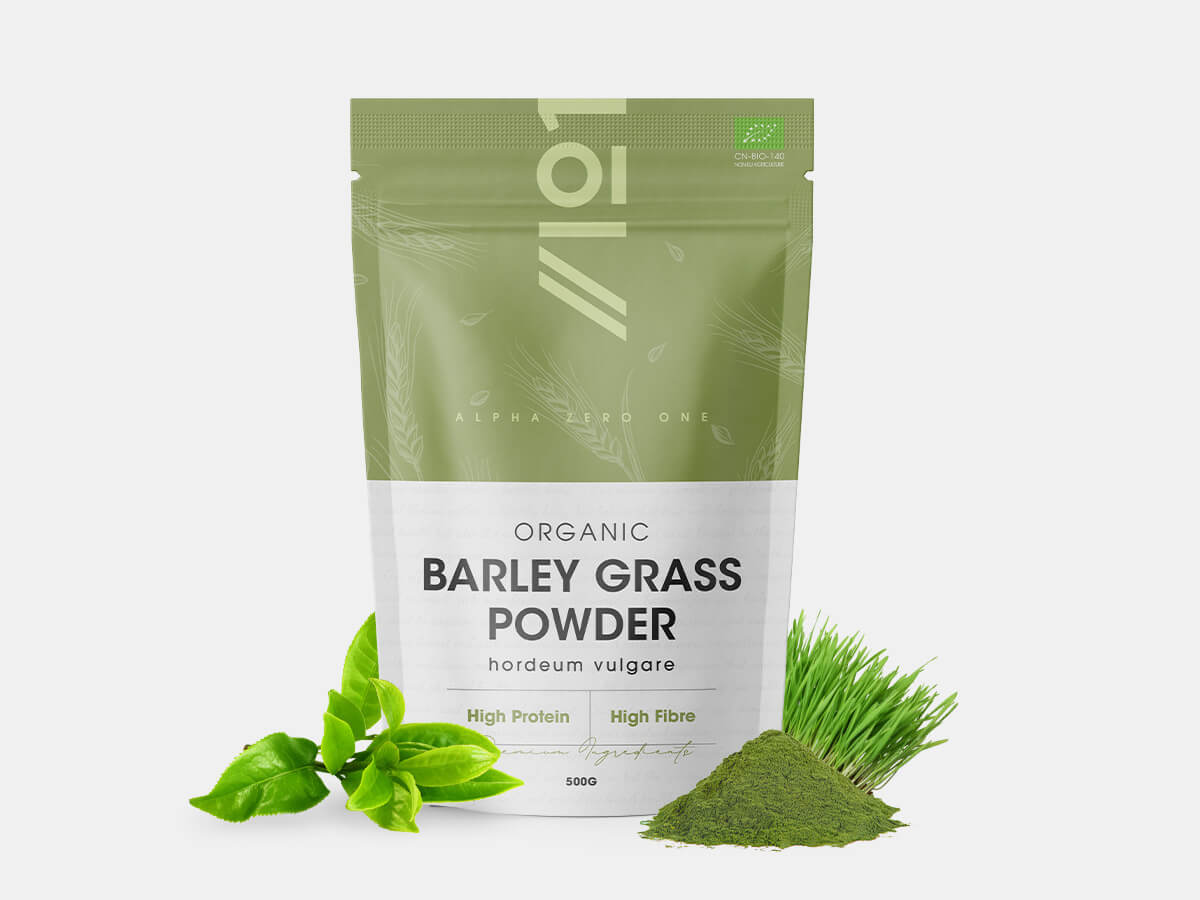
If you pick up a pouch of organic barley grass powder, two words stand out on the front: High Protein and High Fibre. Both are worked out per 100g, while most of us use a teaspoon at a time, so the figures are easy to misread. Organic Barley Grass Powder is the young leaf of the barley plant, dried and milled, one ingredient and nothing else, certified organic, in 200g, 500g and 1kg pouches from £5.99 [3]. The powder qualifies as a source of protein, so the wording authorised in the Great Britain Nutrition and Health Claims Register applies to it: protein contributes to a growth in muscle mass, to the maintenance of muscle mass and to the maintenance of normal bones [2]. This guide breaks down what those front-of-pack words mean, shows the simple maths behind a single teaspoon, and compares the three pouches and our capsules on price per 100g so you can pick the size that suits you.
Barley grass powder at a glance
Suits you if you want a single-ingredient green powder to stir into water, juice or a smoothie, and you would rather set the amount yourself than take capsules.
Per 100g on the panel: energy 1305kJ (310kcal), protein 19g, fibre 24g, carbohydrate 44g of which sugars 11g, fat 3.0g, salt 0.32g [3]. The pouch states no serving size; a level teaspoon is roughly 3g, which is our measure, not the label's.
Format: loose powder, ingredients list one line, Organic Barley Grass Powder (100%); certified organic; resealable pouch.
Price per 100g: 200g £5.99 (£3.00), 500g £14.99 (£3.00), 1kg £21.99 (£2.20), at the time of writing.
Claims the label can carry: High Protein and High Fibre, both printed on the pouch front and both met by the panel figures [2][3]; and because the powder is a source of protein, "Protein contributes to the maintenance of muscle mass" [2].
ORGANIC BARLEY GRASS POWDER · 500G
£14.99 · £3.00 per 100g · 100% organic barley grass powder · per 100g: protein 19g, fibre 24g · High Protein, High Fibre on the pouch front
SHOP NOW
Which Barley Grass Powder Is Right for You?
Comparing pack sizes and cost per 100g
The same powder, three pouches, and the price per 100g is lowest in the largest pouch. The 200g pouch is £5.99, £3.00 per 100g; the 500g pouch is £14.99, £3.00 per 100g; the 1kg pouch is £21.99, £2.20 per 100g, prices at the time of writing [3]. At a level teaspoon of about 3g, that is roughly 65 teaspoons in the 200g, 165 in the 500g and 330 in the 1kg. Start with the 200g if you have not tasted barley grass before; move to the 1kg once you know a teaspoon a day is a habit.
Choosing between powder and capsules
The powder is the flexible option; the capsule is the measured one. The pouch's direction is to add the powder to water, juice, shakes or smoothies, so you decide the amount, and the powder is the cheaper way to take the leaf. If you would rather not taste it, Organic Barley Grass 1500mg gives 1,500mg of the same organic powder in three vegan capsules a day, 30 servings for £5.99, 20p a day [3]; our barley grass capsules guide covers that label in full, so this guide sticks to the powder.
Barley grass or wheatgrass powder?
Two cereal grasses, two panels, the same front-of-pack words. Organic Wheatgrass Powder 500g is the young leaf of wheat, Triticum aestivum, at £14.99 for 500g; its panel declares 22g protein and 51g fibre per 100g, and its pouch front also prints High Protein and High Fibre [3]. Barley grass declares 19g protein and 24g fibre. Both are 100% single-ingredient organic leaf powders, and our wheatgrass powder guide covers the wheat one.
Reading the label carefully
Three lines tell you what you are buying. The ingredients list (ours is one line, Organic Barley Grass Powder 100%), the nutrition panel per 100g (ours declares protein and fibre, and no vitamins or minerals), and how the leaf was processed. There are two kinds of barley grass powder on the shelf:
• Milled leaf powder: the whole dried leaf ground fine, so the leaf's fibre stays in the powder. Ours is this kind.
• Spray-dried juice powder: the juice pressed from the leaf and dried, which leaves most of the leaf fibre behind, so its panel reads differently.
ORGANIC BARLEY GRASS POWDER · 500G
£14.99 · £3.00 per 100g · about 165 level teaspoons · 100% organic young barley leaf, dried and milled · certified organic (CN-BIO-140) · also in 200g and 1kg
SHOP NOW
What do High Protein and High Fibre mean on the pouch?
They are nutrition claims, and UK law sets a threshold for each. A food may be called high in protein only when at least 20% of its energy value comes from protein, and high in fibre only when it contains at least 6g of fibre per 100g [2]. The panel on the pouch is what decides it [3]:

Protein is 24.8% of the energy value, fibre is four times the threshold. Protein counts as 17kJ per gram on a UK label, so 19g of protein is 323kJ of the 1305kJ per 100g. That clears the 20% line for High Protein. Fibre at 24g per 100g clears the 6g line for High Fibre four times over.
19g protein × 17kJ = 323kJ; 323 ÷ 1305kJ = 24.8% of the energy value from protein (High Protein needs 20%). Fibre 24g per 100g (High Fibre needs 6g). A level teaspoon, about 3g, is a thirtieth of the panel: about 0.6g of protein and 0.7g of fibre. Price per 100g: £3.00 in the 200g, £3.00 in the 500g, £2.20 in the 1kg.
Organic Barley Grass Powder, nutrition panel per 100g [3]
The NHS puts the daily fibre target at 30g and says most adults eat about 20g [4]. At 24g of fibre per 100g, the powder is an easy way to add fibre to a smoothie or a glass of juice.
“Government guidelines say our dietary fibre intake should increase to 30g a day, as part of a healthy balanced diet. As most adults are only eating an average of about 20g day, we need to find ways of increasing our intake.”
How to get more fibre into your diet, nhs.uk [4]
The ingredients list is one line [3]: Organic Barley Grass Powder (100%). No filler, no binder, no flavour, no sweetener.
How to compare barley grass powders by the label
Every green-powder label breaks down into the same steps: read the ingredients list for anything other than the leaf; check whether it is milled leaf or spray-dried juice; read the protein and fibre per 100g and any vitamins or minerals actually declared; divide the pack price by its weight for the price per 100g. The table applies those steps to our range; prices are at the time of writing.
100% organic barley grass powder · per 100g: protein 19g, fibre 24g, carbohydrate 44g (sugars 11g), fat 3.0g, salt 0.32g · High Protein and High Fibre on the pouch front
Choose if you are trying barley grass for the first time · about 65 level teaspoons · £5.99: £3.00 per 100g
The same powder and the same per-100g panel as the 200g
Choose if you use it most days and want the mid-size pouch · about 165 level teaspoons · £14.99: £3.00 per 100g
The same powder and the same per-100g panel as the 200g
Choose if a teaspoon a day is already a habit and you want the lowest price per gram · about 330 level teaspoons · £21.99: £2.20 per 100g
3 capsules · 1,500mg of the same organic barley grass powder · the panel declares the leaf weight only, no protein or fibre figure · hypromellose shell, organic brown rice flour
Choose if you want a measured 1.5g a day without the taste · vegan · £5.99 for 30 servings: 20p a serving, about £13.30 per 100g of powder
100% organic wheatgrass powder, Triticum aestivum · per 100g: protein 22g, fibre 51g, carbohydrate 10g (sugars 5.0g), fat 2.8g, salt 0.40g · High Protein and High Fibre on the pouch front
Choose if you want the other cereal grass, with more fibre per 100g on its panel · £14.99: £3.00 per 100g
Two things stand out once the maths is done. The 1kg pouch costs less per 100g than the 200g for the identical powder, so the only reason to buy small is to taste it first. The capsules cost more per gram because the same powder comes ready-measured in a vegan capsule, with no taste and nothing to mix.
What is barley grass and how is the powder made?
Barley grass is the young green leaf and stem of the barley plant, Hordeum vulgare, a cereal of the grass family, taken in its vegetative stage: from the seedling about ten days after sprouting to the point where the stem lengthens, before the plant flowers and sets grain [1]. Barley itself is one of the world's major cereal crops [1]; the leaf powder is a different product from the grain, with its own panel.
The product page describes ours as "made from the growing shoots and leaves of the young barley plant" and "harvested by hand before the plant forms grains" [3]. The cut leaf is dried and milled to a fine green powder. Because it is a whole milled leaf and not an extract, the label carries no extract ratio and no standardised marker compound: the panel per 100g is the whole description.
Organic Barley Grass Powder sits in our herbal powders range alongside the wheatgrass, chlorella and spirulina powders and the other single-ingredient organic powders we sell.
Barley grass powder benefits: the claims UK rules authorise
UK rules let a food carry only the claims authorised in the Great Britain Nutrition and Health Claims Register. What the powder can state comes from its panel. The nutrition claims High Protein and High Fibre are allowed because the panel meets both thresholds, and because the powder is a source of protein, the register's authorised protein claims apply to it [2]:
• Protein contributes to a growth in muscle mass.
• Protein contributes to the maintenance of muscle mass.
• Protein contributes to the maintenance of normal bones.
Every health claim on the Great Britain register passed a scientific review: independent scientists examined the research and the evidence behind it before it was authorised. The law itself says that health claims shall be “based on and substantiated by generally accepted scientific evidence” (Regulation (EC) No 1924/2006, Article 6).
How to use and store barley grass powder
The label direction, in its words: add powder into water, juice, shakes or smoothies; enjoy as part of a balanced diet and healthy lifestyle [3]. The pouch states no serving size in grams, so a level teaspoon, about 3g, is the practical starting measure. Blend it with apple, cucumber or citrus, whisk it into cold water with a squeeze of lemon, or fold it into yoghurt or hummus. Whisk rather than stir, because the fine powder floats.
Storage, in the label's words: store in a cool, dry place out of direct sunlight [3]. Keep the pouch sealed and away from the hob and the kettle. The pouch front carries the organic leaf mark with the code CN-BIO-140 and the words "non-EU agriculture", the required origin statement for the certified organic crop [3].
READY TO TRY ORGANIC BARLEY GRASS POWDER?
One ingredient, the whole young barley leaf dried and milled, with High Protein and High Fibre earned by the panel: 19g of protein and 24g of fibre per 100g. 500g for £14.99, £3.00 per 100g, at the time of writing; 200g and 1kg pouches and capsules also available.
SHOP BARLEY GRASS POWDER
Barley Grass Powder FAQs
1. Is barley grass powder high in protein?
Yes. The panel declares 19g of protein per 100g, which is 24.8% of the powder's energy value, above the 20% a High Protein claim needs [2][3]. As a source of protein, the powder can also carry the register's wording: protein contributes to the maintenance of muscle mass [2].
2. How much barley grass powder should I take a day?
The pouch gives a direction, not a dose: add the powder to water, juice, shakes or smoothies and enjoy it as part of a balanced diet and healthy lifestyle [3]. It states no serving size in grams. A level teaspoon, about 3g, in a glass of cold water or juice is the usual starting measure, and you can adjust from there.
3. Does barley grass powder contain gluten?
Barley is a gluten-containing cereal. Barley grass is the leaf, cut before the plant forms grain; the product page lists no allergens and the pouch carries no gluten-free claim, so if you avoid gluten, check the pack in your hand.
4. Barley grass powder or capsules: which is cheaper per day?
The powder, by a wide margin. Three capsules hold 1.5g of the same organic powder for 20p; 1.5g of loose powder costs about 4.5p from the 200g pouch, 4.5p from the 500g and 3.3p from the 1kg [3]. The capsules are the measured option; the powder is the one you mix yourself.
5. Is organic barley grass powder vegan, and what else is in the pouch?
Nothing else. The ingredients list is Organic Barley Grass Powder (100%), a milled plant leaf with no additive, filler or flavour, so it is suitable for vegans and vegetarians [3]. The pouch front carries the organic leaf mark with the control-body code CN-BIO-140 and the origin statement "non-EU agriculture".
6. Does barley grass have an authorised health claim in the UK?
Not for the plant. The Great Britain Nutrition and Health Claims Register has no entry for barley grass or barley leaf, and its barley entries concern the grain [2]. What the powder can state comes from its panel: High Protein and High Fibre as nutrition claims, and the register's protein claims, listed in the section above, because the powder is a source of protein.
7. What is the difference between barley grass and wheatgrass powder?
The plant and the panel. Barley grass is the young leaf of Hordeum vulgare and declares 19g protein and 24g fibre per 100g; wheatgrass is the young leaf of Triticum aestivum and declares 22g protein and 51g fibre per 100g [3]. Both are single-ingredient organic milled leaf powders at £14.99 for 500g, and both print High Protein and High Fibre on the pouch front.
8. How should I store barley grass powder?
The label says to store it in a cool, dry place out of direct sunlight [3]. Light and heat dull a dried green leaf, so keep the pouch resealed with a dry spoon and use it before the date printed on the pack.
Choose Organic Barley Grass Powder 200g if you want to taste barley grass before you commit, £5.99.
Choose Organic Barley Grass Powder 500g if you use it most days and want the mid-size pouch at £3.00 per 100g.
Choose Organic Barley Grass Powder 1kg if a teaspoon a day is already a habit and you want the lowest price per gram, £2.20 per 100g.
Choose Organic Barley Grass 1500mg Capsules if you want a measured 1.5g a day with no taste and nothing to mix.
Order Organic Barley Grass Powder 500g today: one ingredient, High Protein and High Fibre by the panel, £14.99 for 500g.
References
Checked against the product label and the GB Nutrition and Health Claims Register, September 2026.
[1] Zeng Y, Pu X, Yang J, et al. Preventive and Therapeutic Role of Functional Ingredients of Barley Grass for Chronic Diseases in Human Beings. Oxidative Medicine and Cellular Longevity 2018;2018:3232080 (cited only for the definition and growth stage of barley grass and barley's place among cereal crops). PMC. View Source
[2] Department of Health and Social Care. Great Britain nutrition and health claims (NHC) register, GOV.UK (nutrition claims: conditions for High Protein and High Fibre; health claims: protein entries, all authorised; no barley grass entry; barley entries are grain fibre and grain beta-glucans only; accessed 2026-09-17). View Source
[3] Alpha01. Organic Barley Grass Powder 500g: nutrition panel per 100g, pouch front, ingredients, suggested use, storage and price; and the panels, pouch fronts and prices of Organic Barley Grass Powder 200g and 1kg, Organic Barley Grass 1500mg capsules and Organic Wheatgrass Powder 500g (accessed 2026-09-17). View Source
[4] NHS. How to get more fibre into your diet (accessed 2026-09-17). View Source


