THE ALPHA01 GUIDE COLLAGEN & PROTEIN
Bone Broth Powder:
Is It Collagen? What Is Bone Broth Protein?
One ingredient. Two scoops.
A clearer look at the protein, the label and your daily routine.

Do you want more protein in your day without another sweet shake, or have you read about bone broth and decided that six hours at the stove is not for you? A tub of bone broth protein powder answers both, and its one nutrient carries three health statements that UK rules authorise, word for word 1. Protein contributes to a growth in muscle mass. Protein contributes to the maintenance of muscle mass. Protein contributes to the maintenance of normal bones. The NHS names meat, fish, eggs, beans and pulses as the protein foods of a balanced plate, and two scoops of powder add to them in a drink you were having anyway 2.
The confusion starts on the tub. The front says bone broth protein, the product name adds collagen, and the ingredients list holds a single item, grass-fed hydrolysed bovine gelatin 6. Three names, one protein. This guide explains what bone broth protein powder is, how gelatin relates to collagen and to a simmered broth, what 18g of protein per serving means for your day, and how to use two scoops in a hot or a cold drink.
Bone broth protein powder at a glance
- What it is: a protein powder made from grass-fed bovine gelatin that has been hydrolysed, so it dissolves in a drink without setting.
- Two scoops (20g): protein 18g, energy 72kcal, fat 0g, carbohydrate 0g, sugars 0g, salt 0.28g.
- Authorised claims, for the protein: Protein contributes to a growth in muscle mass. Protein contributes to the maintenance of muscle mass. Protein contributes to the maintenance of normal bones 1.
- How to take it: mix two scoops with 200 to 300ml of liquid, hot or cold, once a day.
- Format: an unflavoured powder of hydrolysed gelatin from pasture-raised, grass-fed cattle.
- Price: £19.99 for 400g, 20 servings at about £1.00 a day; £34.99 for 1kg, 50 servings at about 70p a day.
01 / FIND YOUR FORMAT
Bone broth protein powder 400g, 1kg or multi collagen: which is right for you?
All three are unflavoured collagen protein powders with 18g of protein in a 20g serving. The bone broth protein comes in two sizes of the same powder, and the multi collagen is a different product.
A SINGLE-INGREDIENT START
Bone Broth Protein
400g tub
2 scoops (20g) per daily serving
about £1.00 a day
£19.99 per tub. Unflavoured grass-fed hydrolysed bovine gelatin, with 18g of protein per serving.
Explore the 400g tubTHE SAME POWDER, MORE SERVINGS
Bone Broth Protein
1kg pouch
2 scoops (20g) per daily serving
about 70p a day
£34.99 per pouch. The same ingredient and nutrition panel, in a larger pack for your routine.
Explore the 1kg pouchBone broth protein powder 400g: one ingredient, twenty servings
If you want a single bovine ingredient that goes into a soup or a stew as easily as a shake, our Bone Broth Protein Powder, 400g is the place to start. Its ingredients list is one line, the powder is unflavoured, so it disappears into a hot drink, and 20 servings cost £19.99, about £1.00 a day.
Bone broth protein powder 1kg: the same powder, fifty days at about 70p
If two scoops a day is already your routine, the Bone Broth Protein Powder, 1kg is the same powder with the same panel, line for line, in a pouch of 50 servings for £34.99. That is about 70p a day, and two and a half of the 400g tubs would cost £49.98 for the same 50 servings.
Multi collagen protein powder: four sources in one tub
If you would rather have collagen from more than one animal source, our Multi Collagen Protein Powder, 400g blends bovine, fish, chicken sternum and eggshell membrane collagen. Its panel declares 20g of collagen beside the 18g of protein. It belongs to our multi collagen range, capsules and powders, and to our daily wellbeing range.
Here are the three labels side by side. Prices are correct at the time of writing.
| Product | What the label declares | Choose your routine |
|---|---|---|
2 scoops (20g) · protein 18g · 72kcal, all of it from protein · fat 0g, carbohydrate 0g, sugars 0g · salt 0.28g · one ingredient: hydrolysed bovine gelatin | Choose if you want to try a single-ingredient bovine protein first · 20 days · £19.99: about £1.00 a day | |
2 scoops (20g) · the same panel line for line: protein 18g, 72kcal, salt 0.28g · one ingredient: hydrolysed bovine gelatin · 50 servings | Choose if two scoops a day is already your routine and you want the lower price a day · 50 days · £34.99: about 70p a day | |
2 scoops (20g) · protein 18g · collagen 20g from bovine, fish, chicken sternum and eggshell membrane · unflavoured | Choose if you want collagen from four sources rather than one · 20 days · £19.99: about £1.00 a day |
All three sit in our collagen and protein range, and the two bone broth sizes make up our bone broth range. For collagen in capsules and powder, see our multi collagen guide, and for the amino acid that makes up a third of collagen, our glycine guide.
Bone broth vs collagen powder: our bovine and marine collagen
Comparing with a collagen powder you already know? Our Bovine Collagen Powder, 400g is grass-fed bovine collagen peptides with the same 18g of protein in a 20g serving, also £19.99 for 20 servings 6. Our marine collagen powder takes its collagen from wild-caught fish instead, with 10.8g of protein in a 12g serving 6.

ONE INGREDIENT · GRASS-FED BOVINE
Bone Broth Protein Powder
18g protein per two scoops (20g).
Unflavoured hydrolysed bovine gelatin.

THE SAME POWDER · A BIGGER PACK
Bone Broth Protein Powder
The same single ingredient and nutrition panel.
50 servings at about 70p a day.
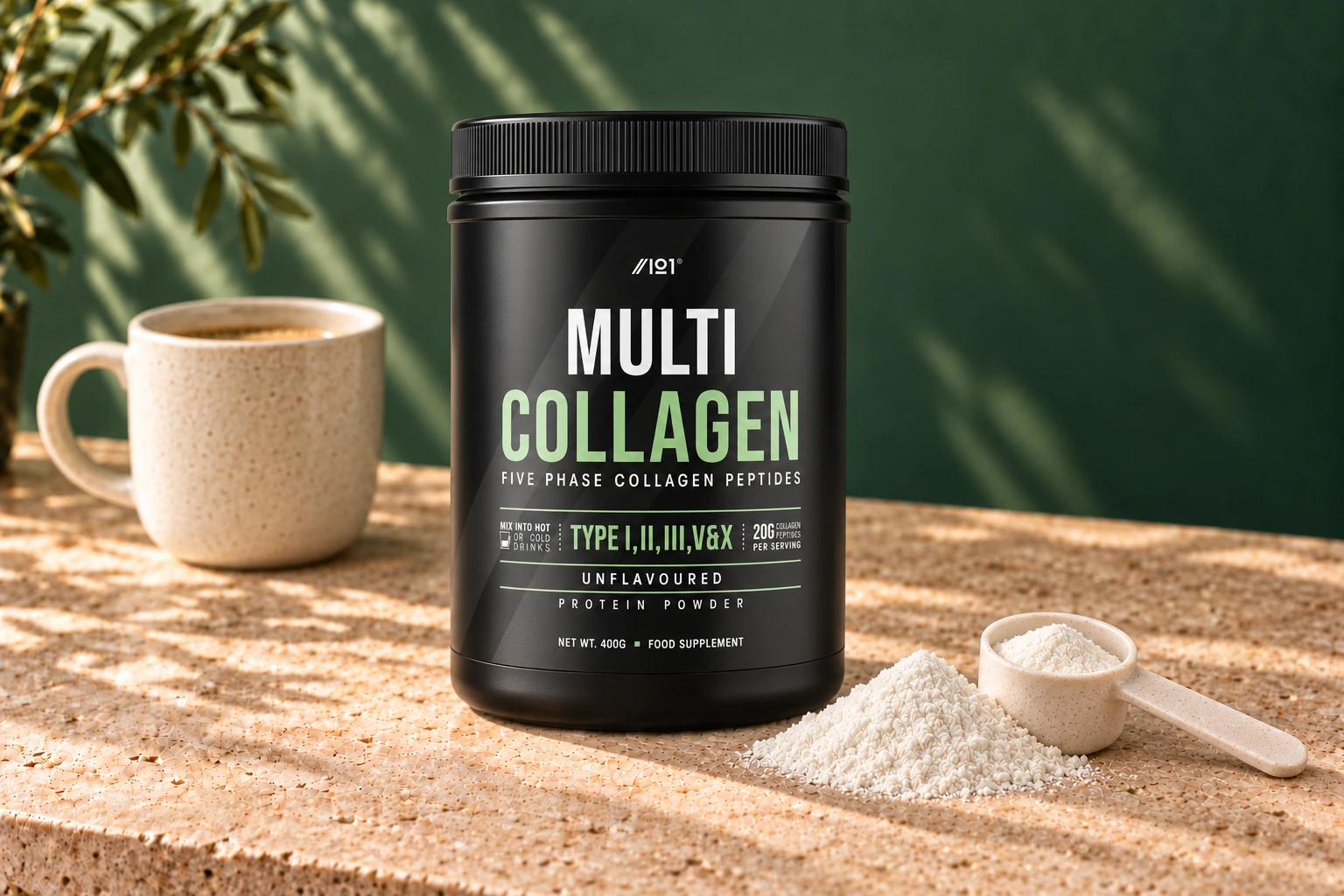
FOUR COLLAGEN SOURCES
Multi Collagen Protein Powder
18g protein and 20g collagen per two scoops.
Bovine, fish, chicken and eggshell membrane.
02 / PROTEIN IN YOUR DAY
How much protein do you need? What the NHS says
NHS
“A healthy balanced diet can include protein from meat, as well as from fish and eggs or non-animal sources such as beans and pulses.”
Meat in your diet, nhs.uk 2
Two scoops add 18g of protein to whatever is on your plate 6.
Bone broth for bones: what the NHS says about calcium and vitamin D
The register lets protein carry a claim for normal bones, and the NHS names what else bones ask for, calcium and vitamin D, with a figure for the first: “Adults need 700mg of calcium a day.” 3
If you want them in your day too, our calcium and vitamin D3 supplements carry their own register sentences: calcium is needed for the maintenance of normal bones, and vitamin D contributes to the maintenance of normal bones 1. The NHS adds exercise to the list 3.
03 / READ THE LABEL
What is in bone broth protein powder? 18g of protein per serving
The panel is short because the ingredients list is short. Two scoops (20g) give 306kJ or 72kcal, protein 18g, and 0g each of fat, carbohydrate and sugars, with 0.28g of salt 6.
One labelled serving
72kcal, all from protein
Bone Broth Protein Powder 400g and 1kg, nutrition panels and prices 6
The same panel for 400g and 1kg
Per 20g serving- Energy
- 72 kcal306kJ
- Protein
- 18 g
- Fat
- 0 g
- Carbohydrate
- 0 gof which sugars 0g
- Salt
- 0.28 g
Per 100g the powder is 90g protein, which is what a single-ingredient protein looks like 6. Everything the register asks of a protein claim is met by that one line.
What is bone broth protein? Hydrolysed gelatin, and where it comes from
You probably know that a good bone broth starts with bones simmered for hours in the kitchen. The protein in those bones is mostly type I collagen, which is what makes the broth so rich 5. To turn it into a powder, one published method simmers the bones for 5 to 6 hours, skims off the fat and spray-dries the broth 5.
What you get in our tub is that same protein, ready to stir into a drink: just one ingredient, grass-fed hydrolysed bovine gelatin 6. Gelatin comes from collagen, and hydrolysed means it has been broken into shorter chains, so it dissolves easily in any drink, hot or cold, without turning into a jelly 4 6.
Bovine source
Pasture-raised, grass-fed cattle
One ingredient
Hydrolysed bovine gelatin
Two scoops
20g powder, 18g protein
Hot or cold
Stir into 200–300ml liquid
Gelatin vs collagen: the same protein under two names
Gelatin is the hydrolysed form of collagen, and both have the same amino acids 4. Collagen is a fibrous protein of more than 1,000 amino acids, built as a triple helix from repeating triplets in which glycine is constant and the other two positions are often proline or hydroxyproline 4. That is why our glycine guide sits next to this one.
Why does a real broth set in the fridge? Gelatin dissolves in hot liquid and sets as it cools. Hydrolysed gelatin has been cut into chains too short to set, which is why the label can say hot or cold drinks and the powder stays a drink 6.
04 / UNDERSTAND THE CLAIMS
Bone Broth Protein Powder Benefits
In the UK a food supplement may carry only the health claims authorised on the Great Britain Nutrition and Health Claims Register 1. Collagen, collagen hydrolysate and gelatin have no authorised claims of their own, and the register’s claims for protein apply in full, because protein is what this powder is.
Every health claim on the Great Britain register passed a scientific review: independent scientists examined the research and the evidence behind it before it was authorised 1. The law itself says that health claims shall be “based on and substantiated by generally accepted scientific evidence” 8.
Protein per serving and the high protein claim
The register’s three general claims for protein, word for word:
They may be used where a food is at least a source of protein, meaning 12% of its energy comes from protein 1. Here it is 100%, because 18g of protein at 4kcal a gram is the whole 72kcal serving, which also clears the 20% needed to call a food high protein 1.
These sentences describe the everyday work protein does, and every 20g serving meets their condition in full. Both sizes also sit in our sport and fitness and protein and performance ranges, beside creatine and amino acids.
05 / KEEP IT SIMPLE
How to take bone broth protein powder: 2 scoops in hot or cold drinks
Mix two scoops, once a day
The label asks for 2 scoops (20g) in 200 to 300ml of liquid, once a day 6. As it is unflavoured, it can be stirred into shakes and smoothies, or into hot drinks, soups and stews. Hot liquid dissolves gelatin fastest, so a coffee or a soup is the easiest place to start.
Keep the tub closed
Keep the tub closed in a cool, dry place out of direct sunlight, as the label asks, and one serving a day makes the 400g tub last 20 days 6.
20 DAYS OF BONE BROTH PROTEIN
If two scoops in your morning coffee or your evening soup suits your routine, a 400g tub covers 20 days at about £1.00 a day, and the 1kg pouch covers 50 days at about 70p.
Shop bone broth protein powder06 / A LITTLE MORE CLARITY
Bone broth protein powder FAQs
What are the benefits of bone broth protein powder?
The benefits UK law authorises belong to the protein: protein contributes to a growth in muscle mass, to the maintenance of muscle mass and to the maintenance of normal bones 1. Two scoops give 18g of protein, so each serving meets the register’s condition with room to spare.
What is bone broth protein powder made of?
Bone broth vs collagen: is this the same as a collagen powder?
Can I put bone broth protein powder in coffee?
Yes. The label says the powder can be added to hot drinks, and hot liquid dissolves gelatin quickly 6. It is unflavoured, so it does not turn your coffee into a broth.
How much protein is in bone broth powder?
This one gives 18g of protein in two scoops (20g), and 90g per 100g 6. All of the serving’s 72kcal come from that protein.
Is bone broth protein powder suitable for vegetarians?
It is made from one animal ingredient, grass-fed hydrolysed bovine gelatin, so the protein comes from cattle 6. If you eat fish but not meat, our marine collagen powder is made from wild-caught fish collagen peptides.
Can I take bone broth protein every day?
Yes. The label gives one daily serving of two scoops, so it is made for daily use, and that serving adds 18g of protein to your day. If you are pregnant or breastfeeding, have a medical condition or take prescription medication, the label asks you to check with your doctor before use 6.
YOUR ROUTINE, YOUR CHOICE
So, bone broth protein powder or multi collagen?
If you want one bovine ingredient that goes into a coffee, a soup or a stew, take the Bone Broth Protein Powder, 400g at about £1.00 a day, or the 1kg pouch at about 70p once it is your routine. If collagen from four sources matters more to you, choose the Multi Collagen Protein Powder, 400g at the same price. Whichever you pick, two scoops add 18g of protein to your day, and with it the three protein claims quoted above.
GO TO THE SOURCE
Sources & references
Checked against the product labels, the GB Nutrition and Health Claims Register, nhs.uk and the published papers cited below, September 2026.
- Department of Health and Social Care. Great Britain nutrition and health claims (NHC) register, GOV.UK (protein: the three general health claims used here, and a children’s bone development claim not used; nutrition claims ‘source of protein’ and ‘high protein’; collagen and gelatin entries non-authorised; calcium and vitamin D: maintenance of normal bones). Accessed 2026-09-25. View source
- Meat in your diet – NHS. Accessed 2026-09-24. View source
- Food for strong bones – NHS. Accessed 2026-09-24. View source
- Naomi R, Bahari H, Ridzuan PM, Othman F. Natural-Based Biomaterial for Skin Wound Healing (Gelatin vs. Collagen): Expert Review. Polymers. 2021;13(14):2319. View source
- Haluk E, Yeliz K, Orhan O, Abonyi FO. Production of Bone Broth Powder with Spray Drying Using Three Different Carrier Agents. Korean Journal for Food Science of Animal Resources. 2018;38(6):1273-1285. View source
- Alpha01. Bone Broth Protein Powder Collagen 400g and 1kg, Multi Collagen Protein Powder 400g, Bovine Collagen Powder 400g and Marine Collagen Powder 200g and 400g: tub and pouch fronts, nutrition information panels, ingredients, suggested use, storage, caution and prices. Accessed 2026-09-25. View source
- Salt in your diet – NHS. Accessed 2026-09-24. View source
- Regulation (EC) No 1924/2006 on nutrition and health claims made on foods, Article 6: scientific substantiation for claims, as it applies in Great Britain. legislation.gov.uk. Accessed 2026-09-25. View source