If you add MCT oil to your daily coffee or shake, you have probably noticed the collection of terms on the bottle. It may mention C8, MCT and caprylic acid, all for an oil that originates from coconuts [1]. It is a common point of confusion: are these different ingredients, or just different ways of describing the same thing? Understanding this distinction is the key to knowing exactly what you are getting, especially when it comes to the standard 15ml serving size shown on the label [4].
Choosing a supplement can feel overwhelming, especially when faced with conflicting information online. This guide explains what C8 means, what is in each 15ml serving and which of our MCT formats suits your routine.

C8 MCT oil at a glance
- What it is: an organic, unflavoured oil from coconuts, described on the label as 100% caprylic acid (C8) triglycerides [4].
- What a 15ml serving contains: 126kcal and 15g of fat, all of it caprylic acid (C8), and nothing else.
- How to use it: added to food or drink, or taken directly.
- Price: £18.99 for 500ml, 33 servings at about 58p, or £12.99 for 250ml.
- Who it suits: you, if MCT goes into your coffee or shakes, or you follow a ketogenic plan, and you want an oil that is C8 only, organic and vegan friendly.
ORGANIC C8 MCT OIL · 500ML
£18.99 · 33 servings of 15ml · about 58p a serving · one ingredient: coconut MCT oil, 100% caprylic acid triglycerides (C8) · unflavoured · organic · vegan friendly
SHOP NOW
Which MCT is right for you: C8 MCT oil, softgels or powder?
Oil, softgel or powder? It’s all the same fat, in three very different amounts: the bottle gives you a tablespoon at a time, the softgel a single gram, and the powder sits in between.
C8 MCT oil 500ml or 250ml: for a daily tablespoon
Already stirring MCT into your morning coffee? Then the Organic C8 MCT Oil 500ml is the economical way to keep doing it: 33 servings of 15ml for £18.99, about 58p each. The bottle carries the EU organic leaf, so you’ll find it in our organic range as well as among the everyday products of our Daily Wellbeing range.
New to it? The 250ml bottle holds the same oil, 16 servings for £12.99, so you can find out how you get on with it before buying the big one. Both sizes stand with our other bottled oils, from macadamia to black seed.
The two bottles make up our Pure MCT Oil range, and the powder has its own MCT powder guide.
MCT oil capsules: one gram in a softgel
Don’t fancy oil in your drink at all? One of our MCT C8 Oil 1000mg softgels a day gives 1,000mg of MCT oil, 990mg of it caprylic acid, for about 10p a day.
Keep the amounts in mind. A softgel holds 1g of oil while a serving from the bottle is 15g, so the softgel suits a small measured amount and the bottle a tablespoon. The softgel shell is bovine gelatin.
MCT powder: for drinks without a blender
Want MCT that stirs in with a spoon? That is the job of our Organic C8 MCT Powder: MCT oil carried on organic gum arabic, 6.7g of fat in a 10g scoop. You get 25 scoops for £14.99, about 60p each.
ORGANIC C8 MCT OIL · 250ML
£12.99 · 16 servings of 15ml · about 81p a serving · the same oil in a smaller bottle
SHOP NOW
What is in 15ml of C8 MCT oil? Reading the panel
Turn the bottle around and you’ll find one of the simplest nutrition panels you will ever read, because there is only one thing in the bottle. Fat 15g, of which saturates 15g, of which caprylic acid 15g. Every other line is a zero.
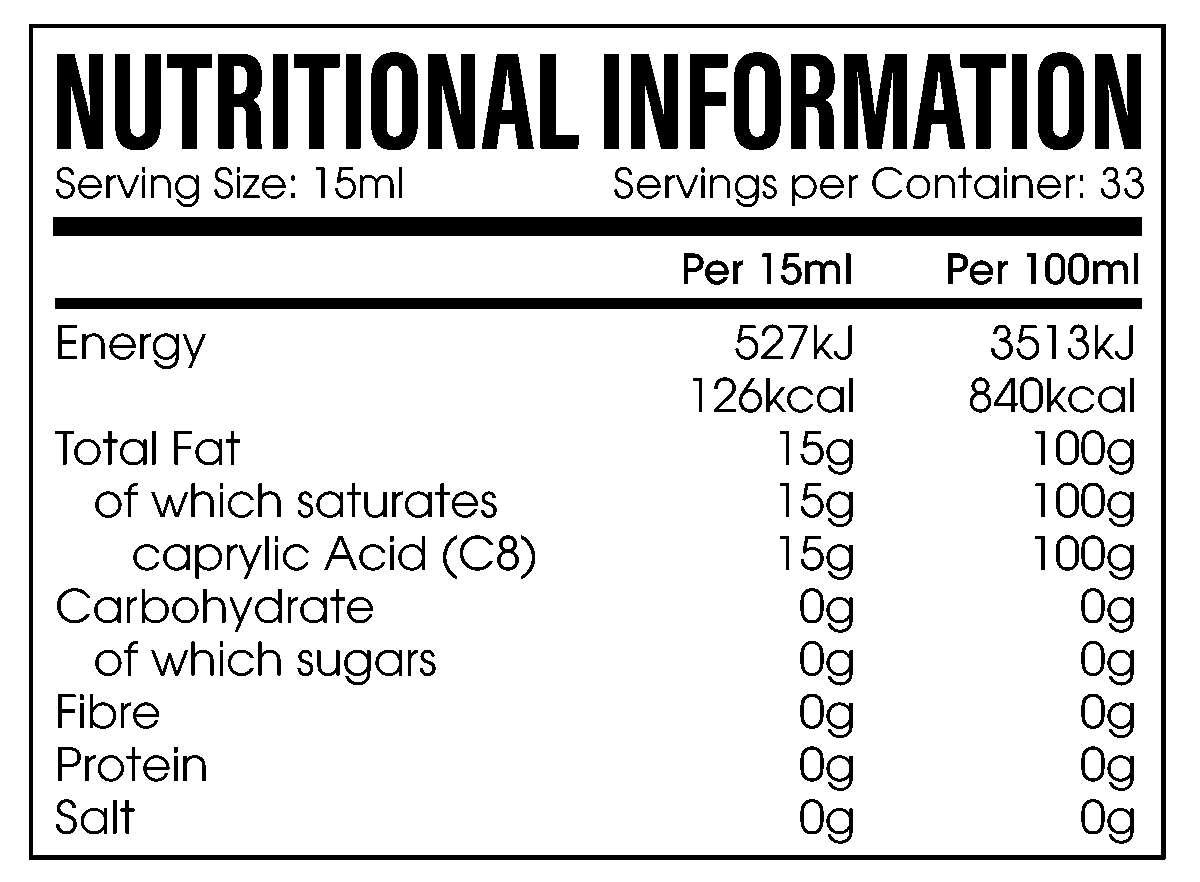
15ml serving = 15g of fat, all of it caprylic acid (C8), 126kcal · 500ml ÷ 15ml = 33 servings · £18.99 ÷ 33 = about 58p a serving · one softgel is 1,000mg, which is 1g of oil, so a serving of the bottle holds as much oil as 15 softgels.
Organic C8 MCT Oil 500ml, nutrition panel [4]
That simplicity is what the C8 on the front of our bottle stands for: one fatty acid, caprylic acid, and nothing else.
C8 MCT oil, softgels and powder: the numbers side by side
The table puts our four MCT products side by side: what each label declares, how much fat a serving holds and what it costs. Prices are correct at the time of writing.
15ml serving: 126kcal · 15g fat, all saturates, all caprylic acid (C8) · 0g carbohydrate, protein and salt · one ingredient · unflavoured
Choose if MCT oil is part of your routine and you want the lowest price per serving · 33 servings · £18.99: about 58p a serving, about £3.80 per 100ml · plant-only
Same panel per 15ml · same single ingredient
Choose if you want to try the oil first · 16 servings · £12.99: about 81p a serving, about £5.20 per 100ml
1 softgel: 1,000mg MCT oil providing 990mg caprylic acid (C8) · bovine gelatin shell
Choose if you want a small measured amount with nothing to pour or blend · 90 days · £8.99: about 10p a day
Per 100g: 67g fat, all saturates · 29g fibre · 0g sugars · MCT oil on organic gum arabic · 70% caprylic acid on the front
Choose if you want MCT that stirs into a drink without a blender · 25 scoops of 10g · £14.99: about 60p a scoop
What is C8 MCT oil, and how is it different from coconut oil?
MCT stands for medium chain triglycerides, fats built from medium-chain fatty acids [1]. Ours come from coconuts, which is why the label names coconut MCT oil [4].

The coconut, with its white flesh, is the source of coconut oil
Coconut oil and MCT oil are not the same thing, though. MCT oil keeps only the medium-chain part: most commercial MCTs are made of two fatty acids, C8 and C10 [1].
Want coconut oil itself? Our Organic Coconut Oil 3000mg softgels give 3,000mg of extra virgin coconut oil in a serving of three softgels, about 22p a serving, and our coconut oil guide reads that label line by line.
What does caprylic acid (C8) mean?
The number counts carbon atoms. Caprylic acid is the fatty acid with a chain of eight carbons, hence C8, and capric acid is its ten-carbon neighbour, C10 [1]. A bottle labelled simply MCT oil is usually a blend of the two.
Ours is labelled as C8, and the panel backs that up: all 15g of fat in a serving is listed as caprylic acid. You’ll find both bottles beside the omega oils in our fatty acids range.
How to use MCT oil: in coffee, in food or straight
The label’s own direction reads: “Add 1 serving (15ml) to any food or drink. Alternatively, the oil can be consumed directly. Do not use the oil to cook with at high temperatures, such as frying.”
In a hot drink, reach for a blender or a milk frother. Oil and water part company as soon as you stop stirring, so a spoon leaves a slick on top where a blender gives you an even cup.
Store the bottle in a cool, dry place out of direct sunlight, and don’t use it if the safety seal is missing or damaged.
One ingredient, thirty-three tablespoons
Our Organic C8 MCT Oil is as straightforward as it gets: coconut MCT oil, 100% caprylic acid triglycerides, 33 servings in the 500ml bottle at about 58p each.
SHOP ORGANIC C8 MCT OIL
C8 MCT oil FAQs
1. What are the benefits of C8 MCT oil?
UK rules authorise no health claim for MCT or for caprylic acid, so we list none [3]. What the label does tell you is exactly what you are getting: 15g of caprylic acid triglycerides in a 15ml serving, and nothing else.
2. Can I put MCT oil in coffee?
Yes. The label says it can go into any food or drink, and the front of our bottle says it blends with coffee and shakes. Blend it, don’t just stir it, or it will float.
3. Can I cook with C8 MCT oil?
Not at high temperatures. The label’s direction says not to use it for frying. Add it to food after cooking, or to cold dishes and dressings.
4. Can I take MCT oil every day?
Yes. The label gives one 15ml serving and doesn’t limit the days, so the 500ml bottle is 33 days of that routine and the 250ml bottle 16. Each serving holds 15g of saturated fat, and the NHS figure is no more than 30g of saturated fat a day for men and 20g for women [2].
5. Is C8 MCT oil vegan?
Yes. Its only ingredient is coconut MCT oil, the bottle says vegan friendly, and both sizes are in our vegan range. The powder is plant-only too, while the softgels have a bovine gelatin shell.
6. Is MCT oil the same as coconut oil?
No. MCT oil is made from the medium-chain part of coconut oil, which is mostly C8 and C10 [1], and ours is labelled as C8 only. If it is the whole oil you want, our coconut oil softgels give 3,000mg in a serving of three.
7. How many MCT oil capsules equal a tablespoon of oil?
About fifteen. One softgel holds 1,000mg, which is 1g of oil, and a 15ml serving of the bottle is 15g. So the bottle is for a tablespoon, and the softgel for one measured gram with nothing to pour.
Choose the Organic C8 MCT Oil 500ml if a tablespoon a day is your routine and you want the lowest price per serving, about 58p. Choose the MCT C8 Oil softgels if you want 1g a day with nothing to pour, for about 10p. Choose the Organic C8 MCT Powder if you want MCT that stirs into a drink with a spoon, for about 60p a scoop.
References
Checked against the product labels and the GB Nutrition and Health Claims Register, September 2026.
[1] Watanabe S, Tsujino S. (2022). Applications of Medium-Chain Triglycerides in Foods. Frontiers in Nutrition, 9:802805 (cited for what MCTs are, their origin in coconut oil production, the C8 and C10 fatty acids and their neutral taste only). PMC. View Source
[2] Fat: the facts – NHS (saturated fat guidelines). Accessed 2026-09-18. View Source
[3] Department of Health and Social Care. Great Britain nutrition and health claims (NHC) register, GOV.UK (medium chain triglyceride entries non-authorised; no entry for caprylic acid). Accessed 2026-09-18. View Source
[4] Alpha01. Organic C8 MCT Oil 500ml and 250ml, MCT C8 Oil 1000mg softgels, Organic C8 MCT 250g Powder and Organic Coconut Oil 3000mg softgels: nutritional information panels, ingredients, suggested use, storage and prices. Accessed 2026-09-25. View Source


