If you have ever tipped a bottle of castor oil and waited for it to move, you already know it is no ordinary oil. It is thick, pale yellow and pressed from the seed of a single plant, Ricinus communis, with nothing else in the bottle [1] [2]. Then come the words on the label: cold-pressed, virgin, unrefined, organic, and the much-quoted hexane-free, each of which describes something real about how the oil was made.
This guide explains what each of those words means for our castor oil, which size suits your routine, and how to use such a thick oil on hair and skin with confidence.
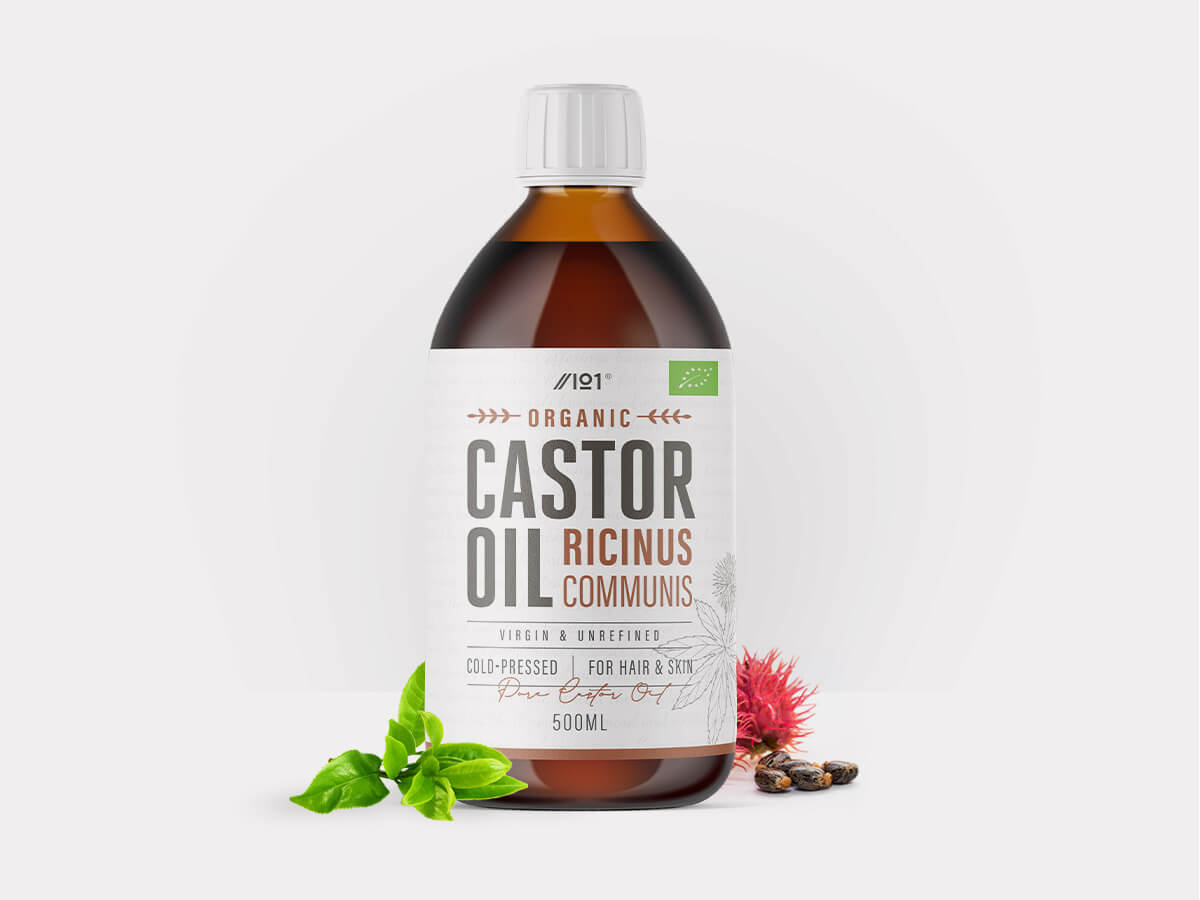
Organic castor oil at a glance
- What it is: one ingredient, organic Ricinus communis seed oil, in an amber bottle [1].
- How it is made: cold-pressed, virgin and unrefined, as printed on the front.
- What it is for: hair and skin. The label’s own words are “for a moisturising and conditioning effect” [1].
- Price: £12.99 for 500ml, about £2.60 per 100ml. There are 100ml and 1000ml bottles too.
ORGANIC CASTOR OIL · 500ML
£12.99 · one ingredient: organic castor seed oil · virgin, unrefined, cold-pressed · for hair and skin · about £2.60 per 100ml
SHOP NOW
What is castor oil?
Castor oil is obtained by pressing the seeds of the castor oil plant, Ricinus communis [2]. The seed is generous: between 30 and 50% of it is oil [2]. You might have heard the seeds called castor beans, which is why the oil is also known as castor bean oil [2].
What makes the oil unusual is one fatty acid. Up to 90% of castor oil is ricinoleic acid, which is why it is so viscous and why no other common oil feels quite like it [2]. Freshly pressed, it is pale yellow [2].
Where the castor oil plant comes from
This is a plant of warm, wet summers. It thrives in tropical summer rainfall areas, and frost kills it, so you will not find it farmed in Britain [2]. World production is concentrated in one small region: Gujarat, in western India [2].
Cold-pressed castor oil on the label: what each word means
Four words on the front of our bottle describe how the oil was made, and each can be checked against how castor oil is produced.
One ingredient on every bottle: organic Ricinus communis (castor) seed oil · 500ml at £12.99 = about £2.60 per 100ml · 1000ml at £18.99 = about £1.90 per 100ml · 100ml at £5.99.
Organic Castor Oil, 500ml, 1000ml and 100ml [1]
Cold-pressed castor oil and hexane: two ways to get oil from a seed
There are two routes from seed to oil. One is solvent extraction, which uses organic solvents such as hexane to draw out the oil [2]. The other is pressing, and in cold pressing the temperature is deliberately held down, for instance by circulating cold water through the press [2].
This is what is meant by hexane-free: an oil that was pressed, not dissolved out with a solvent. Our front says cold-pressed, and the review we cite notes that cold-pressed oil is lighter in colour than solvent-extracted oil [2].
Virgin, unrefined and organic castor oil
Virgin and unrefined say what happened after pressing: nothing. The oil has not been bleached or deodorised, so it keeps its own pale colour and faint scent. Organic is the certified part: the EU organic leaf on the bottle covers how the castor plants were farmed, and every bottle is part of our wider organic range.
Which organic castor oil is right for you: 100ml, 500ml or 1000ml?
It is the same oil and the same label in every bottle, so the only decision is how much of it you will use. A little goes a long way with an oil this thick.
Castor oil for hair and skin every week: 500ml
If castor oil is already part of your routine, the 500ml bottle is the sensible one. At £12.99 it works out at about £2.60 per 100ml.
A first bottle of organic castor oil: 100ml
If you are trying it for the first time, start with the 100ml bottle at £5.99.
ORGANIC CASTOR OIL · 100ML
£5.99 · the same organic cold-pressed oil in a first-bottle size · for hair and skin
SHOP NOW
A bigger bottle of organic castor oil: 1000ml
If you get through a lot of castor oil, or others at home use it too, choose the 1000ml bottle. At £18.99 it works out at about £1.90 per 100ml, the lowest of the three.
ORGANIC CASTOR OIL · 1000ML
£18.99 · the same organic cold-pressed oil in a household size · for hair and skin · about £1.90 per 100ml
SHOP NOW
Here are the three bottles side by side. Prices are correct at the time of writing.
organic Ricinus communis (castor) seed oil, one ingredient · virgin and unrefined · cold-pressed · for hair and skin
Choose if you already use castor oil every week · £12.99: about £2.60 per 100ml
the same oil and the same label
Choose if this is your first bottle, or you want one that travels · £5.99
the same oil and the same label
Choose if you get through a lot of castor oil, or share it at home · £18.99: about £1.90 per 100ml, the lowest of the three
You’ll find all three bottles in our castor oil range, along with our other oils. If you’re curious about a pressed seed oil that is sold as a food, have a look at our black seed oil guide.
How to use castor oil for hair and skin
The label’s directions are short: “Apply lovingly to hair and skin for a moisturising and conditioning effect.” [1] For hair it adds a method: massage into the hair and scalp, starting at the roots and working to the tips.
Because the oil is so thick, warm a few drops between your palms first, or mix it with a lighter oil, and wash it out of hair with shampoo.
Nothing else in the bottle
If a plain, organic, cold-pressed oil for hair and skin is what you were looking for, the 500ml bottle is the one to choose, at about £2.60 per 100ml.
SHOP ORGANIC CASTOR OIL
Castor oil FAQs
1. What are the benefits of castor oil?
Our castor oil is a cosmetic, and its label names “a moisturising and conditioning effect” on hair and skin [1]. Cosmetics are regulated separately from foods in Great Britain, and we make no health claim of any kind for this oil [3].
2. Can I drink this castor oil?
No. Our label says “For external use only. Do not swallow.” [1]
3. Can I use castor oil for eyelashes or eyebrows?
Our label says to avoid contact with eyes, so we don’t suggest using it on lashes [1]. It is labelled for hair and skin.
4. Can I use this oil for castor oil packs?
Yes, you can. A castor oil pack is simply a cloth soaked in the oil and laid on the skin, and our label describes the oil as moisturising and conditioning for hair and skin [1].
5. Is cold pressed castor oil the same as hexane free castor oil?
In practice, yes: cold-pressing is a mechanical method, while hexane belongs to solvent extraction [2]. Our bottle front prints cold-pressed, virgin and unrefined.
6. Why is organic castor oil so thick?
Because of what it is made of: up to 90% of castor oil is ricinoleic acid, which makes it far more viscous than other common oils [2]. Warm a few drops in your palms and it spreads easily.
7. How should I store castor oil?
In a cool, dry place, as the label says, and out of reach of children [1]. The amber bottle keeps light off the oil.
If castor oil is already in your weekly routine, choose the 500ml bottle at about £2.60 per 100ml. If you get through a lot of it, the 1000ml bottle works out at about £1.90 per 100ml. If it is your first, choose the 100ml bottle and see how you get on.
You now know what cold-pressed, virgin and unrefined mean, and that the simplest words on the label matter most: one ingredient, organic castor seed oil.
References
Checked against the product labels, September 2026.
[1] Alpha01. Organic Castor Oil 500ml, 250ml, 100ml and 1000ml: bottle fronts, ingredients, directions, caution and prices. Accessed 2026-09-20. View Source
[2] Patel VR, Dumancas GG, Kasi Viswanath LC, Maples R, Subong BJ. Castor Oil: Properties, Uses, and Optimization of Processing Parameters in Commercial Production. Lipid Insights. 2016;9:1-12. Cited only for the plant, the oil’s composition and how it is pressed. View Source
[3] Office for Product Safety and Standards. Regulation 2009/1223 and the Cosmetic Products Enforcement Regulations 2013: Great Britain, GOV.UK. Accessed 2026-09-20. View Source


