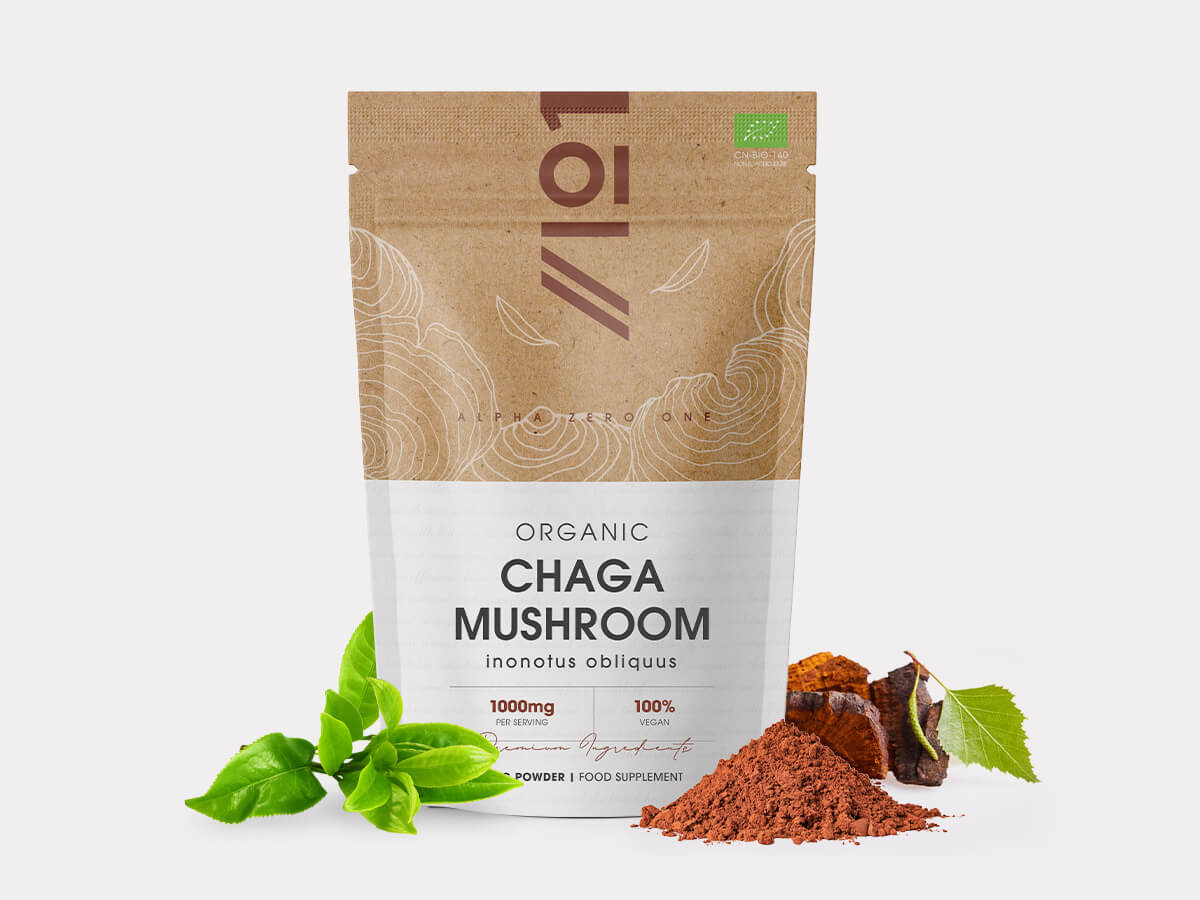
A chaga label can say 1,000mg or 7,500mg and mean two different things: the ground fungus itself, or a concentrated extract counted back to the raw material. In plain terms: Organic Chaga Mushroom Powder is the dried, ground growth of Inonotus obliquus, the black mass that forms on living birch trees [1], one ingredient, 1,000mg in a quarter-teaspoon serving, 100 servings for £7.99 [2]. This guide explains what the numbers on a chaga label mean, compares the powder with our 200g pouch and our 15:1 extract capsules by serving and price, and shows how to use and store it.
Checked against the product label and the GB Nutrition and Health Claims Register, September 2026.
Organic chaga mushroom powder at a glance
Suits you if you want to brew chaga as a tea or stir it into coffee, with one ingredient in the pouch.
Serving and amount: ¼ teaspoon (1g) once a day, which is 1,000mg of organic chaga [2].
Format: fine ground powder, no scoop in the pouch, 100g (100 servings) or 200g (200 servings).
Price per serving: £7.99 for 100 servings, 8p a serving; £14.99 for 200 servings, 7.5p a serving, at the time of writing.
Also as capsules: Organic Chaga Mushroom Extract 7500mg, a 15:1 extract with 250mg of polysaccharides, one a day, 90 capsules for £8.99 [4].
ORGANIC CHAGA MUSHROOM · 100G POWDER
£7.99 · 100 servings · ¼ tsp (1g) per serving · 1,000mg organic chaga mushroom · one ingredient · certified organic · 100% vegan on the pouch front
SHOP NOW
Which Chaga Is Right for You?
If you brew it as a tea or stir it into coffee
Choose the powder. It is the ground fungus with nothing concentrated and nothing added, ready to simmer in water, whisk into coffee or blend into a smoothie.
If you take it every day
Choose the 200g pouch. Organic Chaga Mushroom, 200g Powder holds 200 servings for £14.99, 7.5p a serving against 8p in the 100g pouch [5]. At the labelled quarter teaspoon a day the 100g pouch lasts a little over three months and the 200g pouch about six and a half.
If you want a measured capsule with a declared extract ratio
Choose the capsules. Organic Chaga Mushroom Extract 7500mg, 90 Capsules give a 15:1 extract standardised to 50% polysaccharides, 250mg per capsule, the equivalent of 7,500mg of chaga, in a hypromellose (plant-based) shell with organic brown rice flour. One capsule a day, 90 capsules for £8.99, about 10p a capsule [4].
If you want organic and vegan
All three qualify. Each pouch carries the green leaf organic logo on the front; the powder pouch also prints 100% vegan, and the capsule pouch prints vegan capsules. Chaga is a fungus, and no pouch contains an animal-derived ingredient.
ORGANIC CHAGA MUSHROOM · 100G POWDER
£7.99 · 100 servings · ¼ tsp (1g) per serving · 1,000mg organic chaga mushroom · one ingredient · certified organic · also in a 200g pouch at £14.99
SHOP NOW
What do 1,000mg and 7,500mg mean on a chaga label?
The powder’s number is the fungus itself. Our panel declares Organic Chaga Mushroom 1,000mg per ¼ teaspoon (1g) serving: one gram of ground chaga, no ratio, no standardisation [2].
The capsule’s number is the raw-material equivalent. A ratio such as 15:1 means 15g of raw chaga produced 1g of finished extract, so the 7,500mg on the capsule panel is the chaga that went into each capsule’s 500mg of extract. Standardised to 50% polysaccharides means the extract is tested to contain that share of polysaccharides, a group of plant and fungal carbohydrates, and the panel prints the resulting 250mg [4].
Capsules: 7,500mg of chaga ÷ 15 = 500mg of extract in each capsule · 500mg × 50% = 250mg of polysaccharides, the figure printed on the panel. Powder: ¼ teaspoon = 1g = 1,000mg of ground chaga, no ratio and no standardisation. The two numbers describe different things, so compare form to form, not milligram to milligram.
Organic Chaga Mushroom Extract 7500mg, nutrition panel [4]
What this means for you. If a chaga label gives a large milligram figure, look for the ratio next to it; if there is no ratio, the figure is the ground fungus.
Powder or capsules: how to compare chaga by the label
Each row gives the serving, the chaga per serving as the label declares it, the form and the price per serving; prices are at the time of writing.
¼ tsp (1g) · 1,000mg organic chaga mushroom · no NRV established · ground powder, one ingredient
Choose if you want to brew it as a tea or stir it into coffee · certified organic · 100% vegan on the front · £7.99 for 100 servings: 8p a serving
¼ tsp (1g) · 1,000mg organic chaga mushroom · no NRV established · ground powder, one ingredient
Choose if you take it every day and want the lower price per serving · certified organic · £14.99 for 200 servings: 7.5p a serving
1 capsule · 7,500mg chaga from a 15:1 extract, providing 250mg polysaccharides · no NRV established · hypromellose shell, organic brown rice flour
Choose if you want a measured capsule with a declared ratio · certified organic · vegan capsules · £8.99 for 90 servings: 10p a serving
Five lines on any chaga label tell you what you are buying: the ingredients list, the chaga per serving, whether it is the ground fungus or an extract with a declared ratio and polysaccharide percentage, the servings in the pouch and the price. Read those five and you can compare any brand with ours.
What is chaga and where does it grow?
A fungus on birch. Chaga (Inonotus obliquus) belongs to the family Hymenochaetaceae and grows on the trunks of living birch trees in the cold, humid forests of Russia, northern Europe, Asia and North America. The black, cracked mass harvested from the bark is not a mushroom cap: it is a sclerotium, a hard mass of fungal tissue, and it is this that is dried and milled into chaga powder. Its black colour comes from melanin, and it takes up betulin from the birch it grows on [1].
How it has been used as a drink. A 2023 review in Frontiers in Pharmacology traces its use to the Khanty people of western Siberia, who ground it into everyday drinks, soups and stews or sliced it and simmered the pieces in water for a few minutes, and records that Finnish soldiers drank it as a coffee substitute during the Second World War when supplies ran short [1].
What is in it. The same review reports that more than 250 secondary metabolites had been identified in chaga by 2022, including betulin, vanillic acid, terpenoids and lanosterol, alongside polysaccharides (including beta-glucans), proteins and minerals [1].
The powder sits in our mushrooms range; our reishi powder guide covers the other single-ingredient mushroom powder.
What is in Organic Chaga Mushroom Powder?
Every figure below is taken from the nutrition panel and the pouch front [2]. There is one ingredient and nothing else.
• Ingredients: Organic Chaga Mushroom Powder (100%). No fillers, binders, flow agents or additives.
• Per serving: ¼ teaspoon (1g) provides 1,000mg of organic chaga mushroom; no NRV established, and no vitamin, mineral or fibre value is declared.
• Servings: 100 per 100g pouch, 200 per 200g pouch.
• Appearance and taste: a fine dark-brown powder with an earthy, slightly bitter taste.
• Certification: the green leaf organic logo, with the control code CN-BIO-140 and the words non-EU agriculture, on the pouch front.
• Suitable for: vegans and vegetarians; the pouch front prints 100% vegan.

How do I take chaga powder and make chaga tea?
Suggested use on the label: take ¼ teaspoon (1g) of powder per day, mixed into 150ml of water, juice, shakes or smoothies; the pouch contains no scoop, to reduce plastic waste, so measure with your own teaspoon [2].
As a tea: simmer the powder gently in hot water for a few minutes, strain if you like and drink it, or stir it into coffee or a milk-based drink. If you find the taste strong, start with less and build up to the serving.
Keep the pouch in a cool, dry place out of direct sunlight [2].
READY TO TRY ORGANIC CHAGA MUSHROOM POWDER?
One ingredient: organic chaga, 1,000mg in every ¼ teaspoon serving, 100 servings for £7.99 at the time of writing. Also in a 200g pouch at 7.5p a serving, and as 15:1 extract capsules.
SHOP CHAGA MUSHROOM POWDER
Organic Chaga Mushroom Powder FAQs
1. What does chaga mushroom powder taste like?
Earthy and slightly bitter, which is why it sits naturally in coffee, a milk-based drink or a simmered tea rather than a cold glass of water. The label serving is ¼ teaspoon (1g) a day; if the taste is strong for you, start with less and build up to the serving.
2. How do I make chaga tea from the powder?
Simmer ¼ teaspoon (1g) of the powder gently in hot water for a few minutes, strain if you like, and drink it as it is or with milk. The 2023 review cited above describes the same method for sliced chaga in Siberia.
3. Can I take chaga powder every day?
Yes. The label gives one 1g serving a day, so it is made for daily use; just don’t take more than that [2]. The product is not intended for children or for pregnant or breastfeeding women; if you take any medicines or have a medical condition, ask your doctor first.
4. Is chaga mushroom powder suitable for vegans?
Yes. Chaga is a fungus, the pouch contains one ingredient, organic chaga mushroom powder, and the front prints 100% vegan. The extract capsules use a hypromellose (plant-based) shell and are marked vegan capsules.
5. Is chaga actually a mushroom?
The part that is harvested is not a mushroom cap. It is a sclerotium, a hard black mass of fungal tissue that forms on the trunk of a living birch tree, and that mass is what is dried and milled into the powder. The name mushroom is the common trade name.
6. Does chaga have any authorised health claims in the UK?
No. The Great Britain Nutrition and Health Claims Register holds no entry for chaga, so a UK label cannot carry one [3].
7. How long does a pouch of chaga powder last?
At the labelled ¼ teaspoon (1g) a day, the 100g pouch is 100 servings, a little over three months, and the 200g pouch is 200 servings, about six and a half months. Keep the pouch sealed in a cool, dry place out of direct sunlight.
Choose the 100g powder if you want to brew chaga as a tea or stir it into coffee.
Choose the 200g powder if you take it every day and want the lower price per serving, 7.5p against 8p.
Choose the extract capsules if you prefer a measured capsule with a declared 15:1 ratio and 250mg of polysaccharides.
Order Organic Chaga Mushroom Powder today: one ingredient, 1,000mg per serving, 100 servings for £7.99.
References
[1] Fordjour, E., Manful, C. F., Javed, R., et al. (2023). Chaga mushroom: a super-fungus with countless facets and untapped potential. Frontiers in Pharmacology, 14, 1273786 (botany, sclerotium, melanin and betulin, Khanty and Finnish use as a drink, composition). PMC. View Source
[2] Alpha01. Organic Chaga Mushroom – 100g Powder: nutrition information per ¼ tsp (1g), ingredients, suggested use, caution, storage, pouch front and price. Accessed 2026-09-17. View Source
[3] Department of Health and Social Care. Great Britain nutrition and health claims (NHC) register, GOV.UK (no chaga entries). Accessed 2026-09-17. View Source
[4] Alpha01. Organic Chaga Mushroom Extract 7500mg – 90 Capsules: nutrition information per capsule (15:1 extract, 250mg polysaccharides), ingredients, pouch front and price. Accessed 2026-09-17. View Source
[5] Alpha01. Organic Chaga Mushroom – 200g Powder: nutrition information per ¼ tsp (1g), 200 servings, and price. Accessed 2026-09-17. View Source


