Have you been feeling unusually tired, or wondering if your diet is providing everything it needs? It is a common question, particularly for those who eat little or no meat. The mineral iron is often part of this conversation, as it contributes to the reduction of tiredness and fatigue, to normal energy-yielding metabolism and to normal formation of red blood cells and haemoglobin [1]. When you turn to a food like chlorella powder, the label can seem to offer a simple answer with a figure like 122mg of iron per 100g, but what does that number really mean for the teaspoon in your smoothie [7]?
Our Organic Chlorella Powder prints its figures per 100g and leaves the serving to you: 50g of protein, 122mg of iron and 66.8mg of zinc. This guide breaks down what those numbers mean for a 5g teaspoon, shows how the powder compares with our chlorella tablets, and helps you choose the pouch and the amount that suit your routine.
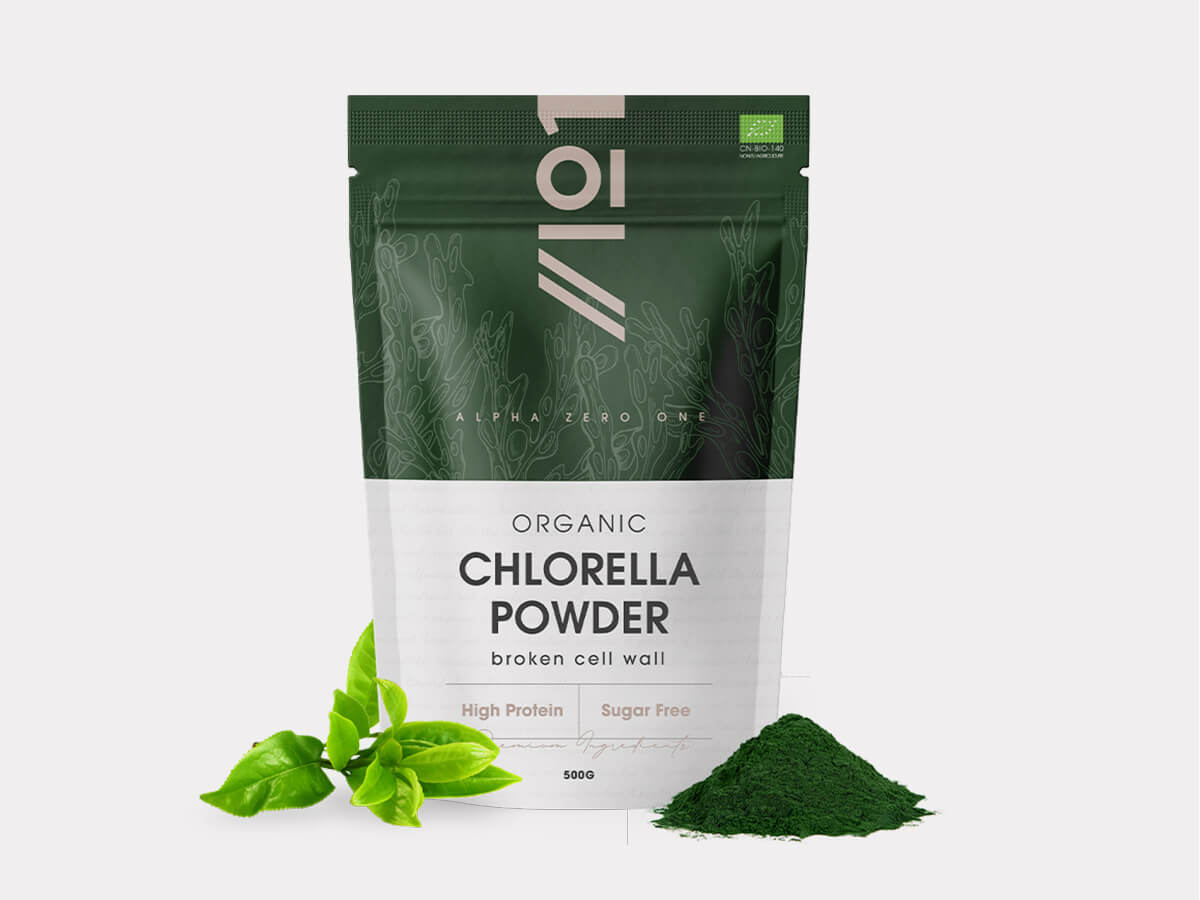
Organic chlorella powder at a glance
- Who it suits: adults who eat little or no meat and want a plant food with its iron, zinc and protein figures printed on the label.
- What it is: a fine, deep green powder milled from a single ingredient, certified organic broken cell wall chlorella, a freshwater microalga.
- What a 5g teaspoon gives: 2.5g of protein, 6.1mg of iron (44% of the NRV), 3.3mg of zinc (33%) and 0g of sugars, by our maths from the per 100g panel [7].
- Price: £17.99 for 500g, about £3.60 per 100g and about 18p for a 5g teaspoon.
- Authorised claims for its iron and zinc: Iron contributes to the reduction of tiredness and fatigue. Zinc contributes to the normal function of the immune system [1].
ORGANIC CHLORELLA POWDER · 500G
£17.99 · about £3.60 per 100g · one ingredient: organic broken cell wall chlorella · per 100g: 50g protein, 122mg iron, 66.8mg zinc, 0g sugars · vegan
SHOP NOW
Which chlorella is right for you: chlorella powder or chlorella tablets?
Powder or tablets? It’s the first choice you’ll make with chlorella. Both pouches hold the same single ingredient, and what separates them is what the label tells you, what you taste and what you pay per 100g.
Organic chlorella powder 500g: iron, zinc and protein by the teaspoon
If you eat little or no meat, you’ll want to see the numbers. The Organic Chlorella Powder 500g is the one that prints them: a full nutrition panel with 50g of protein, 122mg of iron and 66.8mg of zinc per 100g.
Iron is the mineral you get asked about most, and the NHS lists red meat among its good sources [2]. The powder is a plant food: one ingredient, nothing animal-derived, and 6.1mg of iron in a 5g teaspoon by our maths from the label.
Iron contributes to normal formation of red blood cells and haemoglobin [1]. Iron contributes to normal oxygen transport in the body [1].
At £17.99 it works out at about £3.60 per 100g, the lowest of our four pouches. You decide the amount, and it goes into a smoothie, a juice or a shake.
If you’re not ready for the larger size just yet, you can try the taste with our 200g pouch. It’s the same powder for £9.99, which comes to about £5.00 per 100g.
Organic chlorella tablets: a measured amount without the taste
Not keen on a green, earthy drink? Four Organic Chlorella 2000mg tablets give 2,000mg of organic broken cell wall chlorella, swallowed with water, no blender needed.
A pouch of 300 tablets is 75 servings for £8.99 (about 12p a day), and 1,000 tablets are 250 servings for £24.99 (about 10p a day).
Our chlorella tablets guide explains what chlorella is and what broken cell wall on the pouch means. The iron, zinc and protein figures in this guide come from the powder’s panel.
Spirulina and chlorella: two algae in one tablet
Thinking of adding spirulina to your routine too? Our Organic Spirulina and Chlorella tablets give you 1,000mg of each alga in four tablets, 75 servings for £8.99, about 12p a day [7]. If you’d rather have spirulina on its own, as a powder or tablets, see our spirulina guide.
Both powders sit in our herbal powders range, and all four pouches belong to our algae range.
Iron in chlorella powder: what the NHS says about iron and feeling tired
We all know the slump that follows a bad night. But tiredness that never seems to lift, however early you go to bed, is a different story, and one worth paying attention to.
The NHS puts it plainly: “It’s normal to feel tired sometimes. But if you’re tired all the time and do not know why, it could be a sign of a problem.” If you’ve been feeling tired for a few weeks and you’re not sure why, it advises seeing a GP [4].
How much iron do you need each day? The NHS gives 8.7mg for men, 14.8mg for women aged 19 to 49 and 8.7mg for women aged 50 and over [2].
You’ll find iron in many familiar foods: the NHS names beans such as red kidney beans, edamame beans and chickpeas, nuts, dried fruit and fortified breakfast cereals among the good sources [2].
So where does a teaspoon of chlorella fit into the picture? It adds 6.1mg of iron to your day, worked out from the figure printed on the pouch, and iron carries these authorised sentences [1]:
- Iron contributes to the reduction of tiredness and fatigue.
- Iron contributes to normal energy-yielding metabolism.
- Iron contributes to normal cognitive function.
- Iron contributes to the normal function of the immune system.
Chlorella nutrition: what a teaspoon of chlorella powder gives you
Our powder pouch reads more like a bag of flour than a typical supplement: every figure is per 100g, and there is no serving size. That is why 122mg of iron and 871% look so dramatic. Divide by twenty and you have a 5g serving, about a level teaspoon (weigh yours once on kitchen scales, because spoons differ).
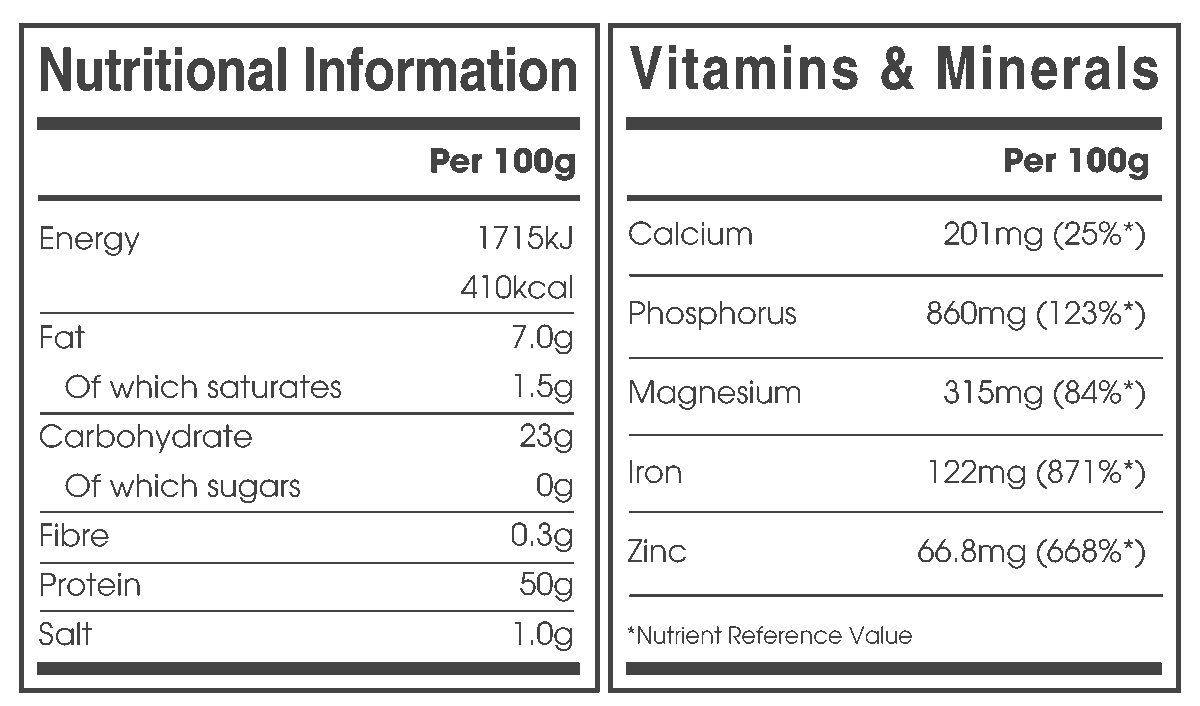
The panel is per 100g and a 5g serving is one twentieth of that · 122mg iron ÷ 20 = 6.1mg, 44% of the 14mg NRV · 66.8mg zinc ÷ 20 = 3.3mg, 33% of the 10mg NRV · 50g protein ÷ 20 = 2.5g · £17.99 ÷ 100 servings = about 18p. These are our sums from the label, which states no serving size of its own.
Organic Chlorella Powder, nutrition panel [7]
A second 5g doubles everything: 5g of protein, 12.2mg of iron (87% of the NRV) and 6.7mg of zinc (67%). NRV stands for nutrient reference value, the daily amount that labels use as their yardstick.
What about the other minerals on the panel? The same 5g serving gives 4% of the NRV for magnesium, 6% for phosphorus and 1% for calcium, so in a teaspoon it’s the iron and zinc that stand out.
Chlorella protein: is chlorella a complete protein?
Half of this powder is protein: 50g in every 100g, which is why High Protein is printed on the front of the pouch, next to Sugar Free for its 0g of sugars. A 2020 review in Nutrients reported all nine essential amino acids in the chlorella products it analysed [6]. Our own label gives the total protein rather than an amino acid profile.
Add a 5g teaspoon to your smoothie and you get 2.5g of protein; two teaspoons give you 5g, along with the iron and zinc.
Protein contributes to the maintenance of muscle mass [1]. Protein contributes to the maintenance of normal bones [1].
Chlorella minerals: does chlorella have zinc, iodine or B12?
Zinc, yes: 66.8mg per 100g on our panel, which is 3.3mg in a 5g serving, 33% of the NRV. The NHS puts an adult’s daily need at about 9.5mg for men and 7mg for women [3].
Zinc contributes to the maintenance of normal hair [1]. Zinc contributes to the maintenance of normal skin [1]. Zinc contributes to the maintenance of normal nails [1].
Iodine, vitamin B12 and chlorophyll are a different story: none of them is declared on our label, so the figures to look at here are the iron and zinc above.
Chlorella powder vs chlorella tablets: how they compare
Comparing a big pouch of powder with a small pouch of tablets can feel like comparing apples and oranges. So the table puts all four on the same footing: what each label declares, and what it costs per serving and per 100g of chlorella. Prices are correct at the time of writing.
Per 100g: 50g protein · 122mg iron (871% NRV) · 66.8mg zinc (668% NRV) · 0g sugars · no serving size on the label
Choose if you want the iron, zinc and protein figures on the label and the lowest price per 100g · about £3.60 per 100g · 100 servings of 5g at about 18p · £17.99
Same panel per 100g · same single ingredient
Choose if you want to try the taste before you commit to 500g · about £5.00 per 100g · £9.99
4 tablets · 2,000mg organic broken cell wall chlorella · the label declares chlorella only, no nutrient figures
Choose if you want a measured amount and no taste · 75 servings · £8.99: about 12p a serving, about £5.99 per 100g of chlorella
4 tablets · 2,000mg organic broken cell wall chlorella · the label declares chlorella only, no nutrient figures
Choose if tablets are your routine and you want the lowest tablet price · 250 servings · £24.99: about 10p a serving, about £5.00 per 100g of chlorella
Comparing another brand? Ask the same questions of its label. Is the panel per 100g or per serving, does it print iron and zinc figures at all, and is the organic certification shown on the pouch?
What is chlorella powder and what is it made from?
So, what is chlorella? It’s a single-celled green microalga that grows in fresh water, and to get it into our pouch it is grown, harvested, dried and milled into a fine, deep green powder [5].
Chlorella vulgaris, the species named on the front of our tablet pouch, is the one a 2024 review in the Journal of Food Science describes going into smoothies, snacks and supplements [5].
Ours is certified organic: the EU organic leaf and the code CN-BIO-140 are printed on the pouch. The ingredients list is a single line, Organic Chlorella Powder (100%).
What does broken cell wall chlorella mean?
Each chlorella cell sits inside a tough wall made of cellulose. That is why the walls are broken mechanically when most chlorella supplements are made, ours included [6]. So when you see broken cell wall on our pouch, you know exactly how the chlorella was prepared.
What does chlorella taste like?
Honestly? Green. The Journal of Food Science review calls the flavour and smell earthy and strong, and says producers blend chlorella with other strong-flavoured ingredients to mask it [5].
That’s your cue at home. A banana, a handful of berries or a sharp juice will carry a teaspoon far better than a glass of plain water. If the taste isn’t for you, the tablets give you chlorella with no taste at all.
Organic chlorella powder benefits: the claims UK rules authorise
You’ll read a lot about chlorella online. In the UK, a food may carry only the health claims authorised on the Great Britain Nutrition and Health Claims Register. Chlorella itself has no entry there, but the nutrients on the powder’s panel do [1].
Every health claim on the Great Britain register passed a scientific review: independent scientists examined the research and the evidence behind it before it was authorised [1]. The law itself says that health claims shall be “based on and substantiated by generally accepted scientific evidence” [9].
To carry one of these claims, a food must be at least a source of the nutrient. For a mineral that means 15% of the NRV per 100g [8], and our panel shows 871% for iron and 668% for zinc. About half of the powder’s energy comes from protein, well above the 20% needed for a high protein claim [1].
Iron, zinc and protein in chlorella powder: the authorised sentences
Seven of them belong to iron.
- Iron contributes to the reduction of tiredness and fatigue.
- Iron contributes to normal energy-yielding metabolism.
- Iron contributes to normal formation of red blood cells and haemoglobin.
- Iron contributes to normal oxygen transport in the body.
- Iron contributes to normal cognitive function.
- Iron contributes to the normal function of the immune system.
- Iron has a role in the process of cell division.
Seventeen belong to zinc.
- Zinc contributes to the normal function of the immune system.
- Zinc contributes to the maintenance of normal skin.
- Zinc contributes to the maintenance of normal hair.
- Zinc contributes to the maintenance of normal nails.
- Zinc contributes to the maintenance of normal bones.
- Zinc contributes to the maintenance of normal vision.
- Zinc contributes to normal macronutrient metabolism.
- Zinc contributes to normal carbohydrate metabolism.
- Zinc contributes to normal metabolism of fatty acids.
- Zinc contributes to normal metabolism of vitamin A.
- Zinc contributes to normal acid-base metabolism.
- Zinc contributes to normal DNA synthesis.
- Zinc contributes to normal protein synthesis.
- Zinc has a role in the process of cell division.
- Zinc contributes to the protection of cells from oxidative stress.
- Zinc contributes to normal cognitive function.
- Zinc contributes to normal fertility and reproduction.
Three belong to protein.
- Protein contributes to a growth in muscle mass.
- Protein contributes to the maintenance of muscle mass.
- Protein contributes to the maintenance of normal bones.
You can see the iron, zinc and protein behind these sentences on the powder’s nutrition panel. Just one 5g teaspoon gives you 44% of the NRV for iron and 33% for zinc, so every sentence above applies in full.
How to use chlorella powder, and how much chlorella powder per day
You’re in charge of the serving size, because the label gives you ideas and not amounts. In its own words: “Add powder into water, juice, shakes or smoothies. Enjoy as part of a balanced diet and healthy lifestyle.”
Start with one 5g teaspoon a day while you get used to the taste. From there, settle on one or two teaspoons daily, the amounts we’ve used for every figure in this guide.
Store the pouch sealed, in a cool, dry place out of direct sunlight. If you have the tablets, the label’s advice is simpler still: four a day with water.
Ready for a greener smoothie?
Want the numbers? Get the powder. Our Organic Chlorella Powder 500g is one organic ingredient with its iron, zinc and protein printed on the back, and its 100 teaspoons work out at about 18p each.
SHOP ORGANIC CHLORELLA POWDER
Chlorella powder FAQs
1. What foods contain chlorella?
None of the everyday ones. Chlorella is a microalga that is grown, dried and milled, so you find it as a powder or as tablets, or as an ingredient that food makers add to things like smoothies and snacks [5]. A food only contains it if someone has put it there.
2. Does chlorella have iodine?
Our label declares no iodine, so we can’t give you a figure for it. If iodine is what you want, look for a product that prints an iodine amount on its panel, as our bladderwrack guide explains.
3. Is chlorella powder the same as chlorophyll powder?
No. Chlorophyll is one of the things inside chlorella, the green pigment behind its colour, while chlorella powder is the whole dried microalga [5]. On our pouch you’ll find chlorella as the single ingredient, with no separate chlorophyll figure.
4. Chlorella vs spirulina: what is the difference?
They are two different organisms sold in similar green pouches. Compare them the way you would compare any two labels: protein and minerals per 100g, organic certification and price per 100g. Our spirulina and chlorella guide does that line by line.
5. Can I take chlorella powder every day?
Yes: it’s a food powder with no set serving, and our figures use one or two 5g teaspoons a day, which give 6.1mg or 12.2mg of iron [7]. The NHS says: “Taking 17mg or less a day of iron supplements is unlikely to cause any harm.” [2] If you also take an iron supplement or a multivitamin with iron, add the powder’s iron to that total.
6. Is organic chlorella powder vegan?
Yes. The only ingredient is organic chlorella, with nothing animal-derived and nothing added. The tablets are pressed from the same kind of organic broken cell wall chlorella and labelled vegan too, placing all four pouches in our vegan range.
7. Do chlorella tablets give the same iron as chlorella powder?
The tablet label gives the chlorella content, 2,000mg in four tablets, but no iron figure, so the iron in this guide is the powder’s. Four tablets hold 2g of chlorella, whereas the powder figures in this guide are worked out for a 5g teaspoon. Choose the powder for the iron, zinc and protein printed on the pack, or the tablets for a measured amount with no taste.
8. Is cracked chlorella the same as broken cell wall chlorella?
Yes. Cracked cell wall and broken cell wall are two names for the same step: the cell walls are broken mechanically during processing [6]. Our pouch uses the words broken cell wall.
For the nutrition figures and the lowest price per 100g, pick the Organic Chlorella Powder 500g and blend it into a smoothie or a juice. If you’d prefer a measured 2,000mg and zero taste, pick the Organic Chlorella 2000mg tablets. Whichever pouch you choose, remember the label lesson: per 100g and per serving are two very different things.
References
Checked against the product labels and the GB Nutrition and Health Claims Register, September 2026.
[1] Department of Health and Social Care. Great Britain nutrition and health claims (NHC) register, GOV.UK (iron, zinc and protein entries and their conditions of use; no entry for chlorella). Accessed 2026-09-17. View Source
[2] Vitamins and minerals: Iron – NHS (sources, daily amounts, advice on supplements). Accessed 2026-09-27. View Source
[3] Vitamins and minerals: Others, Zinc – NHS (daily amounts, advice on supplements). Accessed 2026-09-17. View Source
[4] Tiredness and fatigue – NHS. Accessed 2026-09-27. View Source
[5] Wang CA, Onyeaka H, Miri T, Soltani F. (2024). Chlorella vulgaris as a food substitute: applications and benefits in the food industry. Journal of Food Science, 89(12):8231-8247 (cited for what chlorella is, its food uses and its taste only). PMC. View Source
[6] Bito T, Okumura E, Fujishima M, Watanabe F. (2020). Potential of Chlorella as a Dietary Supplement to Promote Human Health. Nutrients, 12(9):2524 (cited for the cellulose cell wall, mechanical breaking and the amino acid profile only). PMC. View Source
[7] Alpha01. Organic Chlorella, 500g Powder: nutritional information panel, ingredients, suggested use, storage and price; 200g powder, 300 tablets and 1000 tablets labels and prices; Organic Spirulina and Chlorella 2000mg, 300 tablets: nutritional information panel and price. Accessed 2026-09-27. View Source
[8] Retained Regulation (EU) No 1169/2011, Annex XIII: nutrient reference values and the significant amount (15% of the NRV per 100g for products other than beverages). legislation.gov.uk. Accessed 2026-09-17. View Source
[9] Regulation (EC) No 1924/2006 on nutrition and health claims made on foods, Article 6: scientific substantiation for claims, as it applies in Great Britain. legislation.gov.uk. Accessed 2026-09-25. View Source


