A D-mannose label prints one big number, 1,500mg, and it is easy to take that as the amount per capsule when it is the amount per serving of three. In plain terms: D-Mannose 1500mg capsules hold 500mg of D-mannose in each plant-based hypromellose capsule, 1,500mg in a three-capsule serving, with 5mg of BioPerine® black pepper extract and nothing else active, 30 servings for £7.99, about 27p a serving at the time of writing [2].

This guide explains what D-mannose is, breaks the 1,500mg line down into capsules, grams and pence, and sets it beside our cranberry extract capsules.
D-Mannose 1500mg at a glance
Suits you if you want D-mannose as a measured, single-ingredient capsule with the amount per capsule printed on the label, rather than a powder you scoop.
Dose: three capsules a day = 1,500mg of D-mannose, 500mg per capsule, plus 5mg of BioPerine® black pepper extract. No Nutrient Reference Value (NRV, the daily reference amount that vitamins and minerals show as a percentage) exists for either, so the label shows no percentage.
Format: hypromellose (plant) capsule; every other ingredient is plant-derived; no flavouring, sweetener or colour.
Price per serving: £7.99 for 30 servings, about 27p a serving and about 18p per gram of D-mannose, at the time of writing.
D MANNOSE 1500MG · 90 CAPSULES
£7.99 · 30 servings · 3 capsules per serving · 1,500mg D-mannose (500mg per capsule) · 5mg BioPerine® · hypromellose shell
SHOP NOW
Which D-Mannose Is Right for You?
If you want a measured dose without a scoop
500mg in every capsule. Each capsule holds 500mg of D-mannose, so three capsules are 1,500mg every time, with no scoop to level and no powder to weigh [2]. A powder is sold by the tub and dosed by a scoop; the label has to tell you the grams of D-mannose per scoop and the number of scoops in the tub, and the figures only compare once you have worked them back to milligrams per serving.
If you want one ingredient and nothing to flavour it
Nothing to flavour, sweeten or colour. The ingredient list is D-mannose, the capsule shell, a bulking agent, rice starch, safflower oil and BioPerine® black pepper extract [2]. There is no flavouring, sweetener or colour, because a capsule does not need to taste of anything; a flavoured powder or drink mix has to carry those on its list.
If you follow a vegan diet
Plant shell, plant carriers. The shell is hypromellose, a plant-derived cellulose, and the bulking agent is microcrystalline cellulose; rice starch and safflower oil are the only other carriers [2]. Nothing in the capsule comes from an animal, and the product sits in our Vegan range.
If you are choosing between D-mannose and cranberry extract
Two ingredients, two labels. We sell the two as separate single-ingredient capsules, so each label can be compared on its own. The D-mannose capsule declares its D-mannose by the milligram; our Cranberry Extract 52,500mg capsules declare a 50:1 fruit extract (50 parts of fruit concentrated into 1 part of extract), 1,050mg of extract per three capsules, the equivalent of 52,500mg of cranberry, 60 servings for £8.99 [4]. They are different ingredients with different labels; choose the one that names what you want to take, and compare it on its own figures.
D MANNOSE 1500MG · 90 CAPSULES
£7.99 · 30 servings · 3 capsules per serving · 1,500mg D-mannose (500mg per capsule) · 5mg BioPerine® · hypromellose shell · plant ingredients throughout
SHOP NOW
How to compare D-mannose capsules and cranberry extract
Each row gives the serving, the amount per serving as the label declares it, and the price per serving at the time of writing. Two figures do all the work on a D-mannose label: the milligrams per serving and the number of servings in the pack.
Serving 3 capsules · D-mannose 1,500mg (500mg per capsule) · BioPerine® 5mg
Choose if you want D-mannose on its own, in a measured capsule · hypromellose shell · plant ingredients · £7.99 for 30 servings: about 27p a serving, about 18p per gram of D-mannose
Serving 3 capsules · cranberry 50:1 extract 1,050mg = 52,500mg fruit equivalent · no D-mannose declared
Choose if you want the cranberry fruit extract · hypromellose shell, organic brown rice flour · £8.99 for 60 servings: about 15p a serving
Check what else is in the serving: our capsule carries 5mg of BioPerine® and four plant carriers, and no sweetener. That matters with a powder, because D-mannose exists mainly in a sweet-tasting form, about two thirds of it, and a bitter-tasting form, about one third [1]; in a capsule you taste neither.
What is D-mannose, and where does it come from?
D-mannose is a hexose, a six-carbon simple sugar in the same family as glucose and galactose, with the same chemical formula as glucose and a slightly different arrangement of atoms: chemists call it the 2-epimer of glucose [1]. A 2014 review of mannose chemistry and metabolism notes that it occurs in microbes, plants and animals; that free mannose is found in small amounts in many fruits such as oranges, apples and peaches, and circulates in blood plasma at 50 to 100 micromolar; and that in nature it is more often bound up in larger molecules, the mannans of yeast or of ivory nut, than present as free sugar [1].
D-Mannose 1500mg sits in our Specialty Supplements range with the other single-ingredient capsules we stock.
What does 1,500mg per serving mean on the label?
The nutritional information panel says: serving size 3 capsules, servings per container 30; each serving contains D-mannose 1,500mg and BioPerine® black pepper extract 5mg, each marked "no NRV established" [2]. The missing percentage is not an omission: an NRV exists for vitamins and minerals, not for a sugar or a pepper extract, so no D-mannose label can show one, and the milligrams are the only figure to compare from brand to brand.
1,500mg per serving ÷ 3 capsules = 500mg of D-mannose in each capsule · 90 capsules ÷ 3 = 30 servings · £7.99 ÷ 30 = about 27p a serving · 90 × 500mg = 45g of D-mannose, and £7.99 ÷ 45 = about 18p per gram.
D Mannose 1500mg, nutrition panel [2]
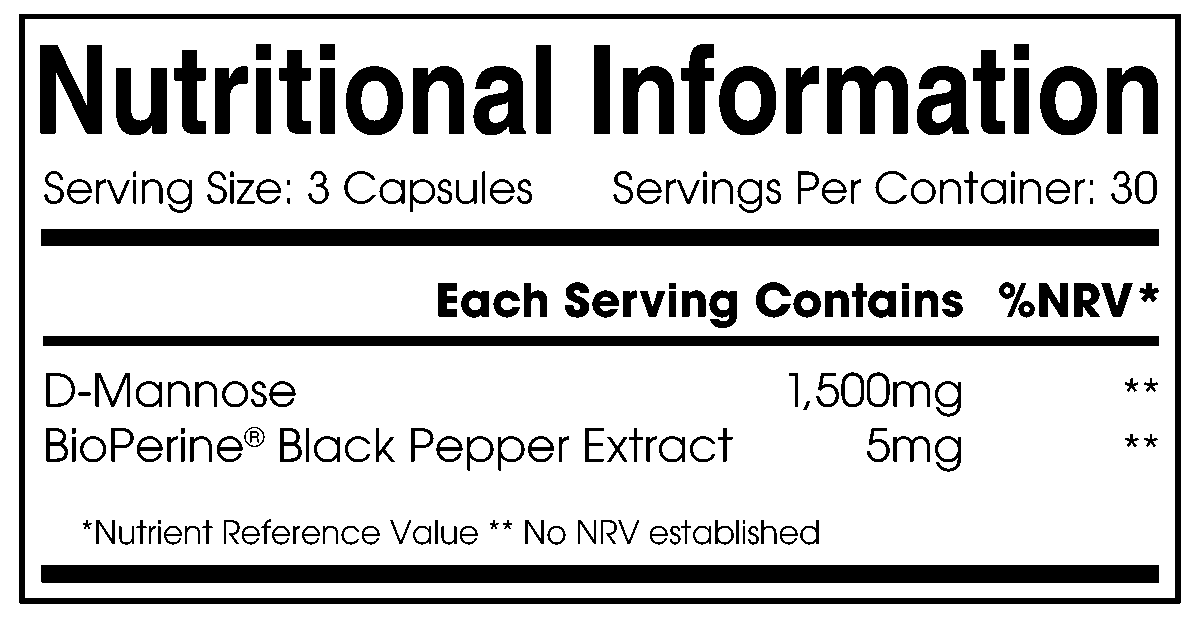
Ingredients, in the label's order: D-mannose, capsule shell (hypromellose), bulking agent (microcrystalline cellulose), rice starch, safflower oil, BioPerine® black pepper extract [2]. Every serving holds 5mg of BioPerine®, a branded extract of black pepper fruit made to a fixed content of piperine. At three capsules a day the pouch is a 30-day supply.
How to take D-mannose capsules
Suggested use on the label: take 3 capsules daily with water [2]. Storage, in the label's words: store in a cool, dry place out of direct sunlight; keep out of reach of young children. The pouch is resealable, and the front carries the BioPerine® mark.
READY TO TRY D-MANNOSE 1500MG?
1,500mg of D-mannose in three capsules, 500mg each, with 5mg of BioPerine® and plant ingredients throughout. 90 capsules, 30 servings, £7.99 at the time of writing: about 27p a serving.
SHOP D-MANNOSE
D-Mannose FAQs
1. How many D-mannose capsules do I take a day?
The label’s suggested use is three capsules daily with water, which is one 1,500mg serving; a 90-capsule pouch is 30 days at that rate. The label also says not to exceed the recommended daily dose. The capsules are not intended for children or for pregnant or breastfeeding women, and if you have a medical condition or take any medication, the label asks you to consult a doctor before use.
2. How much D-mannose is in one capsule?
500mg. The panel declares 1,500mg per three-capsule serving, so one capsule is a third of that.
3. Does D-mannose count as sugar in my diet?
Yes. D-mannose is a monosaccharide with the same formula as glucose, so a 1,500mg serving is 1.5g of sugar. The NHS figure for adults is no more than 30g of free sugars a day [3], so one serving is a small part of that, but it counts.
4. Is D-mannose the same as glucose?
No. The two share a chemical formula but differ in the arrangement of one carbon, which is why D-mannose is called the 2-epimer of glucose. Your body makes most of its own mannose from glucose, and the free sugar occurs in small amounts in fruits such as oranges, apples and peaches.
5. Is the D-mannose in the capsules extracted from cranberries?
No. The ingredient list names D-mannose itself, and no fruit. If you want a fruit extract, our Cranberry Extract capsules declare a 50:1 extract on their own label.
6. Are D-Mannose 1500mg capsules vegan?
Yes. The shell is hypromellose, a plant-derived cellulose, and the other ingredients are microcrystalline cellulose, rice starch, safflower oil and a black pepper extract, so nothing in the capsule is animal-derived.
7. What is BioPerine, and why is it in the capsule?
BioPerine® is a branded extract of black pepper fruit standardised for piperine, its marker compound. Each serving declares 5mg of it. It is plant-derived, like everything else in the capsule.
8. Capsules or powder: which should I choose?
Choose capsules if you want a fixed 500mg per capsule with no scoop, no taste and no sweetener. Our pouch holds 45g of D-mannose for £7.99, about 18p a gram.
D-Mannose 1500mg capsules declare 1,500mg per three-capsule serving, 500mg per capsule, with 5mg of BioPerine® in a hypromellose shell and plant ingredients throughout: 90 capsules, 30 servings, £7.99 at the time of writing, about 27p a serving and 18p per gram.
References
Checked against the product label and the GB Nutrition and Health Claims Register, September 2026.
[1] Sharma V, Ichikawa M, Freeze HH. Mannose metabolism: more than meets the eye. Biochemical and Biophysical Research Communications 2014;453(2):220–228 (D-mannose as the 2-epimer of glucose; sweet α and bitter β forms; free mannose in fruits such as oranges, apples and peaches and in plasma at 50–100µM; mannans; cells derive most mannose from glucose). PMC. View Source
[2] Alpha01. D Mannose 1500mg – 90 Capsules: nutritional information panel, ingredients, suggested use, caution, storage and price. Accessed 2026-09-16. View Source
[3] NHS. Sugar: the facts (free sugars; adults no more than 30g a day). Accessed 2026-09-16. View Source
[4] Alpha01. Cranberry Extract 52,500mg – 180 Capsules: nutritional information panel (cranberry extract 52,500mg from 50:1 extract per 3 capsules, 60 servings), ingredients and price. Accessed 2026-09-16. View Source


