Cultivated for some six thousand years across regions spanning the Mediterranean to India, Trigonella foenum-graecum, commonly known as fenugreek, is a resilient botanical characterised by a distinctive, maple-like aroma [4]. Whilst its clover-like leaves and pale flowers have been documented since the Egypt of the pharaohs, it is the plant’s slender pods, containing hard, golden seeds, that hold its primary value [4].
Today, those same seeds are available as food supplements, often with prominent figures such as 9000mg or 7500mg on the pouch. These numbers become clear once you understand the difference between a concentrated extract and the whole seed, milled. This guide explains what 9000mg, 15:1 and saponins mean on the label, and which of our three fenugreek capsules fits your daily routine.
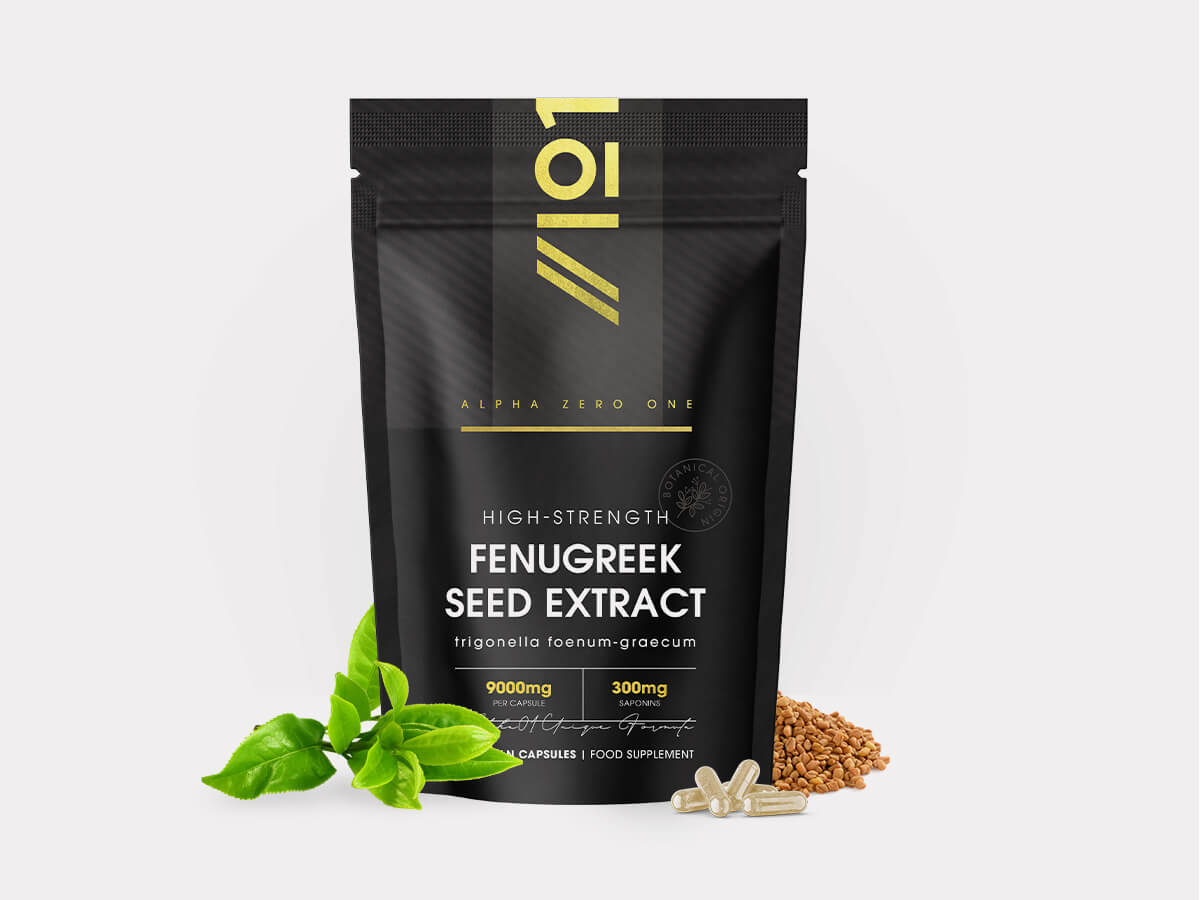
Fenugreek capsules at a glance
- The plant: Trigonella foenum-graecum, an annual legume that looks like a large clover and is grown for its seed [4].
- Where it comes from: native to the Mediterranean region, southern Europe and western Asia [2].
- One capsule: 600mg of 15:1 seed extract, equal to 9,000mg of seed, giving 300mg of saponins [3].
- Price: £7.99 for 90 capsules, about 9p a day.
- The organic alternative: a certified organic extract with 100mg of saponins in one capsule, also about 9p a day.
- The whole seed: certified organic fenugreek seed powder, 2,250mg in three capsules, about 20p a day.
FENUGREEK SEED EXTRACT 9000MG · 90 VEGAN CAPSULES
£7.99 · 90 servings · 1 capsule daily with water · 600mg of 15:1 extract · 300mg saponins · about 9p a day
SHOP NOW
The fenugreek plant behind the capsule
The name itself tells a story. Trigonella is Latin for little triangle, inspired by its yellowish-white flowers, whilst foenum-graecum translates as Greek hay [4]. Known as methi in Hindi and hulba in Arabic, fenugreek is an annual legume, closely related to peas and clover [4].
It’s a resilient plant of dry, bright country, tolerating drought and thriving in the sun across grasslands and hillsides, where winters are mild and summers cool [4]. From sowing to ripe seed takes just four to seven months [4].
Like other legumes, fenugreek gives back to the land: it fixes nitrogen from the air through bacteria on its roots, leaving the soil richer than it found it. Farmers grow it as forage too, which is where the Greek hay comes from [4].
Where the fenugreek plant grows today
Fenugreek is native to the Mediterranean region, southern Europe and western Asia [2]. Today it’s farmed from India, Pakistan and Iran to Egypt, Morocco, Turkey, France, Spain and Argentina [4].
India grows more of it than anyone: about 229,000 tonnes from about 145,000 hectares in the 2023-24 season, mostly in Madhya Pradesh, Rajasthan and Gujarat [5].
Fenugreek seed: the true prize of the plant
The prize, however, lies in the pods. Each one is about 15cm long and holds 10 to 20 small, golden-brown seeds, with a bitter taste and a distinctive maple aroma [4]. It’s this seed, and nothing else from the plant, that goes into our fenugreek capsules.
The organic leaf on our two organic pouches reads non-EU agriculture, which tells you that seed was grown outside the EU.
Decoding a fenugreek supplement label: saponins and standardisation
When you pick up a fenugreek pouch, your eye is drawn first to the largest number, like 9000mg. That figure isn’t the amount of powder in the capsule, but the seed equivalent.

9,000mg ÷ 15 = 600mg of extract in the capsule · 600mg × 50% = 300mg of saponins · 90 capsules = three months · £7.99 ÷ 90 = about 9p a day · per 100mg of saponins: this capsule about 3p, the organic capsule about 9p.
Fenugreek Seed Extract 9000mg, 90 Capsules, nutrition panel and ingredients [3]
Extracts are concentrated. A 15:1 extract turns 15 parts of seed into 1 part of extract, so 9,000mg of seed is boiled down to 600mg of concentrated extract in a single capsule.
Fenugreek saponins: the number to compare
On a fenugreek extract, the figure to check is its saponins. They’re a family of plant compounds, named after the Latin word for soap because they foam in water, and they’re what fenugreek extracts are measured by.
If a 600mg extract is standardised to 50%, every batch is made to hold 300mg of saponins. Our own capsules show why it matters: 9000mg and 7500mg on the fronts look close, but the panels say 300mg and 100mg.
You’ll also see two asterisks on the panel. They mean no Nutrient Reference Value exists for fenugreek, so no label can show you a percentage of a daily need.
Which fenugreek supplement is right for you: extract or whole seed?
We offer three distinct approaches to fenugreek: two extracts measured by their saponins, and the whole seed, simply milled. Here’s how they differ, so you can choose the one that suits your priorities.
Fenugreek seed extract 9000mg: 300mg of saponins
Want the most saponins in a capsule? Our Fenugreek Seed Extract 9000mg gives 300mg in one capsule, and the pouch lasts three months at about 9p a day. Its filler is organic hemp flour.
Organic fenugreek extract 7500mg: 100mg of saponins
If organic certification is what matters to you, this is your capsule. Our Organic Fenugreek Extract 7500mg carries the EU organic leaf and gives 100mg of saponins in one capsule, for the same 9p a day.
ORGANIC FENUGREEK EXTRACT 7500MG · 90 VEGAN CAPSULES
£7.99 · 90 servings · 1 capsule daily with water · 500mg of organic 15:1 extract · 100mg saponins · about 9p a day
SHOP NOW
Organic fenugreek seed capsules: the whole seed, milled
Want the seed just as the plant made it? Our Organic Fenugreek 2250mg is organic seed powder: 2,250mg across three capsules a day. The pouch lasts 30 days at about 20p a day.
Here are the three side by side: what each label declares, and who it suits. Prices are correct at the time of writing.
1 capsule · 600mg of 15:1 extract, equal to 9,000mg of seed · 50% saponins = 300mg · hypromellose shell · organic hemp flour
Choose if you want the most saponins in a capsule, or the lower price per 100mg · vegan · three months · £7.99: about 9p a day, about 3p per 100mg of saponins
1 capsule · 500mg of organic 15:1 extract, equal to 7,500mg of seed · 20% saponins = 100mg · hypromellose shell · organic brown rice flour
Choose if you want a certified organic extract · vegan · three months · £7.99: about 9p a day
3 capsules · 2,250mg of organic fenugreek seed powder (whole seed, milled) · hypromellose shell · organic brown rice flour
Choose if you want the ground seed itself rather than an extract · vegan · 30 days · £5.99: about 20p a day
Fenugreek extract or whole seed: how to read each label
An extract is measured by its saponins, given in milligrams per capsule and as the percentage the extract is standardised to: 300mg at 50% or 100mg at 20% in ours. With the whole seed it’s simpler, as the label shows the milligrams of seed, and our organic seed powder declares 2,250mg in a serving of three capsules.
To work out the daily price, divide what the pouch costs by the days it lasts. Either extract comes to about 9p a day, and the whole seed to about 20p.
All three pouches sit in our fenugreek range, part of our collection of herbal supplements. Another extract with a big number on the front has a guide of its own: our ashwagandha guide.
How to take fenugreek capsules
The labels suggest one capsule of either extract daily with water, or three capsules of the whole seed. None names a time of day, so take yours whenever it suits your routine.
Store the pouch in a cool, dry place out of direct sunlight, and keep it out of reach of young children.
From the plant to a label you can read
If the 300mg capsule is your choice, one pouch covers three months, one capsule a day, at about 9p a day.
SHOP FENUGREEK CAPSULES
Fenugreek supplement FAQs
1. What are the benefits of fenugreek capsules?
A supplement sold in the UK may carry only the health claims on the official register, and it holds none for fenugreek, so we list none [1]. What we can tell you is what’s in the capsule: 600mg of a 15:1 extract of the seed, with a declared 300mg of saponins.
2. Is fenugreek 9000mg really in one capsule?
It’s a seed equivalent. A 15:1 extract concentrates 15 parts of seed into 1 part, so the capsule holds 600mg of extract, which stands for 9,000mg of seed.
3. What are fenugreek saponins?
They’re a family of plant compounds, and they’re what fenugreek extracts are standardised to. Ours are made to hold 50%, which gives 300mg in one capsule, or 20% and 100mg in the organic one.
4. Can I take fenugreek capsules while breastfeeding?
Our label says no: the product isn’t intended for children, or pregnant or breastfeeding women. It also asks you to consult a doctor before use if you have a medical condition or take any medication [3].
5. Where does the fenugreek plant grow?
It’s native to the Mediterranean region, southern Europe and western Asia [2]. Today it’s farmed in dry, sunny country from India to Morocco, and India grows the most [5]. Our organic pouches note that their seed comes from non-EU agriculture.
6. Can I take fenugreek every day?
Yes: each label gives a daily amount, one capsule of either extract or three of the whole seed, and asks you not to exceed it [3].
7. Are your fenugreek capsules vegan?
Yes, all three sit in our vegan range. The front of each pouch says vegan capsules and the shell is hypromellose, which is plant-derived. The filler is organic hemp flour in the 9000mg capsule and organic brown rice flour in the two organic ones.
8. Which of your fenugreek supplements gives more saponins?
The 9000mg extract: 300mg in a capsule against 100mg in the organic one. It also costs less per 100mg, about 3p against about 9p.
If you want the most saponins per penny, choose the Fenugreek Seed Extract 9000mg at about 9p a day. If organic matters more, choose the Organic Fenugreek Extract 7500mg at the same price. And if you want the seed just as the plant made it, choose the Organic Fenugreek 2250mg: 2,250mg of organic seed powder in three capsules for about 20p a day.
References
Checked against the product labels and the GB Nutrition and Health Claims Register, September 2026.
[1] Department of Health and Social Care. Great Britain nutrition and health claims (NHC) register, GOV.UK (the only fenugreek entry, a seed extract, is non-authorised). Accessed 2026-09-20. View Source
[2] National Center for Complementary and Integrative Health (US National Institutes of Health). Fenugreek. Accessed 2026-09-20. View Source
[3] Alpha01. Fenugreek Seed Extract 9000mg, Organic Fenugreek Extract 7500mg and Organic Fenugreek 2250mg (90 capsules each): pouch fronts, nutritional information panels, ingredients, suggested use, storage, caution and prices. Accessed 2026-09-20. View Source
[4] Ahmad A, Alghamdi SS, Mahmood K, Afzal M. Fenugreek a multipurpose crop: Potentialities and improvements. Saudi Journal of Biological Sciences. 2016;23(2):300-10. Cited only for the botany, history and cultivation of the plant; its health statements are not used. View Source
[5] Meena VS, Meena VK, Bhardwaj R, Singh K, et al. Genetic diversity and agromorphological characterization of Fenugreek (Trigonella foenum-graecum L.) germplasm provides insight for breeding and crop improvement. Scientific Reports. 2025;16(1):2324. Cited only for India’s production figures. View Source


