Ginger (Zingiber officinale) is a perennial plant of the family Zingiberaceae, the same family as turmeric and cardamom. It originated in South-East Asia and has been grown for thousands of years; the part used is the rhizome, the knobbly underground stem, which is sold fresh, pickled, candied, or dried and milled into ginger powder. More than 160 constituents have been identified in the rhizome, including the volatile oil that gives ginger its aroma and the gingerol analogues that give it its pungent heat[1]. This guide explains what ginger powder is, how to use it in food and drinks, and how our powder and capsules compare on price.
Fresh ginger’s pungent compounds are mainly gingerols; when the rhizome is dried, part of the gingerol content changes into shogaols, which is why dried ginger tastes sharper and less lemony than fresh.
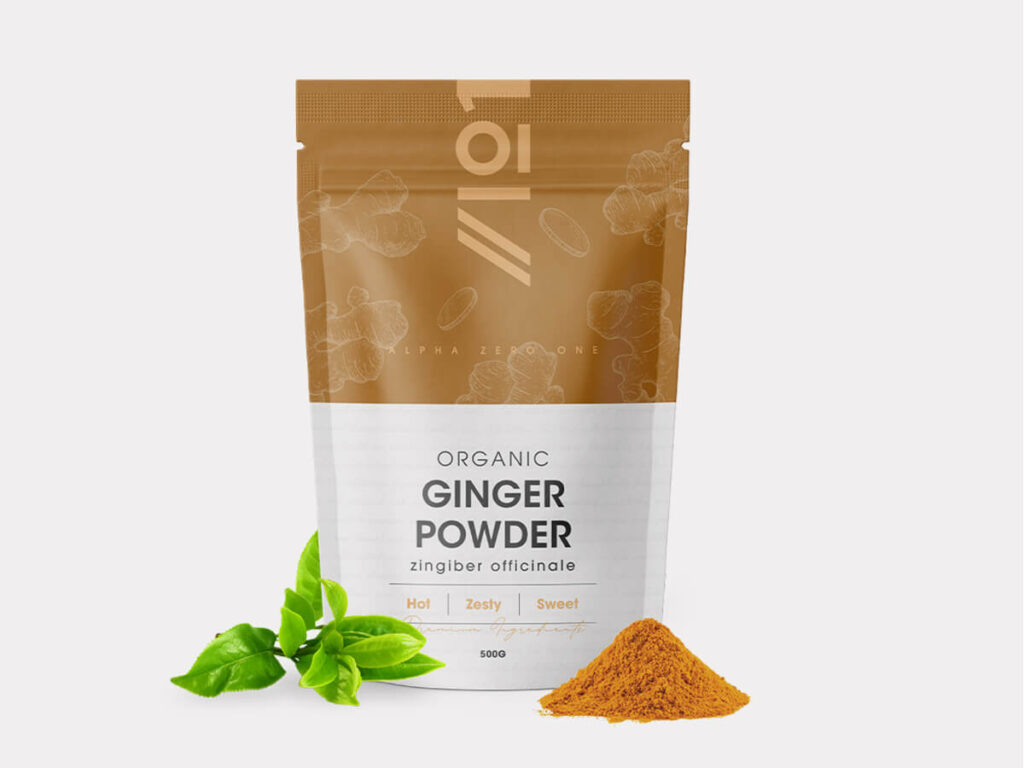
ORGANIC GINGER POWDER 500G
£17.99 · 500g Powder
SHOP NOW
Where Ginger Comes From
Ginger has been cultivated in India and China for thousands of years and is one of the oldest plants in recorded trade, reaching Europe in dried form long before fresh rhizomes could travel. A 2021 review in Phytotherapy Research describes the rhizome as a food with a unique pungent flavour[1]. Today ginger is grown across tropical Asia and Africa, with India the largest producer, and it appears in nearly every world cuisine, from curries and stir-fries to gingerbread and ginger beer.
The same review lists over 160 identified constituents in ginger: volatile oil, gingerol analogues, diarylheptanoids, phenylalkanoids, sulfonates, steroids and monoterpenoid glycosides. The volatile oil provides the aroma; the non-volatile pungent compounds are the gingerols, shogaols, paradols and zingerone[1]. Browse our herbal powder range for the other organic powders we stock.
What Is in Organic Ginger Powder
Every fact below is taken from the product page for our Organic Ginger Powder 500g[2]. There is one ingredient and nothing else.
Ingredients: Organic ginger powder (100%), milled from the dried rhizome of Zingiber officinale. No fillers, anti-caking agents or additives. Certification: certified organic, as printed on the label. Taste: strong, lemony-peppery and warming, as the product page puts it. Pack size: 500g resealable, recyclable pouch. Serving: the label states no serving size; use it by the teaspoon as a recipe or your taste dictates. Suitable for: vegans and vegetarians. Storage: sealed, in a cool, dry place out of direct sunlight; ground ginger loses aroma over time, so keep the pouch closed.
Which Ginger Powder Is Right for You?
If you’re comparing pack sizes and price — work it out per 100g. Organic Ginger Powder 500g is one ingredient in a 500g resealable pouch at £17.99 at the time of writing, which is £3.60 per 100g (about 3.6p per gram); how long the pouch lasts depends on how much you use. If you compare with another ginger powder, check that its price is for the same weight and that the ingredients list is one line.
If you want capsules instead of a loose powder — you have two kinds. Organic Ginger Root 1400mg – 90 Capsules is the same whole ginger root powder in a hypromellose capsule with organic brown rice flour: 1,400mg per two-capsule serving, taken daily with water, 45 servings per pouch, £9.99 at the time of writing (about 22p a serving, or roughly £15.90 per 100g of ginger)[4]. Organic Ginger Extract 3,750mg – 90 Capsules is a measured amount instead: each capsule contains 250mg of organic ginger root 15:1 extract, the equivalent of 3,750mg of ginger root, standardised to 5% gingerols (12.5mg), one capsule a day, 90 servings, £6.99 at the time of writing; the 7,500mg version doubles the extract to 500mg (25mg gingerols) at £9.99. A 15:1 ratio means 15g of ginger root went into each 1g of extract. Pick the powder if you cook with it, the capsules if you want a fixed daily amount without the taste.
If you read labels — four lines tell you what you are buying: the ingredients list (ours is organic ginger powder, 100%, with no fillers or anti-caking agents), the organic certification printed on the label, the pack weight or the ginger per serving with its standardisation if it is an extract, and the price. All three formats are certified organic and suitable for vegans. Use the powder by the teaspoon in cooking and drinks, as the next section explains; dried ginger is stronger than fresh, so start with less.
How to Use Organic Ginger Powder
Our Organic Ginger Powder is certified organic ginger and nothing else. In the kitchen, use it as you would any ground ginger: a teaspoon or two in curries, stir-fries, stews and marinades, in pickles, and in gingerbread, biscuits, cakes and desserts. In drinks, stir a quarter to half a teaspoon into hot water with lemon and honey, into warm milk, or into a smoothie; it does not fully dissolve, so stir or blend well. Dried ginger is stronger than fresh, so start with less than a recipe calls for in fresh root. Store the pouch sealed in a cool, dry place out of direct sunlight.
READY TO COOK WITH ORGANIC GINGER POWDER?
100% organic ginger powder in a 500g resealable pouch, £17.99 at the time of writing. Whole-root and extract capsules also available.
SHOP GINGER ROOT POWDER
Organic Ginger Root Powder FAQs
1. What is ginger root powder and how do I use it?
Ginger root powder is made from the dried and milled rhizome of Zingiber officinale, the same root used in cooking for thousands of years. Ours is 100% organic ginger powder with nothing added. Use it in food and drinks: a teaspoon in soups, stews, curries and baked goods, a quarter to half a teaspoon stirred into warm water or tea, or a pinch in a smoothie, yoghurt or plant-based milk. Dried ginger is more concentrated than fresh, so start with less.
2. What is the difference between ginger powder and fresh ginger?
Both come from the same rhizome. Fresh ginger is mostly water and tastes bright and lemony; drying removes the water, so the powder is more concentrated by weight, and part of the gingerol content changes into shogaols during drying, which gives dried ginger its sharper, warmer taste. As a kitchen rule of thumb, a quarter teaspoon of ground ginger stands in for about a tablespoon of grated fresh root. Which to use depends on the recipe: fresh for stir-fries and teas, powder for baking, spice blends and anything that needs to be shelf-stable.
3. Is organic ginger root powder suitable for vegans?
Yes — our Organic Ginger Root Powder is 100% plant-based and entirely suitable for vegans and vegetarians. It contains no animal-derived ingredients, additives or fillers, and it is certified organic, as printed on the label. Store the powder sealed in a cool, dry place away from direct sunlight and moisture to keep its flavour.
4. Ginger root powder benefits: what can a UK label say?
The Great Britain Nutrition and Health Claims Register holds no authorised health claim for ginger, so a UK label cannot carry one[3]. What our labels give you is certified organic ginger root, whether as a 100% powder, in whole root capsules or as an extract standardised to 5% gingerols.
5. Can I take ginger capsules every day?
Yes. Each capsule label gives a daily amount, taken with water: two capsules of the whole root or one capsule of either extract, and no more than that[4]. The labels say the capsules are not intended for children, and the extract capsules are not intended for pregnant or breastfeeding women either. If you have a medical condition, take any medication or, with the whole root capsules, are pregnant or breastfeeding, the labels ask you to consult a doctor before use[4].
Ginger is the dried rhizome of Zingiber officinale, a plant grown in Asia for thousands of years whose heat comes from gingerols and, once dried, shogaols. Alpha01 Organic Ginger Powder is one ingredient only, certified organic ginger, in a 500g pouch at £17.99 at the time of writing; the same ginger is available as 1,400mg whole-root capsules at £9.99 and as 15:1 extract capsules providing 12.5mg or 25mg of gingerols at £6.99 and £9.99. Use the powder in food and drinks, or choose the capsules for a fixed daily amount without the taste.
References
[1] Zhang, M., Zhao, R., Wang, D., et al. (2021). Ginger (Zingiber officinale Rosc.) and its bioactive components are potential resources for health beneficial agents. Phytotherapy Research, 35(2), 711–742 (botany and the 160+ identified constituents of ginger, reported in the abstract; PubMed). View Review
[2] Alpha01. Organic Ginger Powder 500g: ingredients, description, storage, stock status and price (accessed 2026-09-11). View Product
[3] Department of Health and Social Care. Great Britain nutrition and health claims (NHC) register, GOV.UK (accessed 2026-09-11; no ginger entries). View Register
[4] Alpha01. Organic Ginger Root 1400mg – 90 Capsules and Organic Ginger Extract 3,750mg / 7,500mg – 90 Capsules: nutritional information, ingredients, servings and prices (accessed 2026-09-11). View Product


