THE ALPHA01 GUIDE BOTANICALS & LABELS
Grape Seed
Extract Tablets: OPC Label Facts, Dose and Price
From the seed to the extract.
Compare the ratio, the amount and the declared content.
Pick up our pouch of OPC grape seed extract and the front hands you two numbers at once: 3,000mg per tablet and 142mg of proanthocyanidins 1. Turn it over and the panel adds two more, a 20:1 ratio and 35mg of OPC, and none of it quite adds up until you know what a 20:1 extract is.
This guide reads the label for you, starting with our OPC Grape Seed Extract 3,000mg tablets: what grape seed extract is, which compounds the panel declares and what 3,000mg from a 20:1 extract means in a single tablet. It then sets our two 20,000mg capsules beside the tablet, shows how to take one a day and tells you what a pouch of 180 costs.
Grape seed extract at a glance
- The ingredient: grape seed 20:1 extract, standardised to 95% proanthocyanidins 1.
- The plant: wine grapes, Vitis vinifera, whose seeds the extract is made from 2.
- One tablet: 150mg of 20:1 extract, declared as 3,000mg of grape seed, providing 142mg of proanthocyanidins, of which 35mg OPC 1.
- How to take it: one tablet a day with water.
- The pack: 180 vegan tablets, 180 servings, £7.99, about 4p a serving.
- The capsules: the same 20:1 extract in two capsules a day, and an organic 50:1 extract in one, compared below.
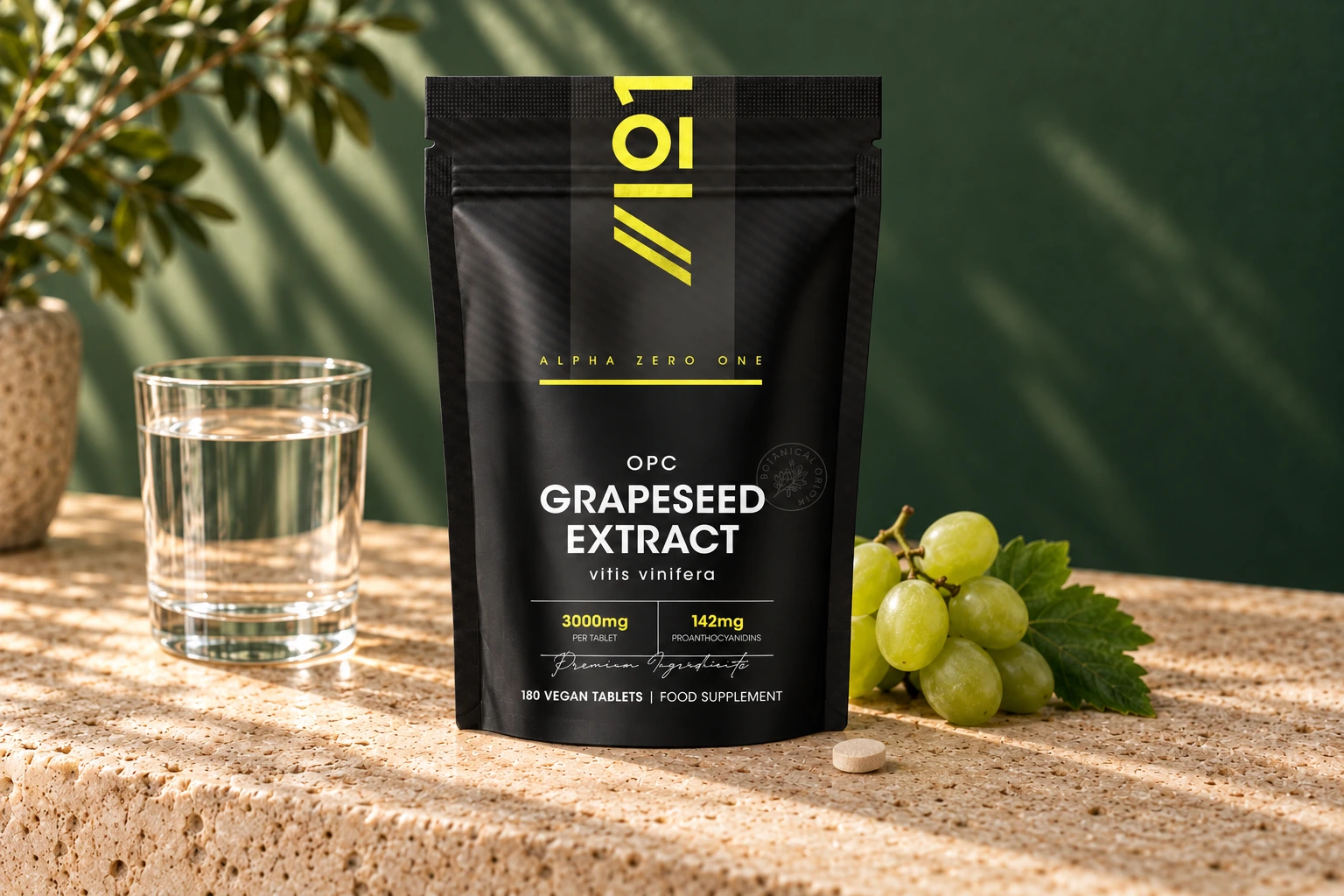
ONE TABLET A DAY
OPC Grape Seed Extract 3,000mg
£7.99 · 180 servings · 3000mg / Tablet
01 / MEET THE PLANT
What is grape seed extract? The seeds of Vitis vinifera, concentrated
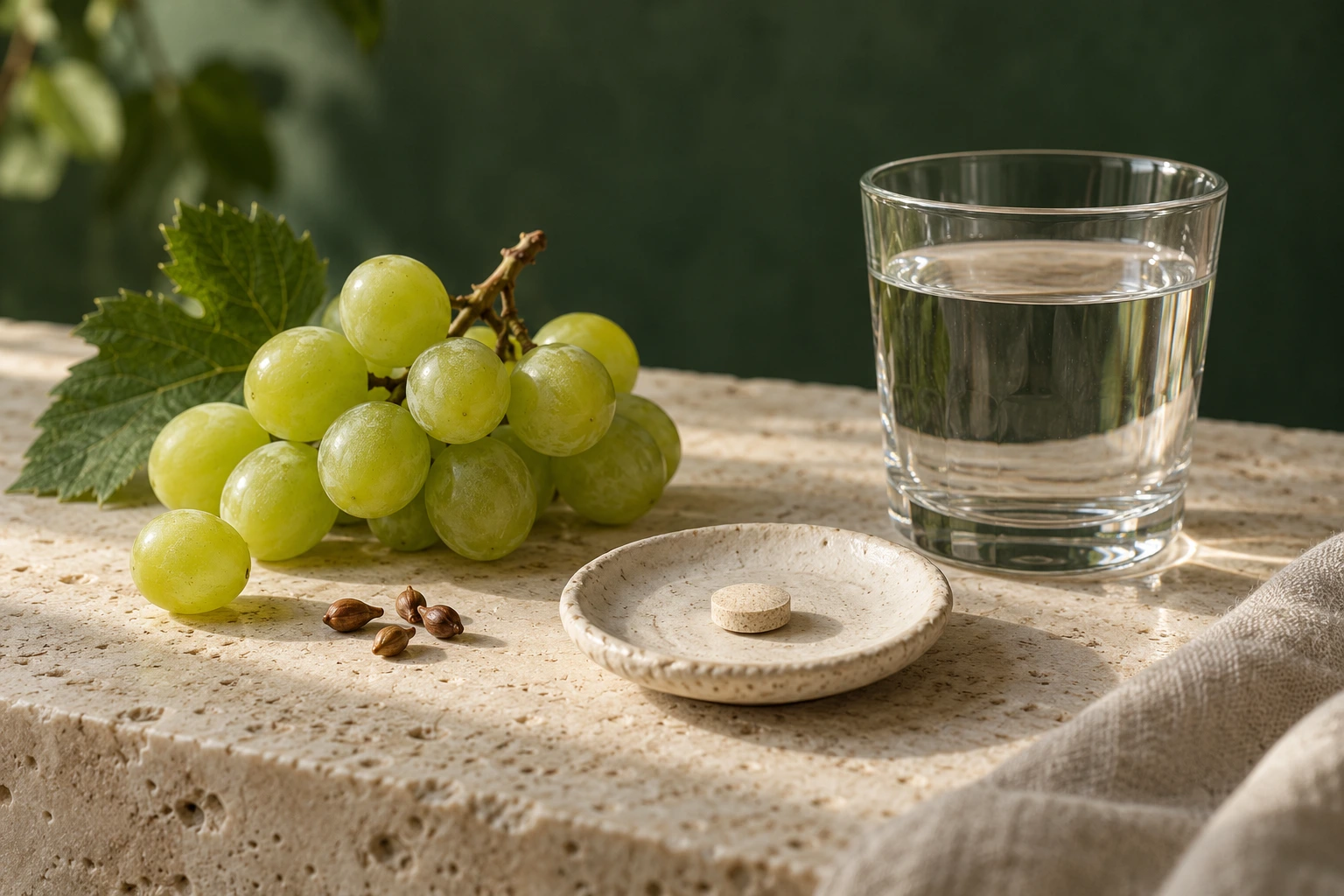
Grape seed extract is made from the seeds of wine grapes, Vitis vinifera, and it contains compounds called proanthocyanidins 2. The seeds are concentrated into an extract, and the panel on each of our pouches prints that extract’s ratio beside the weight of grape seed it stands for 1.
A grape seed supplement is sold as extract powder sealed in a capsule, as the same extract pressed into a tablet or as loose grape seed powder, the milled seed itself. The label tells you which of the three you are buying.
Whether you call it a grape seed dietary supplement or a grape seed food supplement, the front of each of our pouches prints food supplement 1. Browse our herbal supplements category to see the other herbal supplements we sell.
02 / READ THE LABEL
Grape seed extract 3,000mg on the label: what the panel declares
The nutritional information panel on the tablet pouch reads: serving size 1 tablet, servings per container 180 and then the ingredient line: Grape Seed (from 20:1 extract) 3,000mg, providing 142mg proanthocyanidins, of which 35mg OPC, with two asterisks that mean no NRV established 1.
Nutritional Information
Serving Size: 1 Tablet
Servings Per Container: 180
| Ingredient | Amount per Serving | %NRV* |
|---|---|---|
| Grape Seed (from 20:1 extract) | 3,000mg | ** |
| Providing 142mg Proanthocyanidins | ||
| Of which 35mg OPC |
*Nutrient Reference Value
** No NRV established
OPC
What a 20:1 extract means: 150mg in one tablet
On this label, 20:1 is the ratio of grape seed to extract, twenty parts of seed for one part of extract, so the panel’s 3,000mg of grape seed stands for 150mg of extract in the tablet 1. The ingredients list adds that the extract is standardised to 95% proanthocyanidins, and 95% of 150mg is about 142mg, the figure the panel prints 1. No nutrient reference value exists for grape seed, which is why the %NRV column reads No NRV established.
Oligomeric proanthocyanidins: the OPC line on the panel
Proanthocyanidins are chains of linked flavan-3-ol units, and the shorter chains are the oligomers 3; that oligomeric share is the OPC line on our panel 1. Our tablet panel declares the total first, 142mg of proanthocyanidins, and then the oligomeric share, 35mg of OPC, so the 35mg sits inside the 142mg rather than on top of it 1.
The other ingredients: what holds a grape seed tablet together
After the extract, the ingredients list names microcrystalline cellulose as a bulking agent, hypromellose as a gelling agent, polyvinylpolypyrrolidone as a stabiliser and magnesium stearate as an anti-caking agent 1. There is no gelatine in the list, the front prints vegan tablets, and the tablets are made in the EU 1.
03 / FIND YOUR FORMAT
Grape seed extract tablets or capsules: which is right for you?
We sell three grape seed extract supplements: the tablet and the two capsules print 3,000mg or 20,000mg on the front, yet they hold very different weights of extract 1. Compare the ratio, the weight of extract per serving and the proanthocyanidin figure, never the seed-equivalent number alone.
Grape seed extract tablets: 150mg of 20:1 extract, one a day
If you want one tablet a day, our OPC Grape Seed Extract 3,000mg tablets are the format to choose, with both the proanthocyanidin and the OPC figures declared on the panel above and set beside the capsules in the table below 1. Whether you call them grape seed tablets, grape seed pills or a grape seed extract pill, the label calls them tablets, and one pouch covers 180 days.
Grape seed extract capsules: 1,000mg of the same 20:1 extract in two
If you would rather have more extract in a serving, our Grapeseed Extract 20,000mg capsules use the same 20:1 extract at 95% proanthocyanidins, 1,000mg in two capsules, which the panel declares as 20,000mg of grape seed providing 950mg of proanthocyanidins 1. The shell is hypromellose and the only other ingredient is organic brown rice flour 1. A pouch of 90 is 45 servings at £6.99, about 16p a day.
Organic grape seed extract: a 50:1 extract in one capsule
If organic is the point, our Organic Grapeseed Extract 20,000mg capsules are the one certified organic option of the three: 400mg of organic 50:1 extract in one capsule, declared as 20,000mg of organic grape seed, with the EU organic leaf logo, the code SK-BIO-003 and non-EU agriculture on the front 1. This panel declares no proanthocyanidin figure, so the two 20,000mg labels are not the same thing: 400mg of a 50:1 extract and 1,000mg of a 20:1 extract both multiply out to 20,000mg 1. A pouch of 90 is 90 servings at £8.99, about 10p a day.
Grape seed extract powder or grape seed powder: read the ratio first
Our two grape seed capsules hold grape seed extract powder already measured into a serving. If you look at a loose grape seed powder, check whether its label prints a ratio: without one, the weight on the panel is the seed itself, milled, and there is no seed-equivalent figure to set beside ours. On any extract label, find the ratio, the weight of extract and the declared proanthocyanidin content.
Here are the three side by side. Prices are correct at the time of writing.
| Product | Serving / composition | Format / value |
|---|---|---|
| OPC Grape Seed Extract 3,000mg180 tablets | 1 tablet · 150mg of 20:1 extract142mg proanthocyanidins, of which 35mg OPC | 180 days · £7.99About 4p a day |
| Grapeseed Extract 20,000mg90 capsules | 2 capsules · 1,000mg of 20:1 extract950mg proanthocyanidins | 45 days · £6.99About 16p a day |
| Organic Grapeseed Extract 20,000mg90 capsules | 1 capsule · 400mg of 50:1 extractNo proanthocyanidin percentage declared | 90 days · £8.99About 10p a day |

20:1 EXTRACT · TWO CAPSULES
Grapeseed Extract 20,000mg
1,000mg of 20:1 extract per two-capsule serving, providing 950mg of proanthocyanidins. 90 capsules, 45 servings, £6.99.

ORGANIC · 50:1 EXTRACT
Organic Grapeseed Extract 20,000mg
400mg of certified organic 50:1 extract per capsule. No proanthocyanidin percentage declared. 90 capsules, 90 servings, £8.99.
04 / KEEP IT SIMPLE
How to take grape seed extract tablets
One grape seed extract tablet a day, no set time
The label directs one tablet daily with water 1. It names no time of day, so keep the pouch by a meal you never skip, and store it in a cool, dry place out of direct sunlight.
YOUR DAILY ROUTINE
Looking for OPC grape seed extract tablets?
One tablet a day: 150mg of 20:1 extract, declared as 3,000mg of grape seed, providing 142mg of proanthocyanidins, of which 35mg OPC. 180 vegan tablets, 180 servings, made in the EU, £7.99 at the time of writing.
SHOP GRAPESEED05 / A LITTLE MORE CLARITY
OPC Grape Seed Extract FAQs
What does OPC mean in grape seed extract?
On our tablet panel, OPC is the line under the proanthocyanidin figure: the oligomeric proanthocyanidins, the shorter chains of linked flavan-3-ol units 1 3. The 35mg of OPC is part of the 142mg of proanthocyanidins, not an addition to it 1. If an OPC supplement is what you want, of our three the tablet is the one whose panel declares an OPC figure 1.
Why does one label say 3,000mg and another 20,000mg?
How much grape seed extract per day?
The grape seed extract dosage on each label is its serving: one tablet, two of the 20:1 capsules or one organic capsule a day, with water 1. No label names another.
When to take grape seed extract?
The labels name no time of day 1. Taking your tablet or capsules with the same meal each day makes the routine easier to keep.
Can I take grape seed extract every day?
Who should not take grape seed extract?
The label says the product is not intended for children or for pregnant or breastfeeding women, and that if you have a medical condition or take any medication you should consult a doctor before use 1. The NHS adds that herbal products are not recommended for children, and that anyone already taking other medication should check with a pharmacist first 4.
Does grape seed extract contain resveratrol?
Our labels do not declare it. Each panel declares grape seed extract with its ratio, and the two 20:1 panels add a proanthocyanidin figure; none of the three lists resveratrol 1. If a resveratrol figure is what you are after, look for a label that declares one.
Does grape seed extract have an authorised health claim in the UK?
No. The Great Britain nutrition and health claims register holds no authorised entry for grape seed extract, Vitis vinifera seed extract, proanthocyanidins or OPC; every entry for them is listed as non-authorised, so we make no claim 5. What the label gives you is the extract, its ratio and the proanthocyanidin figure it declares.
THE BOTTOM LINE
So, tablet or capsules?
If you want one tablet a day with the proanthocyanidin and OPC figures declared, take the OPC Grape Seed Extract 3,000mg tablets: 180 vegan tablets, made in the EU, £7.99 at the time of writing, about 4p a day. If you would rather have more extract in a serving, the Grapeseed Extract 20,000mg capsules give 1,000mg of the same 20:1 extract in two at £6.99; if organic is the point, the Organic Grapeseed Extract 20,000mg capsules give 400mg of a 50:1 extract in one at £8.99. Whichever you choose, the ratio and the extract weight are the two numbers to compare.
GO TO THE SOURCE
Sources & references
- Alpha01. OPC Grape Seed Extract 3,000mg (180 tablets), Grapeseed Extract 20,000mg (90 capsules) and Organic Grapeseed Extract 20,000mg (90 capsules): pouch fronts, nutritional information panels, ingredients, suggested use, caution, storage and prices. Label maths by the author. Accessed 2026-10-13. View source
- National Center for Complementary and Integrative Health (NIH). Grape Seed Extract (cited for what the extract is made from, the Latin name and the presence of proanthocyanidins only). Accessed 2026-10-13. View source
- Thilakarathna WPDW, Rupasinghe HPV. Optimization of the Extraction of Proanthocyanidins from Grape Seeds Using Ultrasonication-Assisted Aqueous Ethanol and Evaluation of Anti-Steatosis Activity In Vitro. Molecules. 2022;27(4):1363 (cited only for what proanthocyanidins and their oligomers are; its activity findings are not used). Accessed 2026-10-13. View source
- NHS. Herbal medicines and complementary therapies. Accessed 2026-10-13. View source
- Department of Health and Social Care. Great Britain nutrition and health claims (NHC) register, GOV.UK, spreadsheet of 19 May 2026 (grape, Vitis vinifera seed extract, proanthocyanidin and OPC entries: non-compliance only, none authorised). Accessed 2026-10-13. View source