THE ALPHA01 GUIDE MUSHROOM EXTRACTS
Lion’s Mane Capsules,
Powder or Drops: Which Fits Your Day?
The white tooth fungus of the beech woods, and what 28,000mg, 20:1 and 50% polysaccharides mean on our labels.
Find your format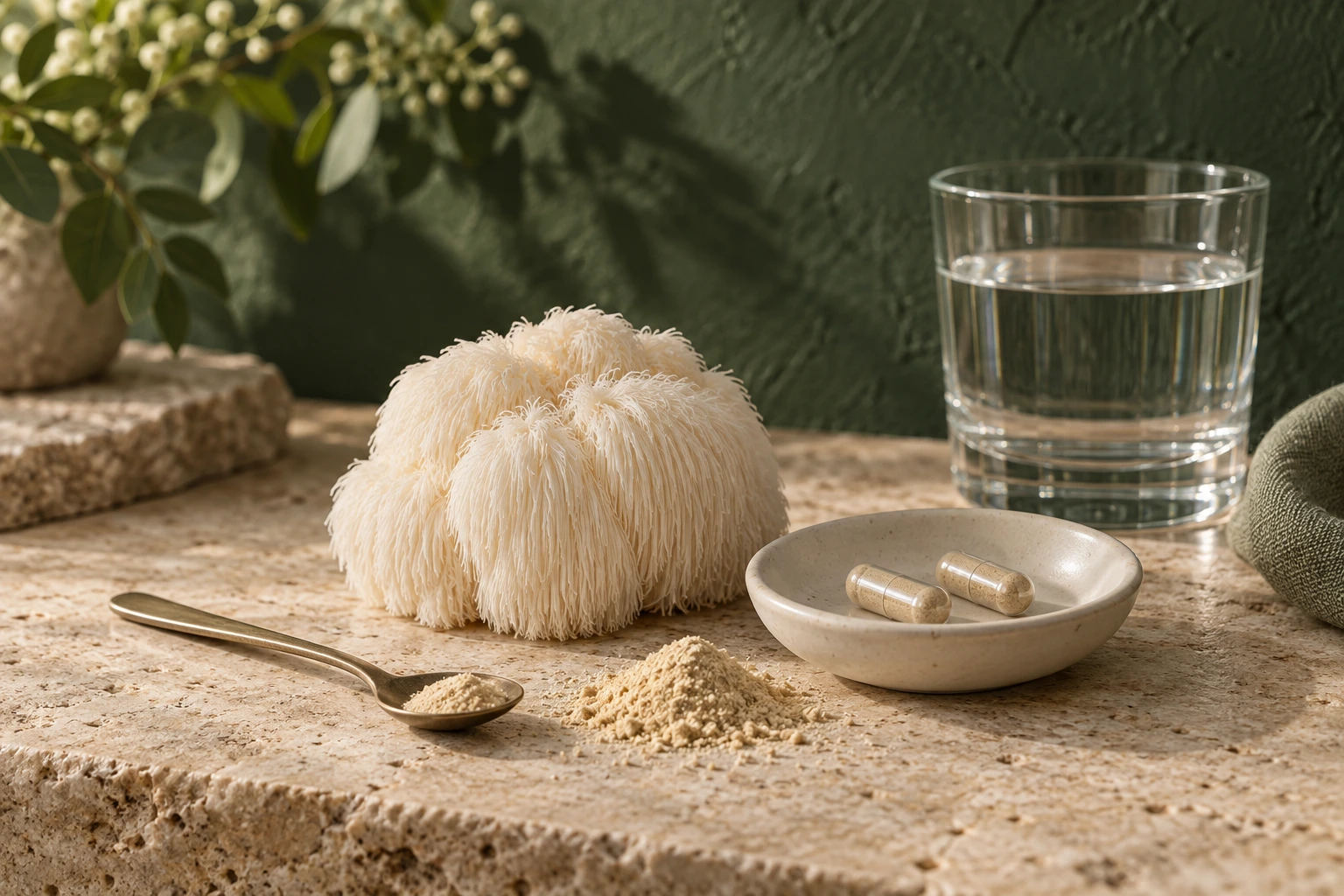
Lion’s mane doesn’t look like a mushroom at all. High on the trunk of an old beech it appears as a white, football-sized cushion of spines that hang down like icicles, a tooth fungus so rare in Britain that it is one of only four fungi the law forbids you to pick 1 2 3. Every lion’s mane sold in the UK has been grown rather than gathered, and in a supplement it reaches you as an extract, which is where the numbers begin: our capsule pouch prints 28,000mg on the front, while two capsules hold 1,400mg of extract 4 5.
Choosing a lion’s mane supplement can feel like a lot of decoding for something you just want to take each day. A UK label may carry only the health claims authorised on the Great Britain register, so everything a label states it can also prove, and this guide sticks to what a label can state. It takes you through our three formats first, capsules, a powder and drops, then through the label: what 20:1, 35:1 and 50% polysaccharides mean, and which format fits your routine and your budget 5 6 7. Then it walks you into the beech woods to meet the fungus itself.
Lion’s mane supplement at a glance
- What a lion’s mane mushroom supplement is: an extract of the lion’s mane mushroom, as capsules, a powder or drops; the capsules and the powder are certified organic 5 6 7.
- The fungus: a white tooth fungus of beech and oak, so rare in the wild that its British stronghold, the New Forest, holds around 45% of the trees known to have carried it between 1960 and 2007 8 1.
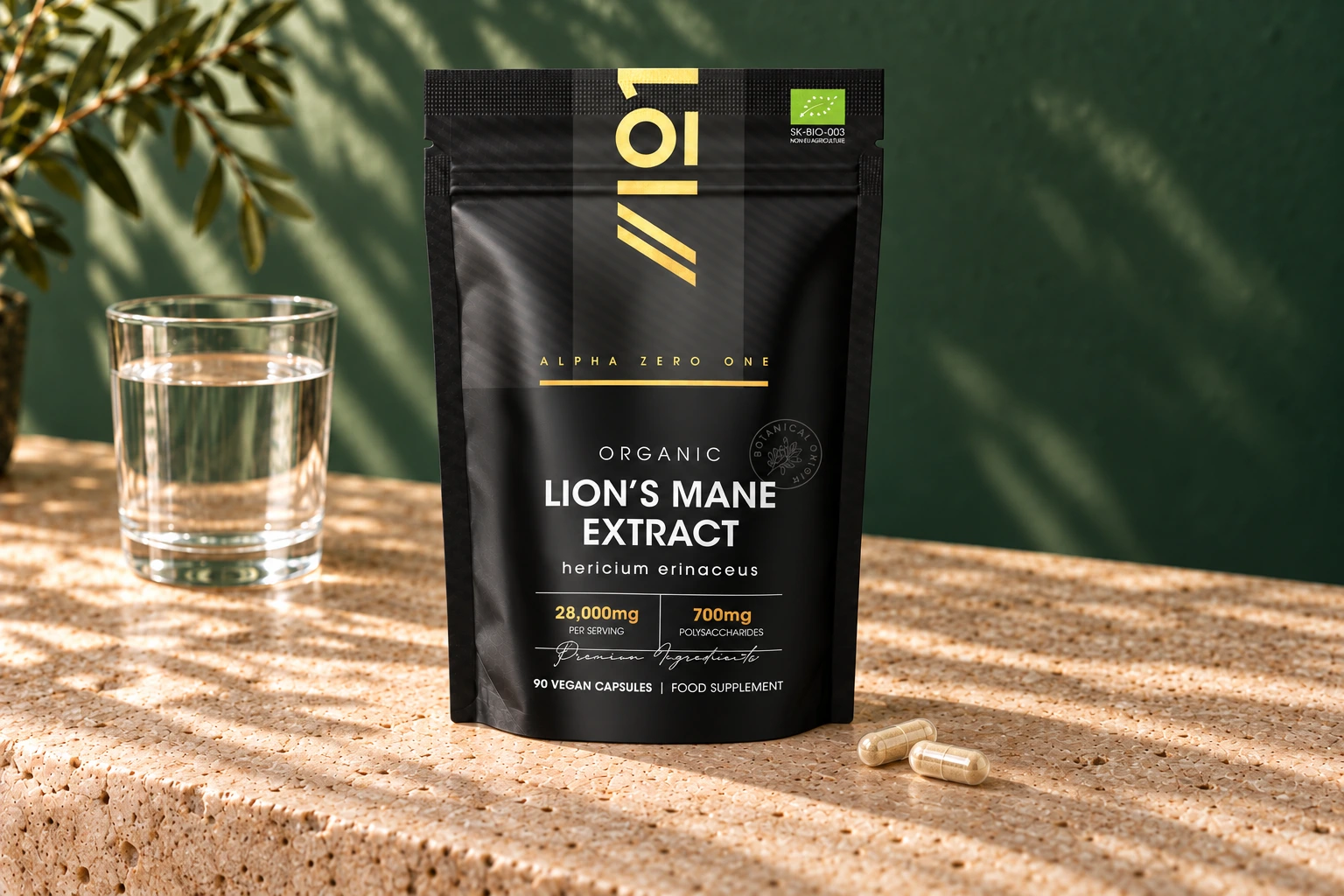
- Capsules: two give 1,400mg of organic 20:1 extract, printed on the panel as 28,000mg of lion’s mane, with 700mg of polysaccharides, for about 22p a serving, or 18p from the 180 pouch 5 9.
- Powder: a quarter teaspoon (1g) of the same organic 20:1 extract, printed as 20,000mg, with 500mg of polysaccharides, for about 9p 6.
- Drops: 2ml give 50mg of a 35:1 extract in spring water and glycerin, printed as 1,750mg, with 25mg of polysaccharides, for about 30p; the one format of the three not sold as organic 7.
- Who it suits: you, if you want a lion’s mane supplement in your day with the amount in every serving printed on the panel 5.
ORGANIC · TWO CAPSULES DAILY
Organic Lion’s Mane Extract
£9.99 · 45 servings · 2 capsules daily with water · 1,400mg of organic 20:1 extract · 700mg polysaccharides · about 22p a serving
AVAILABLE SIZES
Explore the capsules01 / FIND YOUR FORMAT
Lion’s mane capsules, powder or drops: which is right for you?
Three formats, two extracts: the capsules and the powder hold the same organic 20:1 extract, and the drops hold a 35:1 extract in spring water 5 6 7. The right one depends on how you like to take it, and the choice is simpler once you know that the serving, not the number on the front, is what you are comparing.
NO TASTE · MEASURED SERVING
Lion’s mane capsules: two a day with water, no taste
Would you rather not taste it at all? Our Organic Lion’s Mane capsules hold 700mg of organic 20:1 extract in each vegan capsule, so two give 1,400mg with 700mg of polysaccharides: £9.99 for 45 servings, about 22p each 5. If you have seen them called lion’s mane pills, these lion’s mane mushroom capsules are the same thing: a measured amount of extract inside a hypromellose shell 5.
Once they’re part of your day, the 180-capsule pouch is £15.99 for 90 servings, about 18p each: twice the capsules for £6 more 9.
THE LOOSE POWDER
Lion’s mane powder: how much per day and how to use it
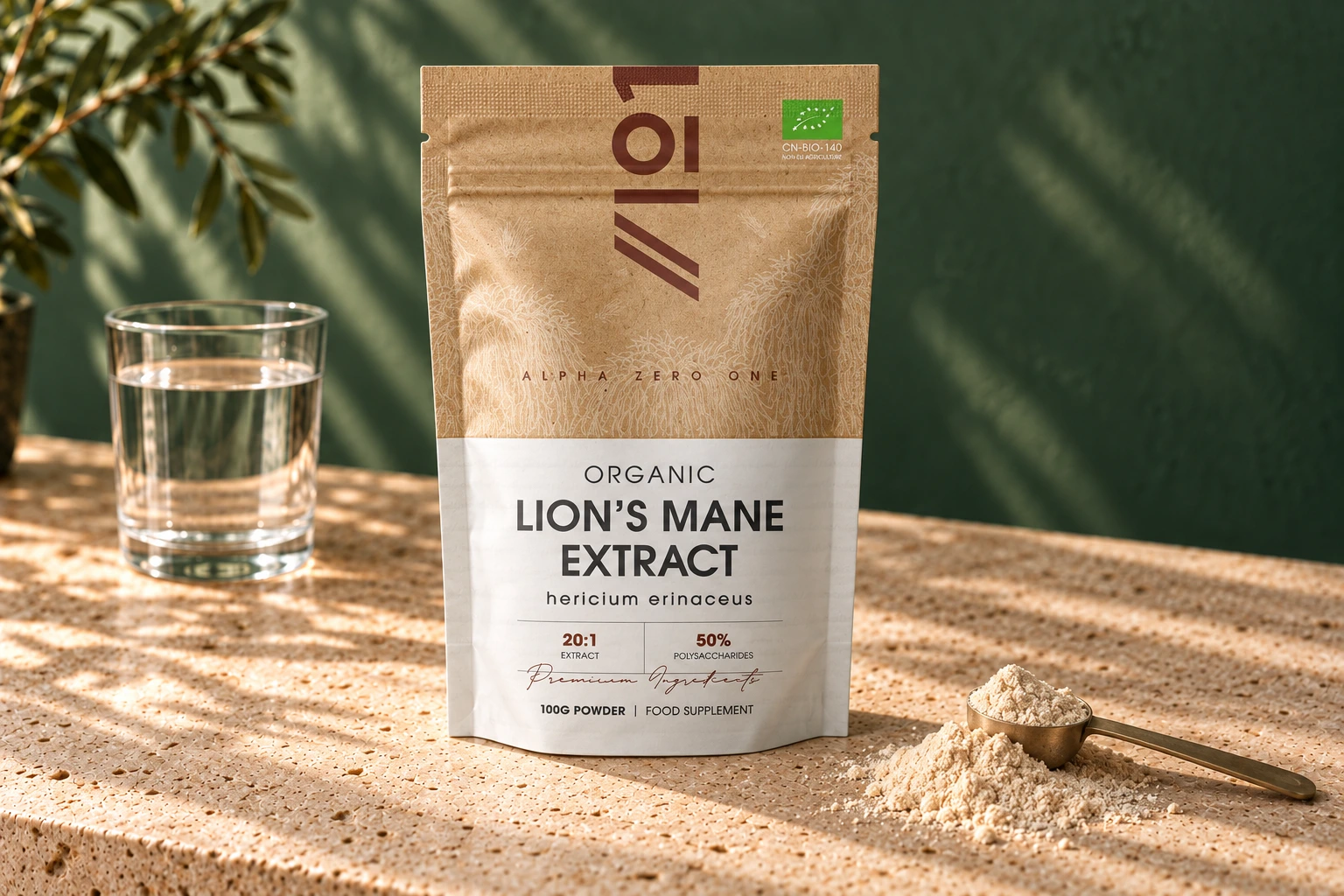
Already making a smoothie most mornings? Our Organic Lion’s Mane Extract powder is the same organic 20:1 extract, loose in the pouch: a quarter teaspoon (1g) once a day, printed on the panel as 20,000mg, with 500mg of polysaccharides, 100 servings for £8.99, about 9p each 6. Its label suggests water, juice, yoghurt or a smoothie, with dark chocolate or peanut butter to go with its naturally earthy taste 6.
The pouch holds nothing but the extract: the ingredients list is one line, so this lion’s mane mushroom powder is the 20:1 extract itself 6. Stir a quarter teaspoon into water or juice and you have a lion’s mane drink 6.
Lion’s mane liquid drops: 2ml of a 35:1 extract, straight or in a drink
Prefer a liquid? Our Lion’s Mane Extract drops give 1,750mg from a 35:1 extract in 2ml, which is 50mg of extract with 25mg of polysaccharides, in a base of spring water and glycerin, the humectant that keeps a liquid from drying out, with potassium sorbate, a preservative that prolongs its shelf life 7 10. The 60ml bottle holds 30 servings for £8.99, about 30p each, taken straight from the dropper or in water or any drink you prefer 7.
Per serving it holds the least extract of the three, 50mg against 1g in a quarter teaspoon of the powder, which is the trade for measuring by the dropper rather than the spoon 6 7. If you’d rather measure by the dropper than count capsules, liquid lion’s mane is the one for you: the bottle prints liquid above the name, and its ingredient line names the lion’s mane mushroom 35:1 extract 7. The 52,500mg in the product’s name is the whole bottle: 1,750mg in each of its 30 servings 7.
Lion’s mane tablets, capsules or powder: what each one physically is
Seen lion’s mane tablets and wondered how they compare with a capsule? A tablet is powder pressed into a small solid, where a capsule holds a measured amount of extract inside a shell, a powder is the extract on its own, measured by the spoon, and drops are an extract in a liquid, measured by the millilitre.
We sell no lion’s mane mushroom tablets, so the comparison in this guide is between our capsules, powder and drops, and whatever the format, the figure to hold is the extract in one serving and what you pay for it. If a measured serving with no taste is what you want from a tablet, the capsules are the nearest format we sell 5.
Lion’s mane and reishi together: the three mushroom blends
If you already take one of our mushroom blends, three capsules of the Organic Seven Mushroom Complex give 225mg of organic lion’s mane beside reishi, cordyceps, white fungus, maitake, shiitake and chaga 11. A quarter teaspoon of the Organic 7 Mushroom Blend Powder gives 200mg 12. Two capsules of the 8 Mushroom Complex give 2,250mg of lion’s mane from a 15:1 extract, which is 150mg of extract 13.
The capsules and the powder give you far more lion’s mane in every serving, 1,400mg and 1g of extract, while a blend spreads its serving across seven or eight mushrooms 5 6. For another mushroom with a ratio and polysaccharides on its label, see our reishi guide.
02 / READ THE LABEL
Lion’s mane 28,000mg on the label: what a 20:1 extract means
It’s easy to read 28,000mg as the weight of what you swallow, but two capsules weigh a fraction of that. The figure is a mushroom equivalent: the amount of mushroom that went into the extract in two capsules 5.
Nutritional Information
Serving Size: 2 Capsules
Servings Per Container: 45
| Ingredient | Each Serving Contains | %NRV* |
|---|---|---|
| Organic Lion’s Mane (from 20:1 extract) | 28,000mg | ** |
| Providing 700mg Polysaccharides | ||
*Nutrient Reference Value
** No NRV established
So here’s the answer to the question the front raises: two capsules hold 1,400mg of lion’s mane extract, 700mg in each, and the panel says so in its own way, organic lion’s mane from 20:1 extract, 28,000mg 5. Divide 28,000 by 20 and you have the 1,400 5. That is what an extract ratio records, and every lion’s mane mushroom extract on our labels prints one: the weight of dried starting material to the weight of extract made from it, as the European guideline on herbal extracts defines it, so 20 parts of dried mushroom became one part of extract 14.
The same reading works for the other two labels: the powder prints 20,000mg for a quarter teaspoon, which is 1g of extract, and the drops print 1,750mg for 2ml, which is 50mg of a 35:1 extract, 35 parts to one 6 7. Set the three side by side and the extract in a serving is the figure to compare, together with the polysaccharides it provides 5 6 7.
by weight
Organic Lion’s Mane capsules, Organic Lion’s Mane Extract powder and Lion’s Mane Extract drops, nutrition panels 5
50% polysaccharides: the figure that lets you compare
Polysaccharides are complex carbohydrates, such as starch and cellulose, formed of large molecules 15: long chains of sugar units. On our labels 50% means that half of the extract by weight is polysaccharides, so two capsules carry 700mg of them, a quarter teaspoon of the powder 500mg and 2ml of the drops 25mg 5 6 7.
Beta-glucans, which some other labels print, are one family of these polysaccharides, a structural part of the fungal cell wall 16. Our lion’s mane panels print the polysaccharide figure and no beta-glucan line, so polysaccharides are the number to compare between our three panels, and with any other label that prints one 5.
Why the panel prints no NRV, and what the organic leaf’s code tells you
Each panel carries two asterisks in the %NRV column. A Nutrient Reference Value is the daily amount a UK label measures a vitamin or mineral against, vitamin C at 80mg or vitamin D at 5µg, and none exists for a mushroom extract, so the panel gives milligrams and leaves it there 17 5. Some call them lion’s mane vitamins, but the pouch holds a mushroom extract, not a vitamin, which is why the panel prints two asterisks in place of a percentage 5 17.
Is it organic? Yes, for the capsules and the powder: each prints the organic leaf 5 6. The code beneath it names the control body that certified the company that labelled the product, and Non-EU Agriculture beneath the leaf says the agricultural ingredients were farmed outside the EU 18 19.
Ingredients are listed in order of weight, main ingredient first 20. On the capsules that is the extract, then the hypromellose shell, a material made from plant cellulose, then organic brown rice flour; on the powder the list is one line, the extract 5 6 21.
03 / COMPARE THE RANGE
Lion’s mane capsules vs powder vs drops: how they compare
Capsules, powder or drops, 45 servings or 100? The table puts our four products side by side, the capsules in two sizes, the powder and the drops: what each label declares and the price of a serving. Prices are correct at the time of writing.
| Product | What the label declares | Routine & value |
|---|---|---|
2 capsules · 1,400mg of organic 20:1 extract, shown as 28,000mg of lion’s mane · 700mg polysaccharides · hypromellose shell, organic brown rice flour | Choose if you want no taste and one measured serving · 45 servings · £9.99: about 22p a serving | |
the same capsule and serving as the 90 pouch · 1,400mg of extract · 700mg polysaccharides | Choose if the capsules are already part of your day · 90 servings · £15.99: about 18p a serving | |
¼ teaspoon (1g) · the same organic 20:1 extract, shown as 20,000mg of lion’s mane · 500mg polysaccharides · nothing else in the pouch | Choose if you want it in a drink or yoghurt at the lowest price a serving · 100 servings · £8.99: about 9p a serving | |
2ml · 50mg of 35:1 extract, shown as 1,750mg of lion’s mane · 25mg polysaccharides · spring water and glycerin | Choose if you would rather take a few millilitres straight from the dropper · 30 servings · £8.99: about 30p a serving |
Two 90 pouches cost £19.98 against £15.99 for the 180 pouch, so once the routine has settled the larger pouch saves you £3.99 over the same 90 servings 5 9. Over a year at two capsules a day, the 180 pouch works out at a little over four pouches, about £65; the powder at a quarter teaspoon a day is a little under four pouches, about £33 9 6.
Set like against like, and the comparison is not 28,000mg against 20,000mg or 1,750mg but the extract in a serving, which is the figure the table carries 5 6 7. Because the mushroom figure rises with the ratio, the same weight of extract prints a bigger number at 35:1 than at 20:1, so the extract in a serving and its polysaccharides are the fairer numbers to compare. If nothing to taste and a counted serving is what you want, the capsules are the one; if the lowest price a serving matters most and a spoon in a drink suits you, the powder; and if you would rather measure 2ml straight from the dropper, the drops are for you.
THE SAME EXTRACT · LOOSE POWDER
Organic Lion’s Mane Extract Powder
£8.99 · 100 servings · ¼ teaspoon (1g) a day · the same organic 20:1 extract · 500mg polysaccharides · about 9p a serving
Explore the powder
A LIQUID DAILY SERVING
Lion’s Mane Extract Drops
50mg of 35:1 extract in 2ml.
25mg of polysaccharides per serving.
04 / MEET THE MUSHROOM
What is lion’s mane? The mushroom behind the name
Lion’s mane, Hericium erinaceus, is a mushroom: a tooth fungus of the family Hericiaceae, its teeth the hanging spines on whose surfaces its spores form 8. It grows as a roundish fruitbody, 15 to 20cm across and sometimes 30cm, with every spine emerging from one point and cascading down like a mop head 8. The spines are 1 to 5cm long, soft and pointed, white at first and yellow-brown with age 8 1 22.
Kew calls it a wood-recycling fungus, often fruiting high on living trunks and as likely to be noticed by hikers and dog-walkers as by field mycologists 1.
It feeds in the dead heartwood of a living beech or oak, and for years it may be imprisoned there by the cylinder of living wood around it, escaping to fruit only where that cylinder is breached: a fissure, a fracture, a hollow, an old branch stub 1. Once it has found its way out, the same tree can fruit on and off from August to December for twenty years or more 22.
Lion’s mane fungus: the hedgehog in the name, and the jellyfish that shares it
The name is young in English: Merriam-Webster dates the first known use of lion’s mane for the mushroom to 1996 and explains it by the hairlike look of the mature fruitbody 23. The British name is bearded tooth, and the Latin is older than lion’s mane: Persoon placed the fungus in Hericium in 1797 8; Hericium means pertaining to a hedgehog, and erinaceus is the Latin noun for the animal, so the scientific name says hedgehog twice 8 24.
Wild Food UK adds pom pom mushroom and the Welsh pigau barfog 25; in China it is hou tou gu, and in Hailin in the north-east the Hailin hou tou gu carries a registered geographical indication, grown in semi-underground houses 26; in Japan it is yamabushitake 27.
The name has another owner, the lion’s mane jellyfish, Cyanea capillata, seen off all UK coasts in summer, whose largest recorded specimen trailed tentacles of 36.6 metres 28 29; this guide is about the mushroom.
Lion’s mane mushroom in the UK: the wild hedgehog fungus of beech and oak
In Britain it grows nearly always on beech and oak, on standing trees, stumps and fallen logs, and over 80% of the records are on beech 8 30. It is a very rare sight, found mainly in southern England and eastern Wales 8. Its stronghold is the New Forest in Hampshire, where Kew counts 40 to 45 trees that have carried fruitbodies at some time between 1960 and 2007 1.
By Kew’s count that is around 45% of the estimated 105 such trees in the whole of Britain 1. Its British rarity is a European matter too: around half (220) of its European localities recorded after 1980 were thought in 2003 to be in Britain or France, and it was red-listed in 13 of the 23 European countries where it had been recorded 1.
That rarity is written into law. Schedule 8 of the Wildlife and Countryside Act 1981 lists it, under the older spelling Hericium erinaceum, as the hedgehog fungus, beside the royal bolete, the oak polypore and the sandy stilt puffball, the only other fungi on the schedule, and section 13 makes it an offence in England and Wales to pick, uproot or destroy it on purpose 2 3 30. Kew notes that no fungus in the UK has a higher legal standing, so if you meet one on a beech, leave it where it is 1.
The records tell a story of their own. In Windsor Forest an ancient hollow beech fruited on and off from the 1960s until 1998; when it collapsed, a 4m section was re-erected in 2001 and strapped to a living beech, and no fruitbody has been seen on it since 1. A research report for English Nature in 2002 gave Hainault Forest’s last record as 1863 and Epping Forest’s as 1987 30, and in December 2022 a London National Park City ranger reported one in Epping Forest again 31.
Fresh lion’s mane as food: how UK growers raise it and how it is cooked
For all its rarity in the wild, the fungus is easily cultivated: Kew lists woodchips, sawdust and cellulose-rich crop residues such as cotton, sugar cane, rice and corn 1. In cultivation it can fruit in as little as two to three weeks, which Kew calls remarkable for a fungus so rarely seen fruiting in the wild 1. Hobby growers buy birch plugs carrying the white mycelium, tap them into holes in a cut log and seal them with wax; in due course cascades of white icicles emerge 8.
Artificial cultivation was first reported in China in 1959, where the mushroom has been a delicacy since ancient times, and China now grows about 85% of all the lion’s mane cultivated worldwide, on sawdust, cottonseed hulls or crop residues with bran 32 26. Growers steam the substrate, add the spawn and, once the white mycelium has run through it, move it to a cooler, lit cropping room to bring on the fruitbodies, as a commercial-scale trial in Thailand recorded 26 27.
Fresh lion’s mane is now a British crop too: in March 2025 a Kent organic farm put 200g punnets into Sainsbury’s at £5, the first time the mushroom had reached a UK supermarket 33, and a London grower raises it on wood-based substrates and sells it fresh in 150g and 500g packs 34. So the punnet, like the pouch, is a grown mushroom, never a gathered one 4.
Cooked, the taste is said to be rather like lobster cooked in butter, and the London grower advises frying it in a pan so its water cooks off, leaving it dense and succulent 8 34. Chefs Jack Croft and Will Murray peel it into strands to finish a mushroom parfait 35. In the kitchen, lion’s mane food means the fresh fruitbody, pan-fried, or made into steaks or crab cakes, three recipes that the grower Some Funguys, which raises it in a former nuclear bunker, lists on its recipe page 36.
The same mushroom, dried and extracted twenty to one, is what our pouches hold: the 28,000mg on the capsule front is the dried mushroom that went into two capsules 5 14.
What does lion’s mane powder taste like? Earthy, says the label; mild when fresh
Drying and extraction change it. The label’s word for the powder is naturally earthy, which is why it pairs it with something sweet or nutty, and Kew’s word for the fresh mushroom is mild, with a texture First Nature likens to fish or tender meat 6 1 8. The capsules are the choice for anyone who would rather not taste it at all 5.
05 / KEEP IT SIMPLE
How to take lion’s mane capsules, powder or drops
Lion’s mane dosage per day: one labelled serving for adults
Each label sets one serving a day for adults: two capsules with water, a quarter teaspoon (1g) of powder in water, juice, yoghurt or a smoothie, or 2ml of drops, straight or in a drink 5 6 7. The labels set no time of day and no mealtime, and they are written for every day, so tie the serving to a moment you already keep: the morning coffee, the lunchtime glass of water or the evening meal.
Store the pouches and the bottle in a cool, dry place out of direct sunlight, keep them out of reach of young children, and don’t use the drops if the seal is missing or damaged 5 6 7. Our capsules, powder and drops sit in our lion’s mane range among our herbs, the drops among our herbal tinctures and the powder among our herbal powders; the capsules and the powder belong to our organic range, and all of them to our vegan and daily wellbeing ranges.
A SIMPLE DAILY ROUTINE
The number on the front, decoded
If two capsules a day with water, and nothing to taste, sounds like the easiest way to make lion’s mane part of your day, the organic capsules are the simple choice: a 90-capsule pouch gives you 45 days for £9.99, and the 180-capsule pouch brings a day down to about 18p, with the serving and its 20:1 ratio printed on the panel, so you can work out the 1,400mg of extract for yourself.
SHOP LION’S MANE CAPSULES06 / A LITTLE MORE CLARITY
Lion’s mane FAQs
What is lion’s mane good for?
The Great Britain Nutrition and Health Claims Register holds no authorised health claim for lion’s mane, so this guide keeps to what the label states 37. Two capsules give 1,400mg of organic 20:1 extract with 700mg of polysaccharides, a quarter teaspoon of the powder gives 1g of the same extract with 500mg, and 2ml of the drops give 50mg of a 35:1 extract with 25mg 5 6 7.
How much lion’s mane per day, and how much is too much?
The labels set it: two capsules, which is 1,400mg of organic 20:1 extract, or a quarter teaspoon (1g) of the powder, or 2ml of the drops, once a day 5 6 7. That is the lion’s mane dosage per day printed on each pack, and each pack says do not exceed the recommended daily dose. Each pack is sized for every day: 45 or 90 days for the capsules, 100 for the powder and 30 for the drops 5 9 6 7.
Can I take lion’s mane with medication or other supplements?
The labels are for adults and not for pregnancy or breastfeeding, and they ask you to check with a doctor first if you have a medical condition or take any medication 5 6 7. With another supplement, keep each product to the serving on its own label; if that supplement is one of our mushroom blends, the blends section above gives the lion’s mane in each of their servings 11 12 13. For pregnancy in general, the NHS adds: “If you need higher dose folic acid or other supplements, speak to a GP” 38.
Lion’s mane powder or capsules: which should you choose?
On the label they are the same extract: both declare organic lion’s mane 20:1 extract at 50% polysaccharides, and the capsules add only a hypromellose shell and organic brown rice flour 5 6. The difference is the serving, 1,400mg of extract in two capsules against 1g in a quarter teaspoon 5 6. So the choice is the routine: two capsules swallowed with water, or a quarter teaspoon stirred into a drink, at about 22p or 18p a serving against about 9p 5 9 6.
What is lion’s mane powder made of, and is it an extract?
Can I put lion’s mane powder in coffee, or make a lion’s mane drink?
Is your organic lion’s mane certified, and are the capsules vegan?
Yes: the capsules and the powder print the organic leaf with the control body’s code beneath it, as the label section above shows 5 6 18. The capsule front prints vegan capsules, and nothing in the hypromellose shell or the rice flour comes from an animal; the powder is the extract and nothing else, and all three sit in our vegan range 5 6 7 21. The drops are not sold as organic, so our organic range holds the capsules and the powder 7.
Does lion’s mane powder expire, and does it need to be refrigerated?
THE BOTTOM LINE
So, lion’s mane capsules, powder or drops?
The right lion’s mane supplement is the one that fits your routine. For two capsules with water and nothing to taste, the Organic Lion’s Mane capsules at about 22p a serving, or 18p in the 180 pouch; for the same extract at about 9p a serving in a drink, the Organic Lion’s Mane Extract powder; for 2ml from the dropper, straight or in a drink, the drops. Whichever of the three you pick, the serving and its ratio are printed on the panel, and you now know what 28,000mg and 20:1 mean before you buy.
GO TO THE SOURCE
Sources & references
Checked against the product labels shown on alpha01.co.uk and the Great Britain Nutrition and Health Claims Register, October 2026. Product formulations, prices and guidance can change.
- Royal Botanic Gardens, Kew. Kew Species Profiles: Hericium erinaceus (Bull.) Pers., bearded tooth (description, distribution, how fruiting occurs, threats and conservation, the Windsor re-erection, cultivation). Kew Science, published on the Colombian Fungi portal (cited for the fungus’s biology, rarity, legal standing, cultivation and the food line of its Uses section only; its health statements are not used). View source
- Wildlife and Countryside Act 1981, Schedule 8, Plants which are Protected (Fungus, Hedgehog: Hericium erinaceum, and the three other fungi, entries added by SI 1998/878). legislation.gov.uk. View source
- Wildlife and Countryside Act 1981, section 13 (wild plants), England and Wales version. legislation.gov.uk. View source
- Great British Chefs (2022, updated 2025). A comprehensive guide to mushrooms: from button to lion’s mane. View source
- Alpha01. Organic Lion’s Mane Mushroom 28,000mg, 90 Capsules: nutritional information panel, ingredients, suggested use, caution, storage, pouch front and price. View source
- Alpha01. Organic Lions Mane Extract, 100g Powder: nutritional information panel, ingredients, suggested use, caution, storage, pouch front and price. View source
- Alpha01. Lions Mane Extract 52,500mg, 60ml Tincture: nutritional information panel, ingredients, suggested use, caution, storage, bottle front and price. View source
- O’Reilly P. Hericium erinaceus (Bull.) Pers., Bearded Tooth: identification guide, habitat, season, distribution, etymology, taxonomic history and culinary notes. First Nature (cited for the fungus’s description, names, range, cooked taste and the birch-plug cultivation only; its health statements are not used). View source
- Alpha01. Organic Lion’s Mane Mushroom 28,000mg, 180 Capsules: nutritional information panel and price. View source
- Regulation (EC) No 1333/2008 on food additives, Annex I: functional classes of food additives (preservatives, humectants). legislation.gov.uk. View source
- Alpha01. Organic Seven Mushroom Complex 1575mg, 90 Capsules: nutritional information panel, ingredients and price. View source
- Alpha01. Organic 7 Mushroom Blend Powder 100g: nutritional information panel, ingredients and price. View source
- Alpha01. 8 Mushroom Complex 18,750mg, 90 Capsules: nutritional information panel, ingredients and price. View source
- European Medicines Agency, Committee on Herbal Medicinal Products (2010). Guideline on declaration of herbal substances and herbal preparations in herbal medicinal products/traditional herbal medicinal products, EMA/HMPC/CHMP/CVMP/287539/2005 Rev.1, section 6 (cited for the definition of the extract ratio only). View source
- Cambridge Dictionary. Polysaccharide. Cambridge University Press & Assessment. View source
- Lima SL, Colombo AL, de Almeida Junior JN (2019). Fungal Cell Wall: Emerging Antifungals and Drug Resistance. Frontiers in Microbiology, 10:2573 (cited only for the description of the fungal cell wall). View source
- Regulation (EU) No 1169/2011 on the provision of food information to consumers, Annex XIII Part A: vitamins and minerals which may be declared and their nutrient reference values. legislation.gov.uk. View source
- Department for Environment, Food and Rural Affairs. Organic food: labelling and advertising rules, updated 20 August 2025 (control body codes and the agricultural origin statement). GOV.UK. View source
- Regulation (EU) 2018/848 on organic production and labelling of organic products, Article 32: the control body code and the statement non-EU Agriculture. legislation.gov.uk. View source
- Food labelling and packaging: ingredients list. GOV.UK. View source
- Vlad RA, Pintea A, Pintea C, Rédai EM, Antonoaea P, Bîrsan M, Ciurba A (2025). Hydroxypropyl Methylcellulose, A Key Excipient in Pharmaceutical Drug Delivery Systems. Pharmaceutics, 17(6):784 (cited only for hypromellose as a cellulose-derived capsule material). View source
- Back from the Brink (Buglife, Plantlife and the Bat Conservation Trust). Species Information Guide: Bearded tooth fungus, Hericium erinaceus. PDF uploaded January 2022, undated in the document (cited for the life cycle and the spines only). View source
- Merriam-Webster. Lion’s mane: definition, etymology and first known use, 1996. View source
- Merriam-Webster. Erinaceous: word history (Latin erinaceus, hedgehog). View source
- Wild Food UK. Mushroom guide: Lion’s Mane, Hericium erinaceus (cited for its common names only; its health statements are not used). View source
- Yang D, Zhu L, Zheng Q (2026). Regional Cultivation Forms of Hericium erinaceus Across China’s Climatic Zones: A Scoping Review and Analytical Lens for Climate-Adaptive Production. Journal of Fungi, 12(4):285 (cited for the share of world cultivation, the substrate and its steaming, and the Hailin name only; its introduction is not used). View source
- Chutimanukul P, Phatthanamas W, Thepsilvisut O, Chantarachot T, Thongtip A, Chutimanukul P (2023). Commercial scale production of Yamabushitake mushroom (Hericium erinaceus (Bull.) Pers. 1797) using rubber and bamboo sawdust substrates in tropical regions. Scientific Reports, 13:13316 (cited for the Japanese name and the cultivation method only). View source
- The Wildlife Trusts. Lion’s mane jellyfish, Cyanea capillata. View source
- Marine Conservation Society. Wildlife A-Z: Lion’s mane jellyfish, Cyanea capillata. View source
- Boddy L, Wald P (2002). Creolophus (= Hericium) cirrhatus, Hericium erinaceus and H. coralloides in England. English Nature Research Reports No. 492, March 2002 (cited for the four Schedule 8 fungi, the share of records on beech and the dated site records only). View source
- Nahaboo K (2022). Searching for Fungi in Epping Forest. Epping Forest Heritage Trust, 16 December 2022. View source
- Zhang N, Tang Z, Zhang J, Li X, et al. (2019). Comparative transcriptome analysis reveals the genetic basis underlying the biosynthesis of polysaccharides in Hericium erinaceus. Botanical Studies, 60:15 (cited for the date of the first reported cultivation and the delicacy line only; its pharmacological statements are not used). View source
- Greaves H (2025). Fresh Lion’s Mane mushrooms are now available in UK supermarkets for the first time. Vegan Food & Living, 19 March 2025 (cited for the launch, the punnet size and price and the farm’s county only). View source
- Merit Mushrooms (Prodac Ltd, London). Lion’s Mane Mushrooms: product page (cited for the taste comparison, the wood-based substrate, the pan-frying advice and the fresh pack sizes only). View source
- Croft J, Murray W (2022). Mushroom parfait with herb infused sourdough. Great British Chefs. View source
- Some Funguys. Lions Mane and Recipes pages (cited for the grower’s premises and the three recipes it lists only). View source
- Department of Health and Social Care. Great Britain nutrition and health claims (NHC) register, updated 19 May 2026 (no entry for lion’s mane, Hericium erinaceus or mushroom polysaccharides). GOV.UK. View source
- Pregnancy vitamins and supplements. NHS. View source
- Understanding food labelling: best before and use-by dates. GOV.UK. View source
- London Borough of Bromley. Storage in your food business: food safety leaflet (cited for the storage of dry goods only). View source