Do you hit the afternoon tired, on a plate that has been short of fruit and vegetables all week, and wonder whether a vitamin C supplement would make a difference? It is a fair question, and UK rules give a clear answer about what vitamin C does, word for word [1]. Vitamin C contributes to the reduction of tiredness and fatigue. Vitamin C contributes to the normal function of the immune system. Vitamin C contributes to the protection of cells from oxidative stress. Vitamin C increases iron absorption. The NHS names citrus fruit, peppers, strawberries, blackcurrants, broccoli and potatoes as good sources, and notes that the body cannot store vitamin C, so you need it every day [2]. Two capsules give you a measured amount every day, whatever the week’s plate looks like.
But choosing a vitamin C supplement is where the confusion begins. The front of our pouch says liposomal and 1000mg, and the panel says 1250% [4]. This guide explains what a liposome is, what the panel declares and which of our three vitamin C formats fits your day.
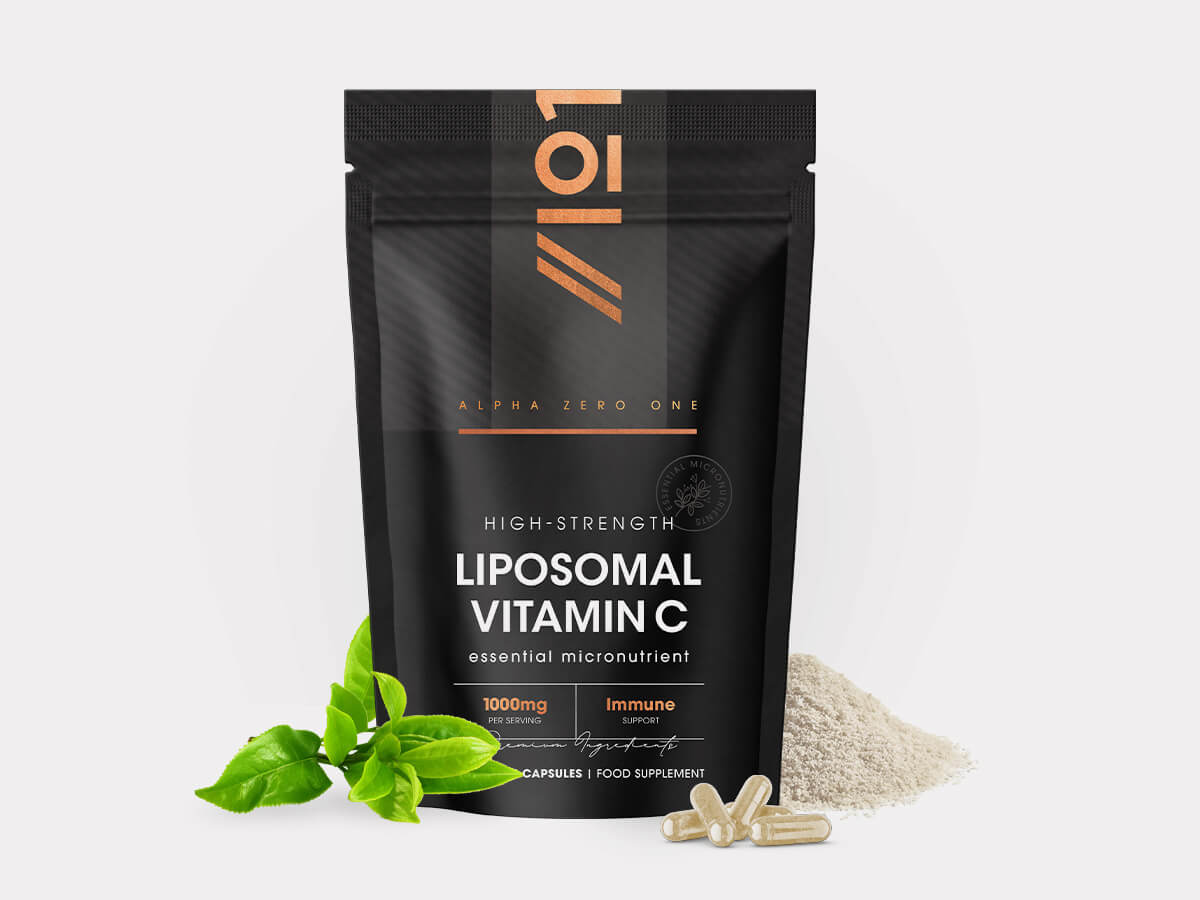
Liposomal vitamin C at a glance
- What it is: vitamin C as ascorbic acid, carried in liposomes made with sunflower lecithin, in a hypromellose capsule.
- Two capsules: vitamin C 1,000mg, 1250% of the reference value of 80mg that every supplement panel counts against [5].
- Authorised claims, for the vitamin C: Vitamin C contributes to the reduction of tiredness and fatigue. Vitamin C contributes to the normal function of the immune system [1].
- How to take it: two capsules a day with water, at any time of day.
- Price: £8.99 for 180 capsules, 90 days at about 10p a day.
LIPOSOMAL VITAMIN C · 1000MG · 180 CAPSULES
£8.99 · 90 servings · 2 capsules a day with water · vitamin C (liposomal) 1,000mg, 1250% NRV · ascorbic acid and sunflower lecithin · about 10p a day
SHOP NOW
Liposomal vitamin C, acerola or gummies: which is right for you?
The three vitamin C supplements in this guide carry the same authorised sentences, because the sentences belong to vitamin C, not to its format [1]. They differ in the amount, the source and what you swallow.
Liposomal vitamin C capsules: 1,000mg, 90 days for £8.99
Our Liposomal Vitamin C 1000mg capsules give 1,000mg of vitamin C in two capsules, for 90 days at about 10p a day [4].
Acerola vitamin C: 260mg from a fruit extract
If you would rather take your vitamin C from a fruit, our Acerola Vitamin C capsules declare 1,000mg of acerola cherry extract providing 260mg of vitamin C, in a vegan capsule with the EU organic logo on the front [4]. That is 45 days at about 18p a day. The capsules sit in our organic, daily wellbeing and acerola cherry ranges.
ACEROLA VITAMIN C · 1000MG AND 260MG · 90 CAPSULES
£7.99 · 45 servings · 2 capsules a day with water · acerola cherry extract 1,000mg providing vitamin C 260mg, 325% NRV · vegan capsule · about 18p a day
SHOP NOW
Vitamin C gummies: 200mg to chew
If swallowing capsules is the obstacle, our Vitamin C Gummies give 200mg in two gummies, set with pectin rather than gelatin and sweetened with maltitol and isomalt [4]. The label says adults chew two a day and children over 4 years chew one, and they sit in our gummies range.
Here are the three labels side by side. Prices are correct at the time of writing.
2 capsules · vitamin C (liposomal) 1,000mg, 1250% NRV · ascorbic acid with sunflower lecithin · hypromellose shell, rice starch, safflower oil
Choose if you want the full 1,000mg in two capsules · 90 days · £8.99: about 10p a day
2 capsules · acerola cherry extract 1,000mg providing vitamin C 260mg, 325% NRV · vegan capsule · EU organic logo on the front
Choose if you want vitamin C from a fruit extract · 45 days · £7.99: about 18p a day
2 gummies · vitamin C 200mg, 250% NRV · sweeteners maltitol and isomalt · pectin, no gelatin · citrus mix flavour
Choose if you would rather chew than swallow · 30 days · £9.99: about 33p a day
Our liposomal capsules sit in our vitamin C and vitamins ranges. For the fruit behind the acerola capsule, see our acerola cherry guide, and for the NHS figures on iron, our iron guide.
Taking liposomal vitamin C with a multivitamin or a collagen capsule
Already taking a multivitamin or a formula with added vitamin C? Our multivitamins give 40mg to 90mg of vitamin C a day, and a daily serving of our Multi Collagen Complex, Marine Collagen or vegan collagen capsules, Potassium Citrate with Vitamin C, Organic Acerola Cherry, MSM or Glucosamine and Chondroitin gives 80mg [6]. Our L-Lysine capsules give 150mg and a B Complex gummy 15mg [6].
If you already take one of these, you could add the acerola capsules at 260mg or the gummies at 200mg to your routine. Two liposomal capsules give 1,000mg, so on their own they are the whole day’s vitamin C supplement [4] [6].
How much vitamin C do you need a day? What the NHS says
The NHS gives one daily figure for adults: “Adults aged 19 to 64 need 40mg of vitamin C a day.” [2] It names citrus fruit such as oranges and orange juice, peppers, strawberries, blackcurrants, broccoli, brussels sprouts and potatoes as good sources [2].
Vitamin C every day: why the body does not keep a store
“Vitamin C cannot be stored in the body, so you need it in your diet every day.” [2] That single sentence explains why a supplement is a daily habit rather than an occasional one.
Liposomal vitamin C on the label: 1,000mg and 1250%
The panel has one line: vitamin C (liposomal) 1,000mg, at 1250% of the nutrient reference value [4]. The ingredients list explains the word in brackets: liposomal vitamin C is ascorbic acid with sunflower lecithin, followed by the hypromellose capsule, rice starch and safflower oil.

1,000mg ÷ 1250% = 80mg, the reference value every supplement panel counts against · 180 capsules ÷ 2 = 90 days · £8.99 ÷ 90 = about 10p a day.
Liposomal Vitamin C, nutrition panel and price [5]
What is a liposome? A bubble of phospholipid
A liposome is a tiny, sphere-shaped bubble made of one or more phospholipid bilayers: a microscopic parcel that carries an active molecule, first described in the mid-60s and used since then in several medicines [3]. On this label the phospholipid comes from sunflower lecithin, a plant source of phospholipids, and the ascorbic acid is carried inside it [4].
Liposomal or regular vitamin C: what the label shows
A liposomal and a regular vitamin C label both declare vitamin C in milligrams, and the authorised sentences belong to vitamin C in either form, so the liposomal capsule carries every one of them [1] [4]. What sets it apart is the ingredients list, where sunflower lecithin, the plant source of the phospholipids that form the liposome, stands beside the ascorbic acid [4].
1250% NRV: what the percentage means
Every supplement panel counts against a labelling reference of 80mg, so 1,000mg reads as 1250% [5].
Vitamin C benefits: the claims UK rules authorise
In the UK a food supplement may carry only the health claims authorised on the Great Britain Nutrition and Health Claims Register [1]. A claim needs 15% of the reference value, which is 12mg of vitamin C, and every vitamin C product in this guide meets it.
Every health claim on the Great Britain register passed a scientific review: independent scientists examined the research and the evidence behind it before it was authorised [1]. The law itself says that health claims shall be “based on and substantiated by generally accepted scientific evidence” [7].
Vitamin C on the label and on the register: the authorised sentences
Fourteen of them apply to any product that meets that condition, and each one is quoted here word for word.
- Vitamin C contributes to the reduction of tiredness and fatigue.
- Vitamin C contributes to the normal function of the immune system.
- Vitamin C contributes to the protection of cells from oxidative stress.
- Vitamin C contributes to normal energy-yielding metabolism.
- Vitamin C contributes to normal functioning of the nervous system.
- Vitamin C contributes to normal psychological function.
- Vitamin C contributes to normal collagen formation for the normal function of skin.
- Vitamin C contributes to normal collagen formation for the normal function of bones.
- Vitamin C contributes to normal collagen formation for the normal function of cartilage.
- Vitamin C contributes to normal collagen formation for the normal function of gums.
- Vitamin C contributes to normal collagen formation for the normal function of teeth.
- Vitamin C contributes to normal collagen formation for the normal function of blood vessels.
- Vitamin C contributes to the regeneration of the reduced form of vitamin E.
- Vitamin C increases iron absorption.
One more claim is authorised for foods that give 200mg a day, which all three vitamin C supplements in this guide do: Vitamin C contributes to maintain the normal function of the immune system during and after intense physical exercise. The register requires this information beside it: the beneficial effect is obtained with a daily intake of 200mg in addition to the recommended daily intake of vitamin C [1].
These sentences describe the everyday work vitamin C does, and they apply in full to two liposomal capsules, just as they do to the acerola capsules and the gummies.
How to take liposomal vitamin C: two capsules a day with water
The label asks for two capsules daily with water [4]. There is no timing on it, so keep the capsules by a meal you never skip, and the 180 capsules in a pouch last 90 days.
Keep the pouch sealed in a cool, dry place out of direct sunlight, as the label asks [4].
90 days of liposomal vitamin C
If a simple two-capsule routine suits you, one pouch covers three months for £8.99, about 10p a day.
SHOP LIPOSOMAL VITAMIN C
Liposomal vitamin C FAQs
1. What are the benefits of liposomal vitamin C?
The benefits UK law authorises belong to vitamin C itself: vitamin C contributes to the reduction of tiredness and fatigue, to the normal function of the immune system and to the protection of cells from oxidative stress, among the sentences quoted word for word above [1]. Two capsules give 1,000mg, so they carry every one of them.
2. What does liposomal mean on a vitamin C supplement?
It means the ascorbic acid is carried in liposomes, small spheres of phospholipid bilayer [3]. On this label the phospholipid is sunflower lecithin, named in the ingredients list beside the ascorbic acid [4].
3. Liposomal or regular vitamin C: is there a difference on the label?
Yes, in the ingredients list: the liposomal capsule names sunflower lecithin, the source of the phospholipids that form the liposome, beside the ascorbic acid [4]. Both declare vitamin C in milligrams and carry every authorised sentence [1].
4. Is 1000mg of vitamin C a day too much?
The NHS says taking less than 1,000mg of vitamin C supplements a day is unlikely to cause any harm [2]. Two of our liposomal capsules give 1,000mg, so take two a day, as the label asks, and make them your only vitamin C supplement [4].
5. How much vitamin C a day do adults need?
“Adults aged 19 to 64 need 40mg of vitamin C a day.” [2] The NHS lists oranges, peppers, strawberries, blackcurrants, broccoli, brussels sprouts and potatoes among the good sources.
6. Can I take liposomal vitamin C every day?
Yes. The label gives a daily amount of two capsules, so it is made for daily use [4]. The NHS notes that vitamin C cannot be stored, so daily is how it is meant to be taken [2].
7. Are liposomal vitamin C capsules suitable for vegans?
The ingredients list holds nothing of animal origin: ascorbic acid, sunflower lecithin, a hypromellose shell, rice starch and safflower oil, which is why the capsules sit in our vegan range [4]. The acerola capsules print vegan capsules on the front, and the gummies are set with pectin rather than gelatin.
8. Vitamin C and iron: what does the register say?
“Vitamin C increases iron absorption.” is an authorised claim, quoted word for word [1]. If you take an iron supplement, our iron guide covers the NHS figures for iron itself.
If you want the full 1,000mg in two capsules, take the Liposomal Vitamin C 1000mg capsules at about 10p a day, with 90 days in a pouch. If you would rather take your vitamin C from a fruit extract or chew it, choose the Acerola Vitamin C capsules at 260mg or the Vitamin C Gummies at 200mg. Whichever you pick, the authorised sentences belong to vitamin C itself, so each of the three carries all of them.
References
Checked against the product labels, the GB Nutrition and Health Claims Register, nhs.uk and the published paper cited below, September 2026.
[1] Department of Health and Social Care. Great Britain nutrition and health claims (NHC) register, GOV.UK (vitamin C: fourteen authorised health claims for a source of vitamin C and the exercise claim at 200mg a day, with their conditions of use). Accessed 2026-09-25. View Source
[2] Vitamin C – Vitamins and minerals – NHS. Accessed 2026-09-24. View Source
[3] Akbarzadeh A, Rezaei-Sadabady R, Davaran S, et al. Liposome: classification, preparation, and applications. Nanoscale Research Letters. 2013;8(1):102. View Source
[4] Alpha01. Liposomal Vitamin C 1000mg 180 Capsules, Acerola Vitamin C 90 Capsules and Vitamin C Gummies 60 Gummies: pouch and bottle fronts, nutrition information panels, ingredients, suggested use, caution and prices. Accessed 2026-09-24. View Source
[5] Alpha01. Liposomal Vitamin C 1000mg: nutrition panel and price. Label maths by the author. Accessed 2026-09-24. View Source
[6] Alpha01. Nutrition information panels of MultiVitamin and Minerals, Women’s Multivitamins, Organic Women Multivitamin, Multi Collagen Complex 2400mg, Marine Collagen 2400mg, Vegan Collagen Support, Potassium Citrate with Vitamin C, Organic Acerola Cherry, MSM 3000mg, L-Lysine 1500mg, Glucosamine and Chondroitin and B Complex Gummies (vitamin C per daily serving). Accessed 2026-09-25. View Source
[7] Regulation (EC) No 1924/2006 on nutrition and health claims made on foods, Article 6: scientific substantiation for claims, as it applies in Great Britain. legislation.gov.uk. Accessed 2026-09-25. View Source


