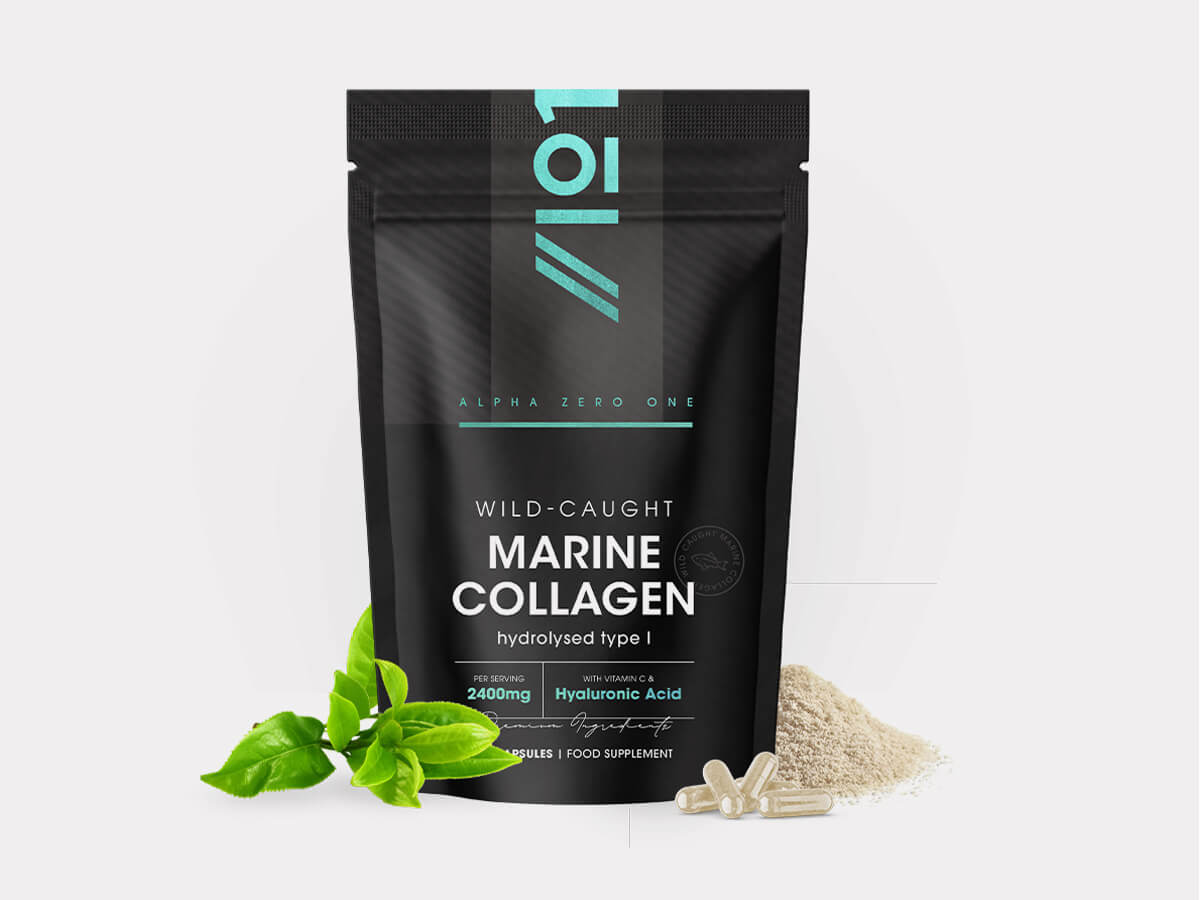
You have decided on marine collagen, but now face the final, often confusing, step: choosing between a powder, capsules or gummies. The challenge is that the labels can seem worlds apart, making a simple choice feel unnecessarily difficult. One pouch front says 2400mg, a tub declares 12g, and a jar states 99mg per serving [5]. These figures are not just different; they represent vastly different quantities of the core ingredient. To make a straightforward comparison, the 12g serving of powder contains more than five times the collagen found in the four-capsule serving [5]. Only the capsules add a full day’s vitamin C, and vitamin C contributes to normal collagen formation for the normal function of skin, to the normal function of the immune system and to the reduction of tiredness and fatigue [1]. This guide is here to decode those numbers.
Navigating the world of dietary supplements can feel complex. We will show you what each amount on the front means and which of our three formats suits your routine.
Marine collagen at a glance
- Capsules: four a day give 2,200mg of hydrolysed marine collagen with 120mg of hyaluronic acid and 80mg of vitamin C, which is 100% of the NRV [5].
- Powder: two scoops give 12g of hydrolysed fish collagen peptides and nothing else, with 10.8g of protein.
- Gummies: two give 99mg of collagen in a strawberry tapioca gummy.
- Price: capsules about 33p a day, powder about 76p a day, gummies about 33p a serving of two.
- All three are made from wild-caught fish.
- The claims: in the capsules, vitamin C contributes to normal collagen formation for the normal function of skin; in the powder, protein contributes to the maintenance of muscle mass [1].
MARINE COLLAGEN 2400MG · 180 CAPSULES
£14.99 · 45 servings · 4 capsules daily with water · marine collagen 2,200mg · hyaluronic acid 120mg · vitamin C 80mg · about 33p a day
SHOP NOW
Marine collagen powder, capsules or gummies: which is right for you?
Two simple questions settle it. First, how much collagen do you want in a day? Second, which format will you still be taking, day in, day out, a month from now?
Marine collagen capsules: collagen with vitamin C and hyaluronic acid
Want the format with the most authorised claims behind it? Our Marine Collagen capsules pair 2,200mg of collagen with 80mg of vitamin C, and that vitamin C carries fourteen authorised sentences, all listed below [1]. Among them, vitamin C contributes to normal collagen formation for the normal function of bones and cartilage and of teeth and gums [1].
The serving is four capsules a day, an easy fit for your daily wellbeing routine, so the 180 pouch lasts 45 days at about 33p a day. The 90 pouch lasts 22 days if you’d rather try it first.
Marine collagen powder: 12g in a serving, about 6p a gram
Want grams, not milligrams? If your first question is about the amount of collagen, the powder is the clear answer: our Marine Collagen Powder gives 12g of collagen peptides in two scoops, more than five times what the capsules give, for about 76p a day.
It’s one ingredient, unflavoured, and the front of the tub says it mixes into hot or cold drinks. Each serving gives 10.8g of protein, so it carries the protein claims: Protein contributes to the maintenance of muscle mass [1]. You’ll also find it in our protein and performance range and in our sport and fitness range.
MARINE COLLAGEN POWDER · TYPES I AND III · 400G
£24.99 · 33 servings · 1 to 2 scoops once a day · 12g of hydrolysed fish collagen peptides · unflavoured · about 76p a day
SHOP NOW
Marine collagen gummies: wild-caught collagen in a strawberry chew
Just want something easy? Two Marine Collagen Gummies give 99mg of wild-caught marine collagen in a strawberry chew from our gummies range, set with citrus pectin. The 60 gummies give you 30 servings of two for £9.99, about 33p a serving.
Choose them if you’d enjoy a strawberry chew every day, with no capsules to swallow and nothing to mix.
Marine collagen or bovine collagen: our other collagen supplements
Not set on fish? Our Bovine Collagen Powder gives 20g of collagen from grass-fed cattle in a 20g serving, and our bone broth protein powder gives 18g of protein from hydrolysed bovine gelatin in the same 20g [5]. Both are a source of protein, so the protein sentences listed below belong to them too [1].
Want several sources in one product? Our multi collagen capsules give 2,200mg of collagen from bovine, marine, eggshell and avian sources with 80mg of vitamin C and 50µg of biotin, and the multi collagen powder gives 20g of collagen in two scoops [5]. Our multi collagen guide sets the two side by side.
Our three marine collagen formats sit in our marine collagen range, part of our wider collagen and protein range and our beauty range.
Collagen with vitamin C: what the NHS says about the vitamin
The claims on our capsules belong to the vitamin C inside them, 80mg in every four capsules [5]. Vitamin C contributes to normal collagen formation for the normal function of blood vessels and to the protection of cells from oxidative stress [1].
Your body can’t bank vitamin C. “Vitamin C cannot be stored in the body, so you need it in your diet every day.” [4] Adults need 40mg a day, and citrus fruit, peppers, strawberries, broccoli and potatoes all provide it [4].
Four capsules add 80mg to whatever is on your plate, 100% of the NRV [5].
“Vitamin C contributes to normal collagen formation for the normal function of skin.”
Great Britain Nutrition and Health Claims Register, authorised claim [1]
Marine collagen 2400mg on the label: what the number includes
You might have spotted the 2400mg on the front of the capsule pouch and wondered what it includes. It’s the combined total of three ingredients in every serving. Turn the pouch over and the panel splits it three ways: 2,200mg of marine collagen, 120mg of hyaluronic acid and 80mg of vitamin C.
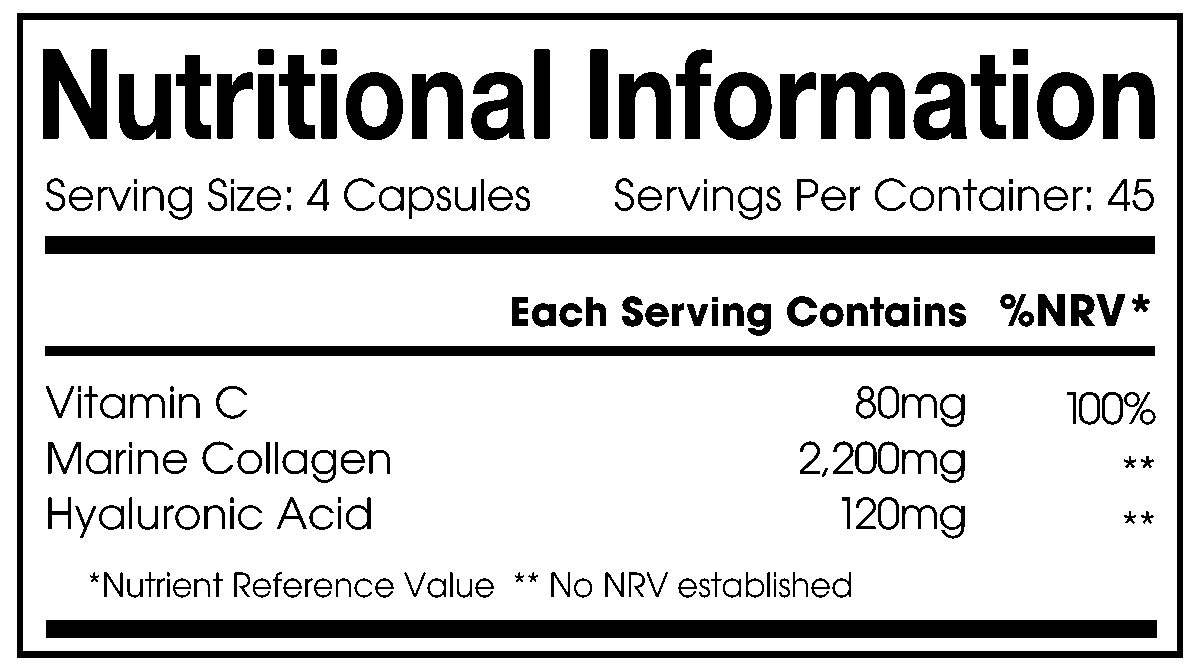
2,200mg collagen + 120mg hyaluronic acid + 80mg vitamin C = the 2400mg on the front · 2,200mg ÷ 4 = 550mg of collagen in each capsule · 180 capsules ÷ 4 = 45 days · £14.99 ÷ 45 = about 33p a day.
Marine Collagen 2400mg, 180 Capsules, nutrition panel [5]
So the collagen itself is 2,200mg, or 550mg in each capsule. The hyaluronic acid has its own line on the panel too, 120mg in every serving, so you can see exactly how much of it you take.
The powder label is simpler: one ingredient, 12g a serving, 10.8g of it protein. The gummy label shows 99mg of wild-caught marine collagen in two strawberry gummies.
Marine collagen powder vs capsules vs gummies: how they compare
The table puts our three labels side by side: what each declares, and who it suits. Prices are correct at the time of writing.
4 capsules · marine collagen 2,200mg, hydrolysed type I · hyaluronic acid 120mg · vitamin C 80mg, 100% NRV · hypromellose shell
Choose if you want collagen with vitamin C and its authorised claims · 45 days · £14.99: about 33p a day, about 15p per gram of collagen · also in a 90 pouch, 22 days, £8.99
2 scoops, 12g · hydrolysed fish collagen peptides and nothing else · protein 10.8g · unflavoured · mixes into hot or cold drinks
Choose if you want grams of collagen a day at the lowest price per gram · 33 servings · £24.99: about 76p a day, about 6p per gram · also in a 200g tub, about 17 servings, £14.99
2 gummies · marine collagen 99mg · citrus pectin and tapioca gummy with cane sugar · strawberry flavour · no vitamin C
Choose if a strawberry chew fits your day better than a capsule or a drink · 30 servings of two · £9.99: about 33p a serving, about £3.36 per gram
How to compare marine collagen supplements
Find the collagen in a daily serving, check that the label says hydrolysed and wild-caught, and look for vitamin C or protein on the panel, because that’s where the authorised claims come from. All three of ours say hydrolysed and wild-caught on the front. The capsules add vitamin C, and the powder gives you protein [5].
What is hydrolysed marine collagen, and what do types I and III mean?
Ever wondered what collagen actually is? It’s the structural protein of animal tissue: skin, bone, tendon, cartilage [2]. Marine collagen is just a straightforward way of saying it comes from fish, and you’ll see wild-caught on all our labels.
Hydrolysed means the long collagen chains have been broken down by enzymes into short pieces called peptides, which is why the powder dissolves in a drink [3].
The Roman numerals are family names. Type I is the main collagen of skin and bone, and type III sits alongside it in skin [2]. Our capsule pouch says type I, and our tub says types I and III.
Marine collagen benefits: the claims UK rules authorise
In the UK a supplement can carry only the claims authorised on the Great Britain Nutrition and Health Claims Register [1]. The claims for our marine collagen come from two nutrients on the labels: the vitamin C in the capsules and the protein in the powder.
Every health claim on the Great Britain register passed a scientific review: independent scientists examined the research and the evidence behind it before it was authorised [1]. The law itself says that health claims shall be “based on and substantiated by generally accepted scientific evidence” [6].

Collagen with vitamin C: the claims the capsules can carry
Four capsules give 80mg of vitamin C, 100% of the NRV, and these fourteen sentences belong to it, word for word [1]:
- Vitamin C contributes to normal collagen formation for the normal function of skin.
- Vitamin C contributes to normal collagen formation for the normal function of bones.
- Vitamin C contributes to normal collagen formation for the normal function of cartilage.
- Vitamin C contributes to normal collagen formation for the normal function of gums.
- Vitamin C contributes to normal collagen formation for the normal function of teeth.
- Vitamin C contributes to normal collagen formation for the normal function of blood vessels.
- Vitamin C contributes to the protection of cells from oxidative stress.
- Vitamin C contributes to the normal function of the immune system.
- Vitamin C contributes to the reduction of tiredness and fatigue.
- Vitamin C contributes to normal energy-yielding metabolism.
- Vitamin C contributes to normal psychological function.
- Vitamin C contributes to normal functioning of the nervous system.
- Vitamin C contributes to the regeneration of the reduced form of vitamin E.
- Vitamin C increases iron absorption.
Marine collagen powder: the protein claims
Two scoops give 10.8g of protein and the powder is 90% protein, so these belong to it, and to our bovine and bone broth powders too [1]:
- Protein contributes to the maintenance of muscle mass.
- Protein contributes to a growth in muscle mass.
- Protein contributes to the maintenance of normal bones.
How to take marine collagen: capsules, powder and gummies
Here’s how you’d take each one. For the capsules, the label says four daily with water. For the powder it’s one to two scoops in 200 to 300ml of liquid, once a day, and for the gummies it’s one to two, twice daily.
Store all three in a cool, dry place, and don’t use a pack if the safety seal is missing or damaged.
Marine collagen with hyaluronic acid and vitamin C
If the capsules sound right for you, the 180 pouch covers 45 days, with a full day’s reference amount of vitamin C in every serving, at about 33p a day.
SHOP MARINE COLLAGEN CAPSULES
Marine collagen FAQs
1. What are the benefits of marine collagen?
UK rules authorise no claim for collagen itself, so the benefits come from the nutrients on our labels [1]. In the capsules, vitamin C contributes to normal collagen formation for the normal function of skin, bones and cartilage and to the normal function of the immune system, among fourteen sentences listed above. In the powder, protein contributes to the maintenance of muscle mass and of normal bones.
2. How much marine collagen should I take a day?
There’s no NRV for collagen, which is why the panels show two asterisks beside it. Our labels set the serving: 2,200mg in four capsules, 12g in two scoops of powder, or 99mg in two gummies. The four capsules also give 80mg of vitamin C, and the NHS says taking less than 1,000mg of vitamin C supplements a day is unlikely to cause any harm [4].
3. Is marine collagen different from bovine collagen?
They come from different animals: marine from fish, bovine from cattle. Both are hydrolysed into peptides, and our marine and bovine powders are both a source of protein, so the choice comes down to the source that suits your diet [5].
4. Do marine collagen gummies contain vitamin C?
No, the gummy panel lists collagen only. If you want vitamin C with your collagen, the capsules give 80mg in four, 100% of the NRV.
5. Can I put marine collagen powder in coffee or tea?
Yes. The front of the tub says it mixes into hot or cold drinks, and it’s unflavoured. The label suggests 200 to 300ml of liquid.
6. Are marine collagen capsules suitable for vegetarians?
The collagen comes from wild-caught fish, in a plant-derived hypromellose shell, so the capsules suit you if fish is part of your diet. All three of our formats are made from fish, so they are not for anyone with a fish allergy. The capsule label also says they are not intended for children [5].
If you avoid fish, our vegan collagen alternative is made without collagen, but one capsule gives 80mg of vitamin C, as four marine capsules do, so the fourteen vitamin C sentences above belong to it too, alongside biotin, zinc and copper [5]. It also contains vitamin A, and its label says it is not intended for pregnant or breastfeeding women.
7. Why does the marine collagen capsules pouch say 2400mg?
Because it adds up three ingredients: 2,200mg of collagen, 120mg of hyaluronic acid and 80mg of vitamin C. The collagen alone is 2,200mg.
8. How long does a tub of marine collagen powder last?
The 400g tub holds 33 servings of 12g, so about a month at the full serving. The 200g tub holds about 17.
It comes down to your priority: for collagen with vitamin C and its authorised claims, choose the Marine Collagen capsules, and for grams of collagen at about 6p a gram, choose the Marine Collagen Powder. If you’d prefer a strawberry chew, the Marine Collagen Gummies give 99mg of wild-caught collagen in two, with 30 servings for £9.99, and whichever you pick, you now know what each number on the front means.
References
Checked against the product labels and the GB Nutrition and Health Claims Register, September 2026.
[1] Department of Health and Social Care. Great Britain nutrition and health claims (NHC) register, GOV.UK (vitamin C and protein entries and their conditions of use; collagen, collagen hydrolysate and hyaluronic acid entries non-authorised). Accessed 2026-09-19. View Source
[2] Gelse K, Pöschl E, Aigner T. (2003). Collagens: structure, function, and biosynthesis. Advanced Drug Delivery Reviews, 55(12):1531-46 (cited for what collagen is and where types I and III occur in tissue only). PubMed. View Source
[3] León-López A, et al. (2019). Hydrolyzed Collagen: Sources and Applications. Molecules, 24(22):4031 (cited for what hydrolysed collagen is only). PMC. View Source
[4] Vitamins and minerals: Vitamin C – NHS. Accessed 2026-09-19. View Source
[5] Alpha01. Marine Collagen 2400mg capsules (180 and 90), Marine Collagen Powder (400g and 200g) and Marine Collagen 99mg Gummies: nutritional information panels, ingredients, suggested use, storage, caution and prices; for comparison, the Bovine Collagen Powder, Bone Broth Protein Powder, Multi Collagen Complex capsules and powder and Vegan Collagen Support panels and ingredients. Accessed 2026-09-25. View Source
[6] Regulation (EC) No 1924/2006 on nutrition and health claims made on foods, Article 6: scientific substantiation for claims, as it applies in Great Britain. legislation.gov.uk. Accessed 2026-09-25. View Source


