THE ALPHA01 GUIDE PAPAYA LEAF
Papaya
Leaf Extract: What 12,000mg Means in Two Capsules
One tropical leaf. A 12:1 extract.
A clearer look at the numbers on the pouch.
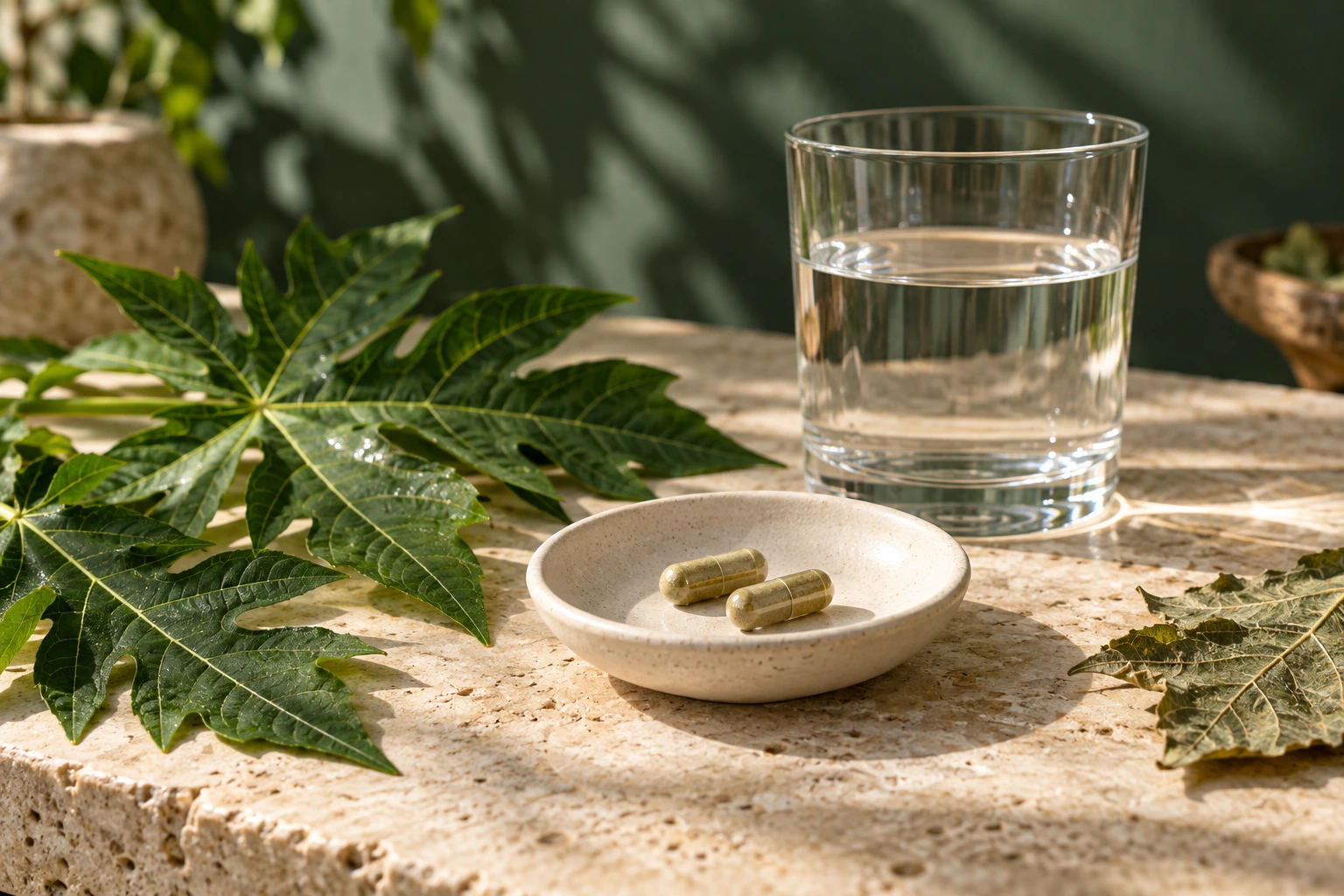
Papaya is a shrub that behaves like a tree. Carica papaya comes from Central America and southern Mexico, the region botanists call the Mesoamerican centre, and it is grown today across the tropics, from Brazil to India and the Philippines 2. It belongs to a small family, the Caricaceae, and answers to three names, papaya, pawpaw and kates 2. The world grows it for the sweet orange fruit, but the plant is used almost whole: seeds, leaves, roots, flowers, bark and the milky latex that runs when the fruit is cut 2. The leaf holds papain, the enzyme named after the plant, among other compounds 2.
Our pouch holds that leaf as an extract, and the numbers on it need a moment: 12,000mg per serving on the front, and from 12:1 extract on the panel, for two capsules that do not weigh twelve grams 3. This guide explains what a 12:1 extract is, what the leaf holds, how a capsule differs from the juice and the tea people ask about, and what two a day cost, so you know exactly what you are bringing into your daily routine.
Papaya leaf extract at a glance
- What it is: 1,000mg of organic papaya leaf extract in two capsules, from a 12:1 ratio, declared as a 12,000mg leaf equivalent; Carica papaya.
- Ingredients: organic papaya leaf 12:1 extract, a hypromellose capsule shell and organic brown rice flour, nothing else.
- How to take it: two capsules a day with water.
- Format: a vegan capsule; the pouch carries the EU organic leaf logo with non-EU agriculture printed under it.
- Price: £9.99 for 90 capsules, 45 days at about 22p a day.
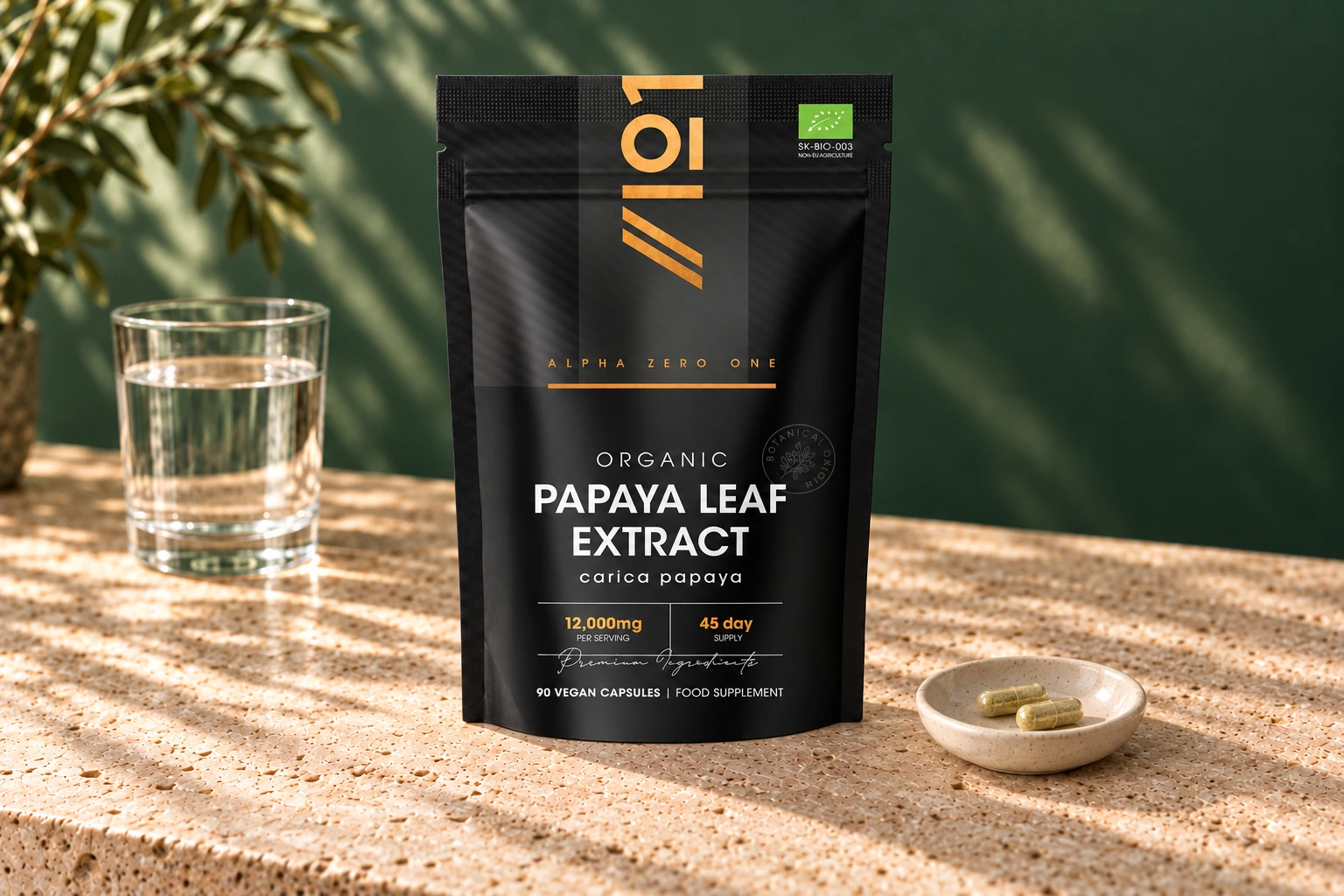
ORGANIC PAPAYA LEAF · A 12:1 EXTRACT
Organic Papaya Leaf Extract
£9.99 · 45 servings · 2 capsules a day with water · organic papaya leaf 12,000mg from a 12:1 extract, 1,000mg of extract in two capsules · vegan hypromellose capsule · about 22p a day
01 / MEET THE PLANT
What is papaya? A shrub from Central America grown across the tropics
The word shrub surprises people, because Carica papaya grows tall and fast enough that most call it a tree. The tropical and subtropical belt grows it, and one review names Brazil, Australia, Malaysia, China, India, Thailand, Myanmar and the Philippines among the main producers 2.
Carica papaya: the fruit, the leaf and the latex
Cut an unripe fruit and a milky latex runs out, and that latex is where papain, the enzyme named after the plant, was first taken from. Our Papain Enzyme capsules hold the enzyme itself, 250mg in each capsule, and you can read all about it in our papain guide 3. Here, though, we’ll stay with the leaf.
Papaya leaf: papain and what else the leaf holds
The leaf’s main constituents, as one review lists them, are papain, cystatin, chymopapain, tocopherol, phenolic acids, glucosinolates and vitamin C 2. Our panel declares the leaf itself, 12,000mg from a 12:1 extract in two capsules, rather than any one of these compounds 3.
02 / READ THE LABEL
Papaya leaf extract on the label: 12,000mg from a 12:1 extract
The panel has one line: organic papaya leaf 12,000mg, with from 12:1 extract underneath and two asterisks that mean no NRV established 3. That figure is the leaf equivalent, not the weight of the capsules.
Nutritional Information
Serving Size: 2 Capsules
Servings Per Container: 45
| Ingredient | Amount per Serving | %NRV* |
|---|---|---|
| Organic Papaya Leaf (from 12:1 extract) | 12,000mg | ** |
*Nutrient Reference Value
** No NRV established
per pouch
Organic Papaya Leaf Extract, nutrition panel and price 3
What a 12:1 extract means: 1,000mg in two capsules
A 12:1 extract means that 12 parts of leaf were reduced to 1 part of extract. So 12,000mg of leaf equivalent is 1,000mg of extract in two capsules, 500mg in each, and 90 capsules hold 45g of extract 3. The other two ingredients are the hypromellose shell and organic brown rice flour, which fills the space the extract does not.
When you compare papaya leaf supplements, look at the ratio alongside the leaf-equivalent figure. Together they give you the weight of extract, which for ours is 1,000mg of a 12:1 extract in two capsules 3.
Organic papaya leaf: the logo, the code and non-EU agriculture
The green leaf on the front is the EU organic logo, with the certifier’s code SK-BIO-003 beneath it and the words non-EU agriculture, so the leaf was grown outside the EU under organic rules 3. The seal beside the name reads botanical origin, which tells you the ingredient comes from a plant. These certified organic capsules belong to our organic range.
03 / FIND YOUR FORMAT
Papaya leaf capsules, papaya leaf juice or papaya leaf tea: which is right for you?
You can take the same leaf in three forms, and when you make the juice or the tea at home, only the capsule comes with a label.
JUICE OR TEA AT HOME
Papaya leaf juice and papaya leaf tea at home: fresh leaf, no panel
When making your own papaya leaf juice or tea, you’re either pressing the fresh leaf or steeping it in hot water. Because these don’t come with a nutrition panel, you have no clear figure to go by for a daily amount.
THE LABELLED EXTRACT
Papaya leaf capsules: 1,000mg of a 12:1 extract, two a day
If you want the leaf with a figure you can read and repeat, our Organic Papaya Leaf Extract capsules give you 1,000mg of a 12:1 extract in two capsules, declared on the panel as 12,000mg of leaf 3. They’re organic, vegan and unflavoured, and one pouch lasts 45 days at about 22p a day, a simple way to take a measured amount each day.
The capsules are part of our herbal supplements range and our wider collection of herbs.
04 / KEEP IT SIMPLE
How to take papaya leaf capsules
A simple daily serving
The directions are simple: take two capsules daily with water 3. Since no particular time is suggested, a good way to remember is to keep the pouch by a meal you never skip, making it an easy part of your daily wellbeing routine.
A SIMPLE DAILY ROUTINE
A simpler way to take papaya leaf
If two capsules a day is easier than pressing leaves, a pouch of 90 covers 45 days for £9.99, about 22p a day.
SHOP ORGANIC PAPAYA LEAF EXTRACT05 / A LITTLE MORE CLARITY
Papaya leaf extract FAQs
What is papaya leaf extract good for?
No health claim is authorised for papaya leaf or papain on the Great Britain register, so we make none 1. What the label promises is 1,000mg of organic papaya leaf extract, declared as 12,000mg of leaf equivalent, in two vegan capsules a day.
What does 12,000mg from a 12:1 extract mean?
It is the leaf equivalent of a 12:1 extract, so two capsules hold 1,000mg of extract, 500mg each 3. The 12,000mg tells you how much leaf went in, not how much powder is in the capsules.
Is papaya leaf extract the same as papaya leaf juice?
No, they are two different things. Juice you press from fresh leaves at home has no label to check. The extract is the leaf reduced 12 times into a powder, declared in milligrams on a label you can compare 3.
Are papaya leaf tablets and capsules the same?
Ours are capsules, with the extract powder held in a plant-based hypromellose shell 3. Whichever form you compare, check the extract ratio: two of our capsules give you 1,000mg of a 12:1 extract, the equivalent of 12,000mg of papaya leaf.
Does papaya leaf extract contain papain?
The papaya leaf is known to hold papain 2. Our label gives you the amount of leaf, 12,000mg from a 12:1 extract in two capsules, rather than a figure for the papain itself 3. If you’re curious about the enzyme, we cover it in our papain guide.
Are papaya leaf capsules vegan?
Can I take papaya leaf every day?
Yes. The label gives a daily amount of two capsules, so it is made for daily use; just don’t take more than the label says 3. The label also says it is not intended for children, or for pregnant or breastfeeding women, and asks you to consult a doctor before use if you have a medical condition or are taking any medications.
How much does organic papaya leaf extract cost a day?
About 22p. A pouch of 90 capsules is £9.99, and two capsules are a day’s serving 3.
THE BOTTOM LINE
So, papaya leaf capsules, juice or tea?
If you want to take papaya leaf with a clear figure on the label, take the Organic Papaya Leaf Extract capsules, two a day, and read the panel as this guide has shown: 1,000mg of a 12:1 extract, declared as 12,000mg. Juice and tea made at home are the same leaf without a label, and the capsule is the form that tells you exactly how much you take.
GO TO THE SOURCE
Sources & references
Checked against the product label, the GB Nutrition and Health Claims Register and the published review cited below, September 2026.
- Department of Health and Social Care. Great Britain nutrition and health claims (NHC) register, GOV.UK (papaya and papain: non-authorised entries only). Accessed 2026-09-24. View source
- Sharma Y, Sharma MK, Sharma J, et al. Carica papaya L. Leaves: Deciphering Its Antioxidant Bioactives, Biological Activities, Innovative Products, and Safety Aspects. Oxidative Medicine and Cellular Longevity. 2022;2022:2451733 (cited only for the plant, its origin, the parts of it that are used and the leaf’s constituents; its health statements are not used). View source
- Alpha01. Organic Papaya Leaf 12,000mg 90 Capsules: pouch front, nutrition information panel, ingredients, suggested use, caution and price; Papain Enzyme 250mg 60 Capsules: nutrition information panel. Label maths by the author. Accessed 2026-09-28. View source