The pomegranate is the seeded apple. Its name comes from pomum, apple, and granatus, grainy, and when Linnaeus named the species he kept the idea in the word granatum, which means granular [2] [3]. Before that it was Malum punicum, the apple of Carthage, though the fruit is older than Carthage: it is native to a stretch of land from part of Iran to northern India [3]. It has one relative, the Socotran pomegranate, which grows only on the Socotra islands off the Horn of Africa and is thought to be its ancestor [3]. The rest is familiar: a deciduous shrub, a leathery skin, and inside it the juicy seeds, the arils, that stain your fingers [2].
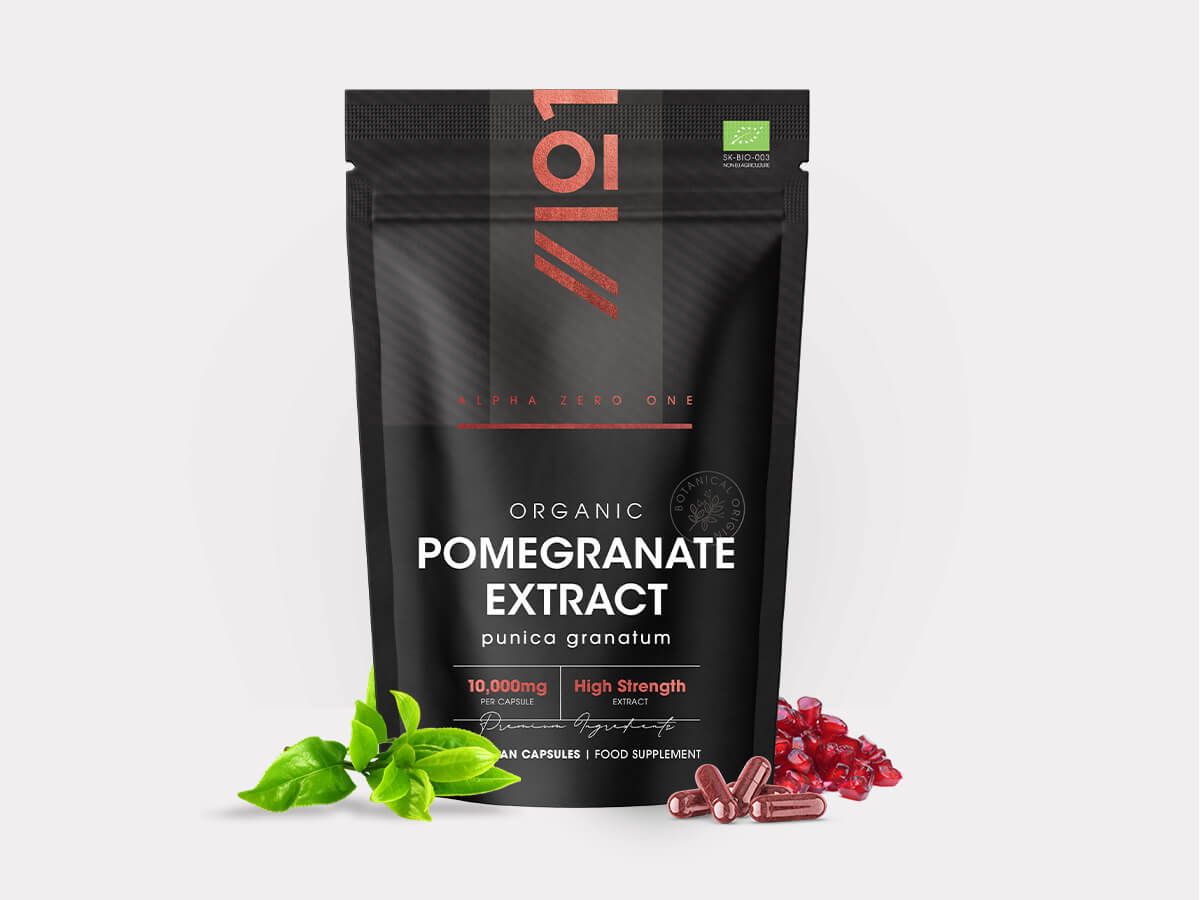
Our pouch puts the fruit in a capsule and prints two numbers worth knowing: 10,000mg per capsule on the front, and from 40:1 extract on the panel, for a capsule that does not weigh ten grams [4]. This guide explains what a 40:1 extract is, who one capsule a day suits and what it costs, so you know exactly what you are bringing into your daily routine.
Pomegranate capsules at a glance
- What it is: organic pomegranate, Punica granatum, at 10,000mg per capsule from 250mg of a 40:1 extract.
- Who it suits: adults who want organic pomegranate as one capsule a day, with nothing to prepare.
- Ingredients: organic pomegranate 40:1 extract, organic brown rice flour and a hypromellose capsule shell, nothing else.
- How to take it: one capsule a day with water.
- Format: a vegan hypromellose capsule, certified organic under the EU organic logo.
- Price: £8.99 for 120 capsules, 120 days at about 7.5p a day.
ORGANIC POMEGRANATE CAPSULES · 10,000MG · 120 CAPSULES
£8.99 · 120 capsules · 1 capsule a day with water · organic pomegranate 10,000mg from a 40:1 extract, 250mg of extract in the capsule · vegan hypromellose capsule · about 7.5p a day
SHOP NOW
What is pomegranate? The seeded apple from Iran to northern India
Punica granatum is a deciduous shrub, and its fruit is unusual: numerous seeds, the arils, packed inside a leathery skin [2]. It is native to the region from part of Iran to northern India, and the wild types run from Iran, Afghanistan and Turkmenistan to northern India, which botanists treat as its centre of origin [3].
Punica granatum and its only relative
The genus Punica holds two species and no more [3]. The other is Punica protopunica, the Socotran pomegranate, found only on the Socotra archipelago off the Horn of Africa and considered the ancestor of the fruit we eat, and molecular studies now place both in the Lythraceae family [3].
Pomegranate fruit: from Egypt and Greece to the world’s largest grower
The fruit was cultivated early in Egypt, Greece, Italy and Iraq, and later across Turkey, Afghanistan, Iran, India and China [2]. From there it reached the Mediterranean, East Asia, America and South Africa [3]. Today India has the largest area under pomegranate, and Iran is the largest exporter, with India next [2].
Pomegranate capsules on the label: 10,000mg from a 40:1 extract
The panel has one line: organic pomegranate 10,000mg, with from 40:1 extract underneath and two asterisks that mean no NRV established [4]. That figure is the fruit equivalent, not the weight of the capsule.
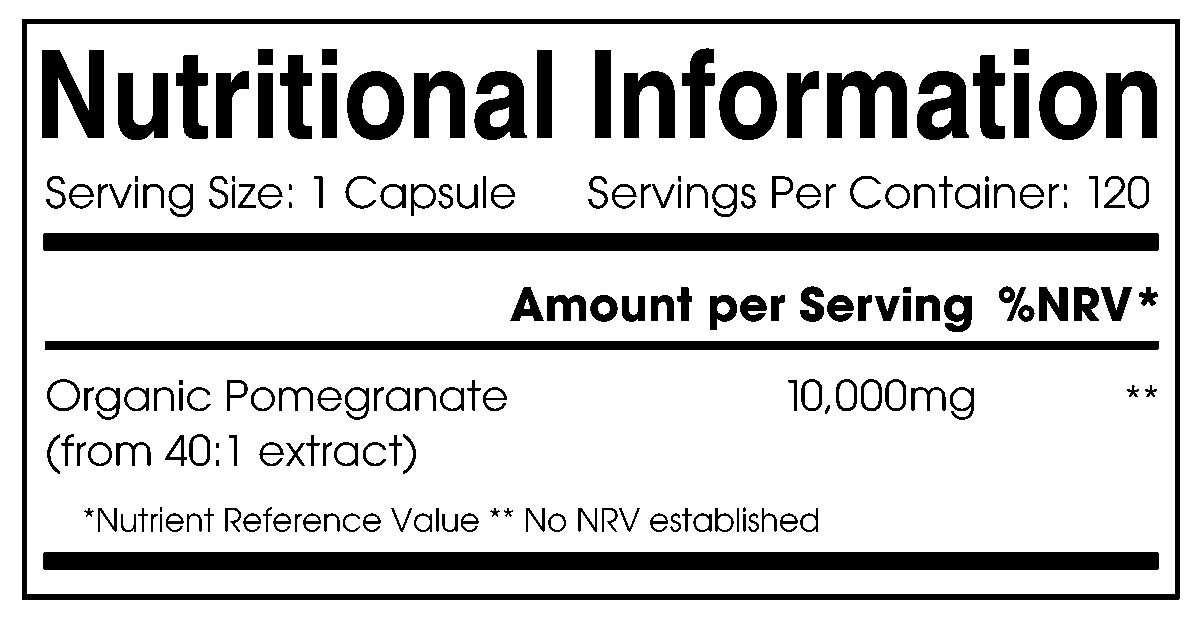
10,000mg ÷ 40 = 250mg of extract in each capsule · 250mg × 120 = 30g of extract in the pouch · £8.99 ÷ 120 = about 7.5p a day.
Organic Pomegranate Capsules, nutrition panel and price [4]
What a 40:1 extract means: 250mg in the capsule
A 40:1 extract means that 40 parts of fruit were reduced to 1 part of extract. So 10,000mg of fruit equivalent is 250mg of extract in the capsule, and the 120 capsules in the pouch hold 30g of extract between them [4]. The two other ingredients are organic brown rice flour, which fills the space the extract does not, and the hypromellose shell.
Organic pomegranate: the EU organic logo and its code
On the front of the pouch you’ll see the green leaf of the EU organic logo, with the certifier’s code SK-BIO-003 beneath it and the words non-EU agriculture, so the fruit was grown outside the EU under organic rules [4]. The seal beside the name reads botanical origin, which tells you that the ingredient came from a plant.
Pomegranate supplement: who one capsule a day suits
Whether you want convenience, a plant-based label or a routine that costs little, the habit is the same: one capsule a day.
Pomegranate pills for a busy day: nothing to prepare
Love the fruit but rarely have time to open one? Each of our Organic Pomegranate Capsules holds 250mg of the extract, so there are no arils to pick out and nothing to pour: one capsule with water, and your daily serving is done [4].
Vegan pomegranate capsules, certified organic
Prefer organic and plant-based? The extract is certified organic and the shell is hypromellose, so the capsules belong to both our organic and vegan ranges [4]. You’ll also find them among our herbal supplements and in our full list of herbs.
Pomegranate extract for about 7.5p a day
Want a routine that is easy to keep up? A pouch of 120 capsules is £8.99, so one capsule a day works out at about 7.5p [4].
For other fruits sold as an extract on a ratio, see our tart cherry extract guide and our blackcurrant guide.
How to take pomegranate capsules: one a day with water
The directions are one line: take one capsule daily with water [4]. The label does not give a time of day, so keep the pouch by a meal you never skip.
120 days of organic pomegranate extract
If one capsule a day is easier than preparing the fruit, one pouch covers four months for £8.99, about 7.5p a day.
SHOP ORGANIC POMEGRANATE CAPSULES
Pomegranate capsules FAQs
1. What are pomegranate capsules good for?
No health claim is authorised for pomegranate on the Great Britain register, so we make none [1]. What you get is organic pomegranate at 10,000mg per capsule, from 250mg of a 40:1 extract, in one vegan capsule a day [4].
2. What does 10,000mg mean on pomegranate capsules?
It is the fruit equivalent of a 40:1 extract, so the capsule itself holds 250mg of extract [4]. The 10,000mg tells you how much fruit went in, not how much powder is in your hand.
3. Is a pomegranate extract the same as pomegranate juice?
No. Juice is the pressed fruit, while the extract is the fruit reduced 40 times into a powder, and each capsule holds 250mg of it [4].
4. Are pomegranate capsules vegan?
Yes. The shell is hypromellose, a plant-derived cellulose, the filler is brown rice flour, and the pouch front says vegan capsules [4].
5. Can I take pomegranate every day?
Yes. The label gives a daily amount of one capsule, so it is made for daily use; just don’t take more than the label says [4]. The label also says it is not intended for children, or for pregnant or breastfeeding women, and asks you to check with a doctor first if you have a medical condition or take medication.
6. Pomegranate tablets or capsules: is there a difference?
The form matters less than what is inside it: the extract weight and the ratio. Ours are capsules, and each one holds 250mg of a 40:1 extract in a plant-based hypromellose shell [4].
7. How much do pomegranate capsules cost a day?
About 7.5p. A pouch of 120 capsules is £8.99, and one capsule is a day’s serving [4].
If you want the seeded apple in an organic, vegan capsule, one a day, take the Organic Pomegranate Capsules: 10,000mg of pomegranate from a 40:1 extract in every capsule, at about 7.5p a day.
References
Checked against the product label, the GB Nutrition and Health Claims Register and the published reviews cited below, September 2026.
[1] Department of Health and Social Care. Great Britain nutrition and health claims (NHC) register, GOV.UK (pomegranate: non-authorised entries only). Accessed 2026-09-24. View Source
[2] Mohan E, et al. Review of Pharmacological and Medicinal Uses of Punica granatum. Cureus. 2024;16(10):e71510 (cited only for the fruit’s names, description, cultivation and trade; its health statements are not used). View Source
[3] Guerrero-Solano JA, Jaramillo-Morales OA, Jiménez-Cabrera K, et al. Punica protopunica Balf., the Forgotten Sister of the Common Pomegranate (Punica granatum L.): Features and Medicinal Properties, A Review. Plants. 2020;9(9):1214 (cited only for the plant’s names, origin, relative, family and spread; its health statements are not used). View Source
[4] Alpha01. Organic Pomegranate Capsules 10,000mg 120 Capsules: pouch front, nutrition information panel, ingredients, suggested use, caution and price. Label maths by the author. Accessed 2026-09-28. View Source


