Two very different plants meet inside this capsule. The first is the Japanese pagoda tree, Styphnolobium japonicum, whose dried flower buds have long been gathered in Asia and are valued today as a source of the yellow plant pigment quercetin [2]. The second is the pineapple, Ananas comosus, and the part that matters is the one few people eat: the tough stem, which holds far more of the enzyme mixture called bromelain than the fruit does [3]. One ingredient is a pigment and the other is a set of working enzymes, which is why their amounts cannot even share a unit.
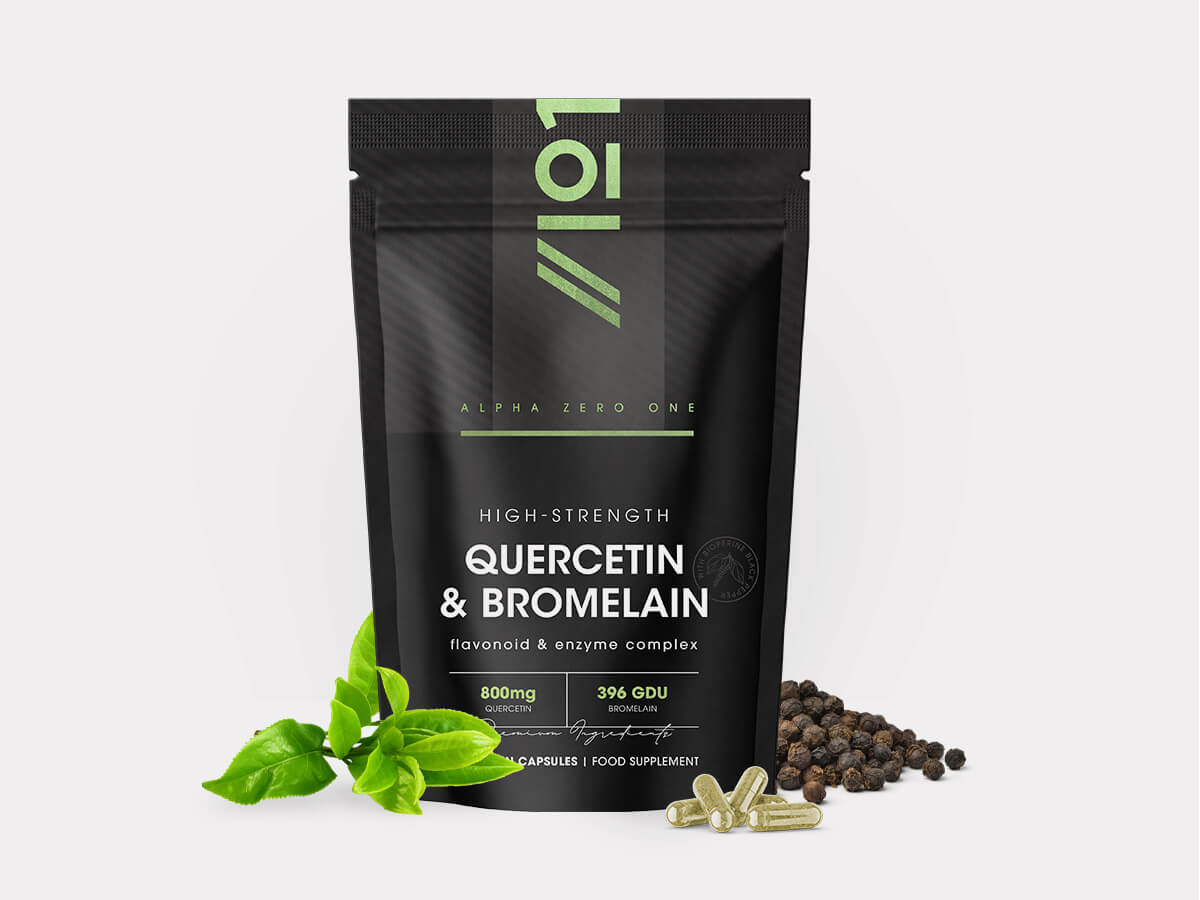
That difference lands on the label, where our pouch prints 800mg for one and 396 GDU for the other, and few people have ever met a GDU [1]. This guide explains where the two ingredients come from, how to read both numbers and which pouch fits your daily routine.
Quercetin and bromelain at a glance
- What it is: quercetin from pagoda tree flower buds and bromelain from pineapple, with a little black pepper extract.
- Two capsules: quercetin 800mg, bromelain 396 GDU and black pepper extract 5mg.
- The two units: mg is a weight, and GDU is a measure of enzyme activity.
- Format: a vegan hypromellose capsule with organic brown rice flour, taken with water.
- Who it suits: you, if you want quercetin and bromelain together, in two vegan capsules a day.
- Price: £12.99 for 120 capsules, 60 days at about 22p a day.
QUERCETIN & BROMELAIN COMPLEX · 120 VEGAN CAPSULES
£12.99 · 60 servings · 2 capsules daily with water · quercetin 800mg · bromelain 396 GDU · black pepper extract 5mg · about 22p a day
SHOP NOW
What is quercetin, and what is bromelain? The two plants behind the capsule
Quercetin is a flavonol, part of the flavonoid family of pigments that give plants their colour. You already eat a little of it in foods like onions, apples and capers. Bromelain is something else entirely: a mixture of protein-digesting enzymes that comes from the pineapple plant [3].
Quercetin from the pagoda tree: the flower bud, not the leaf
Our ingredients list names the source as Sophora japonica, the older scientific name for the Japanese pagoda tree. Its dried flower and flower bud are used in supplements as a source of flavonoids, including rutin and quercetin [2].
What is bromelain? An enzyme mixture from the pineapple stem
Pineapple is the leading edible member of the bromeliad family, grown across the tropics from the Philippines and Thailand to Kenya and India [3]. Chemists have known bromelain since 1875. It is concentrated in the stem [3].
To make the powder, producers cool the pineapple juice, spin and filter it, then freeze-dry it into a yellowish powder [3]. What they have at the end is not one substance but a family of enzymes, and that is why it is measured by what it does, not by what it weighs.
Quercetin 800mg and bromelain GDU: how to read the two numbers
The panel lists three lines for two capsules: quercetin 800mg, bromelain 396 GDU and black pepper extract 5mg. None has a daily reference value, so the panel prints two asterisks where a percentage would be.
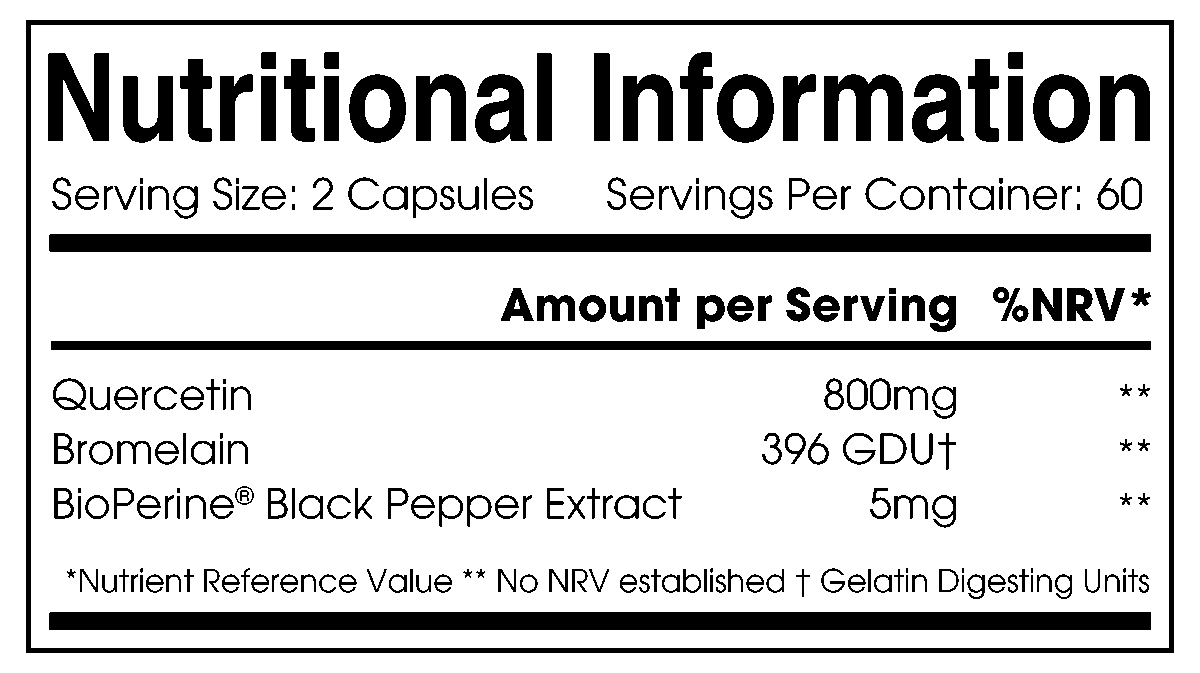
800mg ÷ 2 = 400mg of quercetin in each capsule · 396 GDU ÷ 2 = 198 GDU of bromelain in each capsule · a GDU measures enzyme activity, not weight · £12.99 ÷ 60 = about 22p a day · £8.99 ÷ 30 = about 30p a day.
Quercetin & Bromelain Complex, nutrition panel and prices [1]
The GDU on the label stands for gelatin digesting unit. An enzyme’s activity is tested against a standard substance, gelatin in this case [3]. So the 396 GDU on our label tells you how active the bromelain is, not how much it weighs [1].
Quercetin with bromelain and black pepper: one complex
The front calls the product a flavonoid and enzyme complex with BioPerine black pepper. BioPerine is the registered name of the black pepper extract on the panel. All three sit in the same two capsules, so your daily serving holds the whole complex [1].
Quercetin and bromelain 120 or 60 capsules: which is right for you?
Both pouches hold the same formula and the same two-capsule serving. The only differences are how long they last and what a day costs.
Quercetin capsules for two months: the 120 pouch
If the complex is already part of your routine, the 120 capsules last 60 days at about 22p a day.
Quercetin capsules to try first: the 60 pouch
If you would rather try a month before committing, the 60 capsules last 30 days at about 30p a day.
Here are the two labels side by side. Prices are correct at the time of writing.
2 capsules · quercetin 800mg · bromelain 396 GDU · black pepper extract 5mg · vegan capsule
Choose if you already know the complex suits your routine · 60 days · £12.99: about 22p a day
2 capsules · the same formula and the same serving · 30 servings
Choose if you want a month to try it first · 30 days · £8.99: about 30p a day
Vegan quercetin capsules in our specialty range
Whichever pouch you choose, the capsule is the same plant-based hypromellose shell, so both sit in our vegan range [1]. You’ll also find them among our specialty supplements and in our wider vitamins and supplements collection.
How to take quercetin and bromelain capsules
The label says two capsules daily with water, and it names no time of day. Take them when you will remember, and don’t exceed the daily amount.
Two plants, two numbers, a label you can read
Now that the two plants and the two numbers make sense, the 120 pouch is the simple way to start: two capsules a day for 60 days, at about 22p a day.
SHOP QUERCETIN & BROMELAIN
Quercetin and bromelain FAQs
1. What are the benefits of quercetin and bromelain?
No health claim is authorised for quercetin, bromelain or pineapple on the Great Britain register, so we make none [4]. What you get is 800mg of quercetin from the pagoda tree and 396 GDU of bromelain from pineapple, in two vegan capsules a day [1].
2. What is quercetin found in?
Quercetin is a plant pigment found in everyday foods such as onions, apples and capers. The quercetin in our capsules comes from the flower buds of the Japanese pagoda tree [1] [2].
3. What is bromelain made from?
It is made from the pineapple plant, and mostly from the stem, where it is concentrated [3]. The juice is cooled, filtered and freeze-dried into a powder of mixed enzymes.
4. What does bromelain GDU mean?
GDU stands for gelatin digesting units, a measure of how active the enzymes are [3]. Two of our capsules declare 396 GDU, which is 198 GDU in each.
5. Why take quercetin with bromelain?
Our label pairs them as a flavonoid and enzyme complex: two capsules give you both, 800mg of quercetin and 396 GDU of bromelain, with 5mg of black pepper extract [1].
6. Are quercetin and bromelain capsules vegan?
Yes. The shell is hypromellose, which is plant-derived, and the other ingredients are organic brown rice flour and black pepper extract.
7. Can I take quercetin supplements with my medication?
The label asks you to consult a doctor before use if you have a medical condition or take any medication [1].
8. Can I take quercetin and bromelain while pregnant?
The label says the product is not intended for pregnant or breastfeeding women, or for children [1].
If you already know the complex suits you, take the 120 capsules at about 22p a day. If you want a month to decide, start with the 60 capsules at about 30p. Either way, you now know what 800mg and 396 GDU are telling you.
References
Checked against the product labels, the GB Nutrition and Health Claims Register and the published reviews cited below, September 2026.
[1] Alpha01. Quercetin & Bromelain Complex (120 and 60 capsules): pouch front, nutritional information panel, ingredients, suggested use, caution and prices. Accessed 2026-09-28. View Source
[2] Madden E, McLachlan C, Oketch-Rabah H, Calderón AI. United States Pharmacopeia comprehensive safety review of Styphnolobium japonicum flower and flower bud. Phytotherapy Research. 2022;36(5):2061-2071. View Source
[3] Pavan R, Jain S, Shraddha, Kumar A. Properties and therapeutic application of bromelain: a review. Biotechnology Research International. 2012;2012:976203. View Source
[4] Department of Health and Social Care. Great Britain nutrition and health claims (NHC) register, GOV.UK (quercetin, bromelain and pineapple entries, all non-authorised). Accessed 2026-09-20. View Source


