Every bee in a hive starts life on the same food. For its first three days a larva is fed royal jelly, a yellowish-white, acidic secretion made in glands in the heads of the nurse bees [2]. Then the workers move on to other food, and one larva does not: the future queen is fed royal jelly all her life [2]. The jelly is mostly water, at 60 to 70%, with proteins, sugars and a few per cent of lipids, and the lipids are the odd part: 80 to 90% of the fatty acids have structures found almost nowhere else, and one, 10-HDA, is the yardstick for the product [2].
Our pouch puts that jelly into a softgel: 150mg of royal jelly in each one, providing 7.5mg of 10-HDA [4]. This guide explains what royal jelly is, what 10-HDA measures and what fills the softgel, so you know exactly what you are bringing into your daily routine.
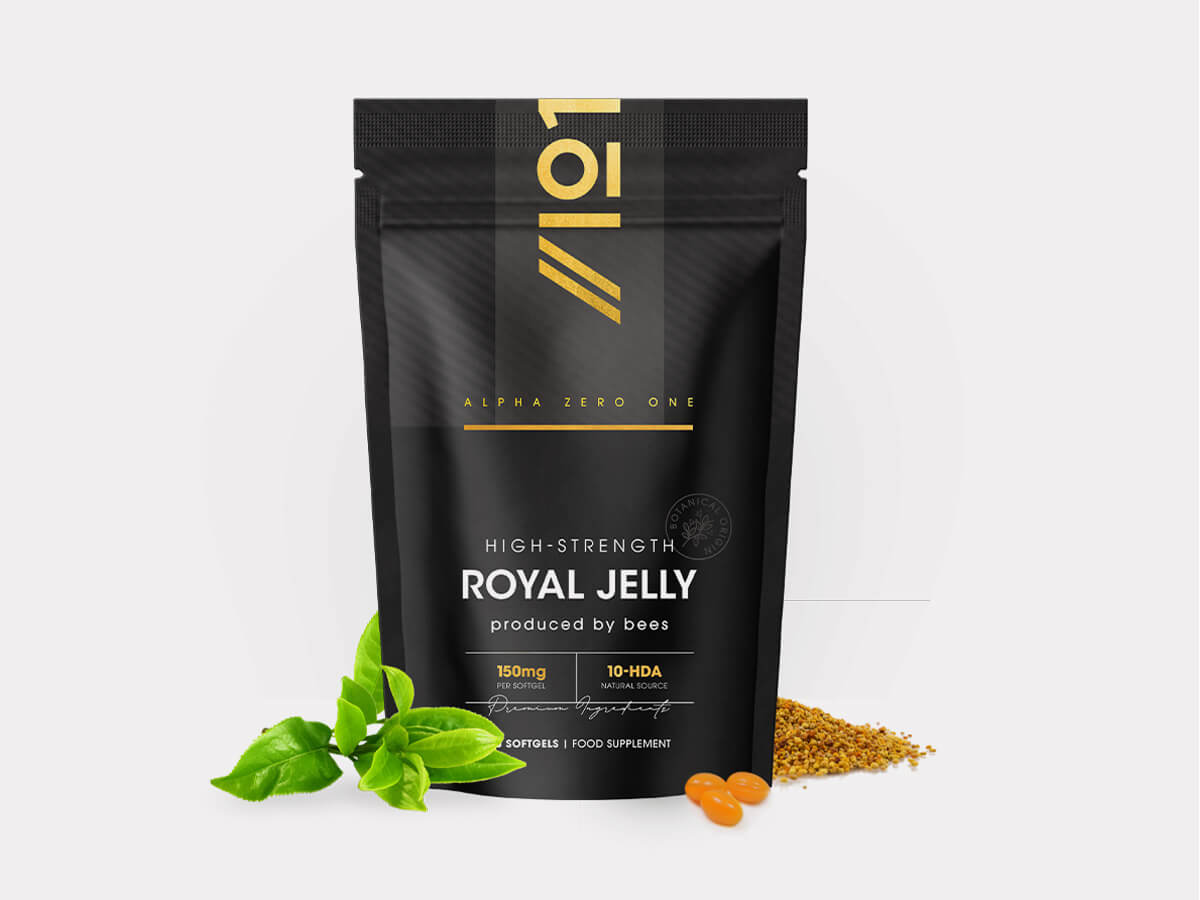
Royal jelly at a glance
- What it is: royal jelly, the secretion nurse bees feed to larvae and to the queen, 150mg in each softgel, providing 7.5mg of 10-HDA.
- The fill: royal jelly (5% 10-HDA) carried in C8 MCT oil, with beeswax as the emulsifier.
- How to take it: one softgel a day with water.
- Format: an oil-filled softgel in a bovine gelatin shell.
- Price: £7.99 for 60 softgels, 60 days at about 13p a day.
ROYAL JELLY · 150MG · 60 SOFTGELS
£7.99 · 60 servings · 1 softgel a day with water · royal jelly 150mg providing 7.5mg 10-HDA · MCT oil carrier, bovine gelatin shell · about 13p a day
SHOP NOW
What is in royal jelly? Water, proteins, sugars and the odd fats
Beside the water, the jelly holds proteins, sugars and lipids, with minerals, amino acids, vitamins and enzymes as minor components [2]. Proposed quality standards for royal jelly are built on four things: moisture, total proteins, sugars and 10-HDA [3].
Royal jelly and honey: two products from one hive
Honey is made from the nectar forager bees bring back to the hive, and it is stored in the comb. Royal jelly is made differently: it comes from the nurse bees’ own bodies and is fed directly to the young larvae and the queen [2].
10-HDA content: the fatty acid that sets the standard
Among the lipids, 10-HDA, 10-hydroxy-2-decenoic acid, is the stable one, and it makes up 3.5% of freeze-dried royal jelly, a figure treated as an international standard of quality [2].
Royal jelly 150mg on the label: 7.5mg of 10-HDA in an oil-filled softgel
The panel has one line: royal jelly 150mg, providing 7.5mg of 10-HDA, with two asterisks that mean no NRV established [4]. The ingredients list tells you what the rest of the softgel is.

150mg × 5% = 7.5mg of 10-HDA per softgel, the figure on the panel · 150mg × 60 = 9,000mg of royal jelly in the pouch · £7.99 ÷ 60 = about 13p a day.
Royal Jelly 150mg, nutrition panel and price [4]
What does 10-HDA mean on our panel? 5% of 150mg
The ingredients list reads royal jelly (5% 10-HDA), and 5% of 150mg is the 7.5mg on the panel [4].
Our label gives both figures: 150mg of royal jelly per serving and the 7.5mg of 10-HDA it provides [4]. A milligram figure on its own would say nothing about how much of the marker compound is inside, so read both when you compare.
Royal jelly with MCT oil: what fills the softgel
Each softgel’s filling is royal jelly in MCT oil, 99% C8 (caprylic acid), with beeswax as the emulsifier that holds the jelly in the oil [4]. The shell is bovine gelatin with glycerin and purified water. If you’re curious about C8, our C8 MCT oil guide explains it in more detail.
Royal jelly softgels or fresh royal jelly: which is right for you?
Royal jelly can reach you in two forms, and only one of them carries a nutrition panel.
Fresh royal jelly: a fridge, a spoon and no panel
Fresh royal jelly is sold chilled and taken by the spoon, and it comes without a nutrition panel of the supplement kind. It is the jelly as the bees make it, and it asks for a fridge and a routine.
Royal jelly softgels: 150mg with the 10-HDA declared, one a day
If you want a figure you can read and repeat, our Royal Jelly 150mg softgels declare 150mg of royal jelly providing 7.5mg of 10-HDA, one softgel a day, for 60 days at about 13p a day [4]. No fridge, no spoon.
You’ll find them in our specialty supplements range, part of our wider vitamins and supplements collection.
Royal jelly and bee propolis: a second product of the hive
Curious about another product of the hive? Alongside our royal jelly softgels, we offer bee propolis: the material honey bees make from plant resin to seal their home.
Our Bee Propolis Extract 4800mg gives you 4,800mg of propolis from a 4:1 extract, providing 108mg of flavonoids, in two capsules a day [5]. It costs about 14p a day in the 180-capsule pouch, or 20p in the 90-capsule pouch, and our propolis guide explains how the numbers on its label fit together.
How to take royal jelly softgels: one a day with water
The directions are one line: take one softgel daily with water [4]. The label does not give a time of day, so keep the pouch by a meal you never skip.
60 days of royal jelly
If one softgel a day is easier than a spoon from the fridge, a pouch of 60 covers two months for £7.99, about 13p a day.
SHOP ROYAL JELLY SOFTGELS
Royal jelly FAQs
1. What is royal jelly good for?
No health claim is authorised for royal jelly on the Great Britain register, so we make none [1]. What the label promises is 150mg of royal jelly providing 7.5mg of 10-HDA in one softgel a day.
2. What is 10-HDA in royal jelly?
A fatty acid, 10-hydroxy-2-decenoic acid, found among the unusual fats of royal jelly and used as its quality marker, at 3.5% of the freeze-dried product in the standard the review cites [2]. Our label declares 7.5mg of it per softgel [4].
3. Royal jelly and honey: are they the same?
No. Honey is made from nectar and stored in the comb; royal jelly is a secretion from the nurse bees’ own glands, fed straight to the larvae and the queen [2].
4. How much royal jelly is in one softgel?
150mg, providing 7.5mg of 10-HDA, in a softgel filled with MCT oil [4]. A pouch of 60 holds 9,000mg of royal jelly in total.
5. Are royal jelly softgels vegan or vegetarian?
The royal jelly is produced by bees, as the pouch front says, and the emulsifier is beeswax. The softgel shell is made from bovine gelatin, glycerin and purified water [4].
6. Can I take royal jelly every day?
Yes. The label gives a daily amount of one softgel, so it is made for daily use; just don’t take more than one a day [4].
7. Who should not take royal jelly?
The label says the product should not be taken by asthma or allergy sufferers, and that it is not intended for pregnant or breastfeeding women [4]. Anyone with a medical condition or on prescription medication is asked to consult a doctor before use.
8. How much does royal jelly cost a day?
About 13p. A pouch of 60 softgels is £7.99, and one softgel is a day’s serving [4].
If you want the queen’s food with a figure on the label, take the Royal Jelly 150mg softgels, one a day, and read the panel as this guide has shown: 150mg of royal jelly providing 7.5mg of 10-HDA, in an oil-filled softgel.
References
Checked against the product label, the GB Nutrition and Health Claims Register and the published papers cited below, September 2026.
[1] Department of Health and Social Care. Great Britain nutrition and health claims (NHC) register, GOV.UK (royal jelly: eleven entries, all non-authorised). Accessed 2026-09-24. View Source
[2] Ahmad S, Campos MG, Fratini F, et al. New Insights into the Biological and Pharmaceutical Properties of Royal Jelly. International Journal of Molecular Sciences. 2020;21(2):382. (cited only for what royal jelly is made of and how bees feed it to larvae and the queen; its health statements are not used.) View Source
[3] Kanelis D, Tananaki C, Liolios V, et al. A suggestion for royal jelly specifications. Arhiv za higijenu rada i toksikologiju. 2015;66(4):275-284. View Source
[4] Alpha01. Royal Jelly 150mg 60 Softgels: pouch front, nutrition information panel, ingredients, suggested use, caution and price. Label maths by the author. Accessed 2026-09-24. View Source
[5] Alpha01. Bee Propolis Extract 4800mg, 180 and 90 Capsules: pouch front, nutrition information panel, ingredients, suggested use and price. Label maths by the author. Accessed 2026-09-28. View Source


