Do you eat little fish or meat, never touch a brazil nut, and wonder whether your plate covers a mineral you cannot taste or see? Selenium is that mineral, and UK rules authorise six sentences about it, word for word [1]. Selenium contributes to the normal thyroid function. Selenium contributes to the normal function of the immune system. Selenium contributes to the maintenance of normal hair. Selenium contributes to the maintenance of normal nails. The NHS names brazil nuts, fish, meat and eggs as the sources of selenium, so a plate light on them gives you less of it to work with [2]. One capsule or tablet a day gives you a measured 200µg, whatever is on your plate [5].
Wondering which one to choose? Our three pouches all say 200µg and 364%, one says organic and two say L-selenomethionine, and once you know that the word organic means three different things on a selenium label, the choice becomes simple [5]. This guide explains what each label’s form of selenium is, what organic means on each pouch and which one fits your day.

Selenium at a glance: 200µg from mustard seed or as L-selenomethionine
- What it is: selenium, a trace mineral, at 200µg a day, which is 364% of the labelling reference of 55µg [5].
- Three products: an organic capsule with selenium from mustard seed, and a tablet with L-selenomethionine in a 180 or a 365 pouch.
- Authorised claims, for the selenium: Selenium contributes to the normal thyroid function. Selenium contributes to the normal function of the immune system [1].
- How to take it: one capsule or tablet a day with water [5].
- Price: £9.99 for 180 capsules, about 5.6p a day; £12.99 for 365 tablets, about 3.6p a day.
ORGANIC SELENIUM · 200µG · 180 CAPSULES
£9.99 · 180 servings · 1 capsule a day with water · selenium from mustard seed 200µg, 364% NRV · vegan hypromellose capsule · about 5.6p a day
SHOP NOW
Organic selenium capsules or selenium tablets: which is right for you?
All three pouches declare the same 200µg and carry the same authorised sentences, because the sentences belong to selenium, not to its form [1]. They differ in the selenium’s source, the form it comes in and the price a day.
Organic selenium capsules: from mustard seed, in a vegan capsule
If you want your selenium from an organic-certified plant, our Organic Selenium 200mcg capsules declare selenium from mustard seed in a hypromellose capsule with organic brown rice flour, under the EU organic logo, for 180 days at about 5.6p a day [5]. You’ll find them in our organic range too.
Selenium tablets 200mcg: L-selenomethionine for a year
If you would rather have a tablet and a year in one pouch, our Selenium Tablets 200mcg, 365 tablets declare 200µg as L-selenomethionine, at about 3.6p a day, the lowest of the three [5]. The 180 pouch is the same tablet for six months at £7.99.
SELENIUM TABLETS · 200µG · 365 TABLETS
£12.99 · 365 servings · 1 tablet a day with water · selenium 200µg as L-selenomethionine, 364% NRV · vegan tablet · about 3.6p a day
SHOP NOW
Here are the three labels side by side. Prices are correct at the time of writing.
1 capsule · selenium (from mustard seed) 200µg, 364% NRV · organic brown rice flour, hypromellose shell · vegan · EU organic logo, non-EU agriculture
Choose if you want selenium from an organic-certified plant source in a vegan capsule · 180 days · £9.99: about 5.6p a day
1 tablet · selenium 200µg, 364% NRV · L-selenomethionine · microcrystalline cellulose, hypromellose coating · vegan
Choose if you want a year in one pouch at the lowest price a day · 365 days · £12.99: about 3.6p a day
1 tablet · selenium 200µg, 364% NRV · L-selenomethionine · the same tablet in a smaller pouch · vegan
Choose if you want the tablet for six months first · 180 days · £7.99: about 4.4p a day
You’ll find all three in our selenium range, part of our minerals and wider vitamins and supplements collections.
Selenium with a multivitamin: 55µg or 60µg a day
Already taking a multivitamin? Two of our multivitamins also carry selenium: our Women’s Multivitamins give 55µg in two tablets, and our Organic Women Multivitamin gives 60µg in two capsules [7]. Taking one of our selenium capsules or tablets alongside either brings your daily total to 255µg or 260µg [5] [7].
Our multivitamin guide sets them side by side with our other multivitamins.
How much selenium do you need a day? What the NHS says
The NHS gives two figures: 75µg a day for men and 60µg a day for women aged 19 to 64 [2].
Selenium in food: brazil nuts, fish, meat and eggs
Brazil nuts, fish, meat and eggs are the sources the NHS names [2]. Brazil nuts are the famous one, and the least predictable: one review reports anything from 0.2 to 512µg of selenium per gram, because the nut takes its selenium from the soil it grew in, and soils vary [3].
Selenium on the label: 200µg, 364% and three meanings of organic
Every panel here has one line: selenium 200µg at 364% of the nutrient reference value, which works out at 55µg [5]. The differences are all in the ingredients list.
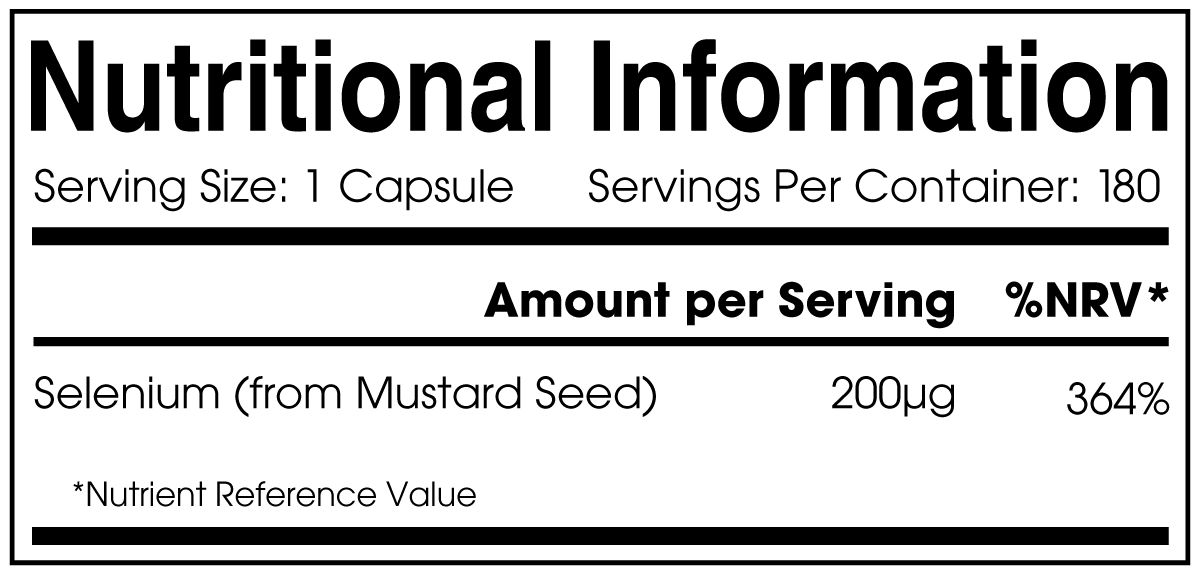
200µg ÷ 364% = 55µg, the reference value on the panel · £9.99 ÷ 180 = about 5.6p a day · £12.99 ÷ 365 = about 3.6p a day.
Organic Selenium and Selenium Tablets, nutrition panel and prices [5]
Organic selenium: certified mustard seed, not selenium yeast
The organic pouch means organic in the farming sense: the EU leaf logo, the certifier’s code SK-BIO-003 and the words non-EU agriculture, so the mustard seed was grown outside the EU under organic rules [5]. It is not selenium yeast, a different ingredient altogether, and you won’t find yeast anywhere on its ingredients list.
Mustard belongs to the Brassicaceae, and several members of that family accumulate large amounts of selenium from the soil, converting it into the organic forms found in food, in particular selenomethionine and selenocysteine [3].
L-selenomethionine tablets: the form plants and foods carry
The chemist’s organic selenium is the third meaning: selenium bound into a carbon compound, and in food that is selenomethionine and selenocysteine [3]. Our tablets name L-selenomethionine, selenium carried on the amino acid methionine, in a microcrystalline cellulose tablet with a hypromellose coating [5].
Selenium benefits: the claims UK rules authorise
In the UK a food supplement may carry only the health claims authorised on the Great Britain Nutrition and Health Claims Register [1]. A claim needs 15% of the reference value, which is 8.25µg of selenium, and every product on this page is well above it. Our selenium capsules and tablets give 200µg, whilst each multivitamin serving gives 55µg or 60µg [5] [7].
Every health claim on the Great Britain register passed a scientific review: independent scientists examined the research and the evidence behind it before it was authorised [1]. The law itself says that health claims shall be “based on and substantiated by generally accepted scientific evidence” [6].
What is selenium authorised to say? The six sentences
Each one is quoted word for word.
- Selenium contributes to the normal thyroid function.
- Selenium contributes to the normal function of the immune system.
- Selenium contributes to the maintenance of normal hair.
- Selenium contributes to the maintenance of normal nails.
- Selenium contributes to the protection of cells from oxidative stress.
- Selenium contributes to normal spermatogenesis.
These sentences describe selenium’s role in the body’s normal function. They describe the everyday work selenium does, and they apply in full to the capsule and the tablets.
How to take selenium: one a day with water
Each label asks for one capsule or one tablet daily with water [5]. No time of day is given, so keep the pouch by a meal you never skip.
180 days of organic selenium
If selenium from an organic-certified plant suits you, one vegan capsule a day covers six months for £9.99, about 5.6p a day. For the lowest price a day, the L-selenomethionine tablets cover a year for £12.99.
SHOP ORGANIC SELENIUM
Selenium FAQs
1. What are the benefits of selenium supplements?
Selenium contributes to the normal thyroid function, to the normal function of the immune system and to the maintenance of normal hair and nails, among the six sentences authorised for selenium, quoted word for word above [1]. They belong to selenium in any form, so they are the same for the capsule and the tablets.
2. What is selenium, and where does it come from?
It is a trace mineral, discovered in 1817 by the chemist Jacob Berzelius and named after selene, the Greek word for the moon [3]. Plants take it from the soil and build it into selenomethionine and selenocysteine, which is how it reaches cereals, meat, fish, eggs and nuts, and in the body its work is done by selenoproteins, each holding at least one selenocysteine [3] [4].
3. How much selenium a day do I need?
The NHS says 75µg a day for men and 60µg for women aged 19 to 64 [2].
4. Is 200µg of selenium a day too much?
The NHS says taking 350µg or less a day of selenium supplements is unlikely to cause any harm [2]. One of our capsules or tablets a day gives 200µg, as the labels direct, and with either of our women’s multivitamins beside it the day comes to 255µg or 260µg, still under that figure [5] [7].
5. What does organic selenium mean on the label?
On our capsule it means the mustard seed was grown under organic rules, shown by the EU leaf logo [5]. It is not selenium yeast, and it is separate from the chemist’s meaning, selenium bound into a compound such as selenomethionine [3].
6. Are selenium tablets and capsules vegan?
The pouch fronts say vegan capsules and vegan tablets, the capsule shell is hypromellose and the tablet’s coating is hypromellose too [5].
7. Can I take selenium every day?
Yes. Each label gives a daily amount of one, so it is made for daily use; just don’t take more than the label says [5]. The labels add that the products are not intended for children, and ask you to consult a doctor before use if you are pregnant, breastfeeding, have a medical condition or take medication [5].
8. Selenium and thyroid: what does the register say?
“Selenium contributes to the normal thyroid function.” is the authorised sentence, quoted word for word [1]. It applies to all three products, the capsule and the tablets alike [1].
If you want selenium from an organic-certified plant in a vegan capsule, choose the Organic Selenium 200mcg capsules at about 5.6p a day. If a year in one pouch and the lowest price matter more, choose the Selenium Tablets 200mcg, 365 tablets at about 3.6p. Whichever you pick, one a day gives you 200µg, and every authorised sentence quoted above comes with it [1].
References
Checked against the product labels, the GB Nutrition and Health Claims Register, nhs.uk and the published papers cited below, September 2026.
[1] Department of Health and Social Care. Great Britain nutrition and health claims (NHC) register, GOV.UK (selenium: six authorised health claims). Accessed 2026-09-24. View Source
[2] Others – Vitamins and minerals – NHS (selenium section). Accessed 2026-09-24. View Source
[3] Kieliszek M. Selenium: Fascinating Microelement, Properties and Sources in Food. Molecules. 2019;24(7):1298. View Source
[4] Labunskyy VM, Hatfield DL, Gladyshev VN. Selenoproteins: Molecular Pathways and Physiological Roles. Physiological Reviews. 2014;94(3):739-777. View Source
[5] Alpha01. Organic Selenium 200mcg 180 Capsules, Selenium Tablets 200mcg 365 Tablets and 180 Tablets: pouch fronts, nutrition information panels, ingredients, suggested use, caution and prices. Label maths by the author. Accessed 2026-09-24. View Source
[6] Regulation (EC) No 1924/2006 on nutrition and health claims made on foods, Article 6: scientific substantiation for claims, as it applies in Great Britain. legislation.gov.uk. Accessed 2026-09-25. View Source
[7] Alpha01. Women’s Multivitamins 90 Tablets and Organic Women Multivitamin 60 Capsules: nutrition information panels (selenium per two-tablet or two-capsule serving). Accessed 2026-09-28. View Source


