If you eat little or no meat, you might be used to two questions: where do you get your protein, and where do you get your iron? Spirulina turns up in a lot of the answers, and our powder’s label shows why: 60g of protein and 60mg of iron in every 100g [5]. Iron matters because it contributes to the reduction of tiredness and fatigue, to normal energy-yielding metabolism and to normal oxygen transport in the body [1].
But opting for spirulina is only half the battle, and the confusion begins when you try to decide which one is right for you. There is green powder, there are tablets, there is a vivid blue spirulina, and chlorella sits right beside them all. The detail is in the small print: our powder’s panel prints its nutrients per 100g, and a level teaspoon holds 3g of protein and 3mg of iron, 21% of the daily reference. This guide shows you how to read our powder’s panel by the teaspoon, how our four spirulina products differ, and which one suits you.
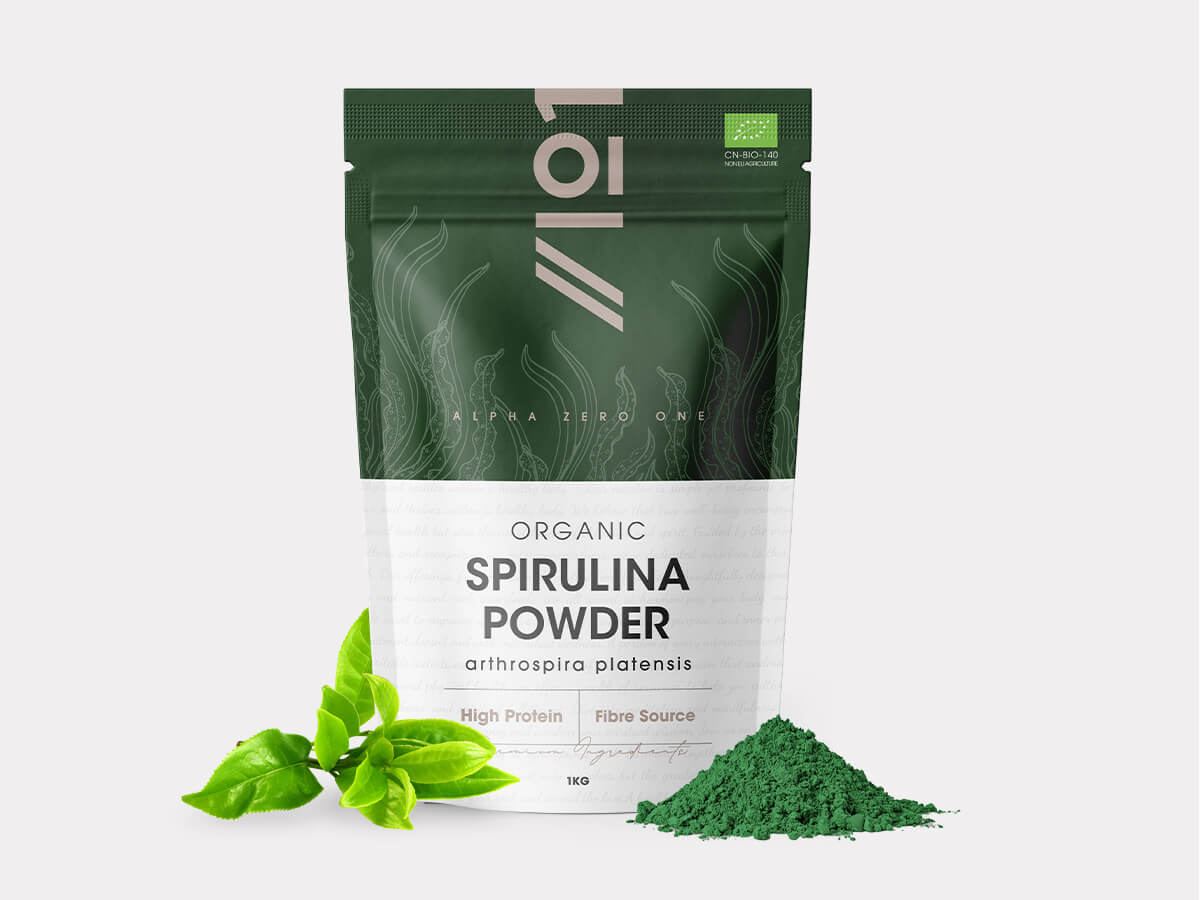
Spirulina powder at a glance
- What it is: dried Arthrospira platensis, a blue-green microalga, as one certified organic ingredient [2] [5].
- On the label, per 100g: protein 60g, iron 60mg, vitamin A 6,000µg, fibre 8.7g and no fat.
- In a level teaspoon, about 5g: 3g of protein, 3mg of iron (21% of the daily reference) and 300µg of vitamin A.
- Authorised claims, for the iron: Iron contributes to the reduction of tiredness and fatigue [1].
- Price: £24.99 for 1kg, about 200 teaspoons at about 12p each.
- The other formats: tablets you swallow, blue spirulina for colour, and tablets that add chlorella.
ORGANIC SPIRULINA POWDER · 1KG
£24.99 · about 200 teaspoons · per 100g: protein 60g, iron 60mg, vitamin A 6,000µg · one organic ingredient · about 12p a teaspoon
SHOP NOW
Spirulina powder, spirulina tablets or blue spirulina: which is right for you?
The right spirulina for you depends on what you want it to do. Here is how to choose between printed nutrients, convenience, colour, or two algae at once.
Spirulina powder: the one with its nutrients on the label
If protein and iron are the reason you are here, the powder is the format to read first. Our Organic Spirulina Powder is the only one of the four whose panel declares them, and 1kg works out at about 12p a teaspoon. It also comes in 500g and 100g pouches if you would rather start small, and all three sit among our powders.
Spirulina tablets: 2,000mg without the taste
If you would rather swallow than taste it, our Organic Spirulina 2000mg tablets are nothing but pressed spirulina, four a day, for about 9p a day. You will find them with our herbal supplements.
ORGANIC SPIRULINA 2000MG · 300 VEGAN TABLETS
£6.99 · 75 servings · 4 tablets daily, preferably with food · 2,000mg of organic spirulina · about 9p a day
SHOP NOW
Blue spirulina: the pigment, not the whole alga
If it is the vivid blue bowl or latte you are after, Organic Blue Spirulina is a different product: the blue pigment extracted from spirulina, not the whole alga. Its label declares 38g of protein per 100g, and you use about a gram at a time.
Spirulina and chlorella: two algae in one tablet
If you cannot decide between the two green algae, our Spirulina and Chlorella tablets hold 1,000mg of each in four tablets, for about 12p a day. Chlorella is a different organism altogether, and its cell wall is broken so that the powder can be pressed.
The tablets sit in our spirulina range, the powders in our spirulina powder range and the blue pigment in a blue spirulina range of its own. Each format also has a deeper guide: spirulina powder, spirulina tablets, blue spirulina, spirulina and chlorella together and chlorella.
What is spirulina? (It is not a plant)
People ask for the spirulina plant, but spirulina is not a plant at all. It is a photosynthetic, filamentous bacterium, commonly called a blue-green microalga, and the species in our pouches is Arthrospira platensis [2] [3]. Under a microscope it looks like a tiny green spiral, which is where the name comes from.
Where the spirulina plant, as people call it, grows
In the wild, Arthrospira lives in saline, alkaline lakes, water too harsh for most other life [3]. For food it is farmed, in open ponds and in closed tanks called photobioreactors, then harvested, dried and milled [3].
Spirulina protein and the pigment behind blue spirulina
Spirulina is unusually rich in protein for something that grows in water: between 60 and 70% of its dry matter [2]. It also carries a blue pigment, phycocyanin, which makes up 14 to 20% of the dried alga, and that pigment is what blue spirulina is made from [3]. The pigment breaks down above about 47°C, which is why blue spirulina belongs in cold drinks and bowls [3].
Spirulina protein and iron on the label: per 100g or per teaspoon?
This is the detail that is easiest to misread. Every figure on the powder’s panel is per 100g, and nobody eats 100g of spirulina. The pouch names no serving size, so the honest way to read it is by the teaspoon, which holds about 5g.

Per 100g the panel says protein 60g, iron 60mg, vitamin A 6,000µg. In a level 5g teaspoon that is 3g of protein · 3mg of iron, 21% of the 14mg NRV · 300µg of vitamin A, about 38% of the 800µg NRV · 1kg = about 200 teaspoons · £24.99 ÷ 200 = about 12p a teaspoon.
Organic Spirulina Powder, nutrition panel per 100g [5]
So 60g of protein per 100g becomes 3g in a teaspoon: a useful addition to a smoothie. The 60mg of iron becomes 3mg, which is 21% of the daily reference amount.
Spirulina vs chlorella, powder vs tablets: how they compare
The table puts our labels side by side: what each declares, and who it suits. Prices are correct at the time of writing.
per 100g: protein 60g · iron 60mg (429%) · vitamin A 6,000µg (750%) · fibre 8.7g · fat 0g · one ingredient, certified organic
Choose if you want spirulina whose nutrients are printed on the label · a 5g teaspoon: 3g protein, 3mg iron · about 12p a teaspoon · also in 500g and 100g
4 tablets · 2,000mg of organic spirulina, 500mg in each · nothing but spirulina powder
Choose if you would rather swallow than taste · 75 days · £6.99: about 9p a day · 1000 tablets about 5p a day
per 100g: protein 38g · fibre 3.9g · fat 0g · the blue pigment, not the whole alga
Choose if you want the vivid blue colour in drinks and bowls · £9.99
4 tablets · 1,000mg of spirulina and 1,000mg of chlorella with a broken cell wall
Choose if you want both algae in one tablet · 75 days · £8.99: about 12p a day
How to compare spirulina supplements
Comparing another brand? Check whether the figures are per 100g or per serving, whether it is the whole alga or the blue pigment, and whether the organic leaf is on the pouch.
Then divide the price by the number of servings.
Spirulina benefits: the claims UK rules authorise
In the UK a food supplement may carry only the health claims authorised on the Great Britain Nutrition and Health Claims Register [1].
Every health claim on the Great Britain register passed a scientific review: independent scientists examined the research and the evidence behind it before it was authorised [1]. The law itself says that health claims shall be “based on and substantiated by generally accepted scientific evidence” [6].
The register has entries for three nutrients on our powder’s panel, and each one below is quoted word for word. They apply to the powder only.
- Iron contributes to the reduction of tiredness and fatigue.
- Iron contributes to normal energy-yielding metabolism.
- Iron contributes to normal formation of red blood cells and haemoglobin.
- Iron contributes to normal oxygen transport in the body.
- Iron contributes to the normal function of the immune system.
- Iron contributes to normal cognitive function.
- Iron has a role in the process of cell division.
- Vitamin A contributes to the maintenance of normal vision.
- Vitamin A contributes to the maintenance of normal skin.
- Vitamin A contributes to the normal function of the immune system.
- Vitamin A contributes to normal iron metabolism.
- Vitamin A contributes to the maintenance of normal mucous membranes.
- Vitamin A has a role in the process of cell specialisation.
- Protein contributes to the maintenance of muscle mass.
- Protein contributes to a growth in muscle mass.
- Protein contributes to the maintenance of normal bones.
The panel lists other minerals too, but a teaspoon gives less than 15% of their daily reference amounts, so we claim nothing for them.
How to take spirulina powder
The label says to add the powder to water, juice, shakes or smoothies, and it names no amount. A level teaspoon, about 5g, is a sensible measure, and the taste is strong, so fruit or a cold smoothie is the usual company. One teaspoon in a morning smoothie makes it an easy part of your daily wellbeing routine.
The tablets’ label says four daily, preferably with food. Store any of the pouches in a cool, dry place out of direct sunlight, and keep them out of reach of young children.
Protein and iron you can read on the label
If you want a straightforward, organic way to add protein and iron to your day, our powder is the place to start. The 1kg pouch gives you about 200 teaspoons for around 12p each.
SHOP ORGANIC SPIRULINA POWDER
Spirulina supplement FAQs
1. What are the benefits of spirulina powder?
Its benefits are the ones UK law authorises for the nutrients its label declares: iron contributes to the reduction of tiredness and fatigue and to the normal function of the immune system, vitamin A contributes to the maintenance of normal vision, and protein contributes to the maintenance of muscle mass [1].
2. How much spirulina protein is in a teaspoon?
About 3g. The panel says 60g per 100g, and a level teaspoon holds about 5g of powder.
3. Is there iron in spirulina tablets?
Our tablets’ label declares no iron figure. For a declared amount, choose the powder: 60mg per 100g, which is 3mg in a teaspoon.
4. What is blue spirulina?
It is the blue pigment extracted from spirulina, not the whole alga [3]. Our blue spirulina label declares 38g of protein and 3.9g of fibre per 100g.
5. Is there really a spirulina plant?
No. Spirulina is a photosynthetic bacterium, commonly called a blue-green microalga, and ours is Arthrospira platensis [2].
6. What is the difference between spirulina and chlorella?
They are different organisms. Spirulina is a spiral-shaped blue-green microalga, while chlorella is a single-celled green alga from fresh water. Both are in our algae range, each on its own and both together in one tablet.
7. Is your organic spirulina vegan?
Yes, and all of it is vegan. The powder is one ingredient, organic spirulina, and the tablets are pressed from the same kind of powder with nothing added. Both carry the EU organic leaf.
8. Can I take spirulina powder with cod liver oil or a multivitamin?
Yes, with one of them. A level teaspoon gives about 300µg of vitamin A, and our Cod Liver Oil 1000mg, MultiVitamin & Minerals and Women’s Multivitamins give 800µg each, so the powder with one of them comes to about 1,100µg [5]. The NHS advises that your daily vitamin A from food and supplements should not exceed 1,500µg, so pair the powder with one product from our vitamin A range [4].
9. Can I take spirulina when pregnant?
Our powder’s label declares vitamin A, and the tablets are pressed from the same kind of powder, so the NHS line on vitamin A applies to both: “If you’re pregnant, avoid taking supplements containing vitamin A, including fish liver oil supplements (such as cod liver oil).” [4]
If you want protein and iron you can read on a label, choose the Organic Spirulina Powder at about 12p a teaspoon. If you would rather not taste it, choose the Organic Spirulina tablets at about 9p a day, and if it is the colour you came for, Blue Spirulina is the one. Whichever you choose, read the panel by the teaspoon, not by the 100g.
References
Checked against the product labels, the GB Nutrition and Health Claims Register and nhs.uk, September 2026.
[1] Department of Health and Social Care. Great Britain nutrition and health claims (NHC) register, GOV.UK (iron, vitamin A and protein entries authorised; no entry for spirulina). Accessed 2026-09-25. View Source
[2] Chaouachi M, Vincent S, Groussard C. A Review of the Health-Promoting Properties of Spirulina with a Focus on athletes’ Performance and Recovery. Journal of Dietary Supplements. 2024;21(2):210-241. Cited only for what spirulina is and its protein content. View Source
[3] Fernandes R, Campos J, Serra M, et al. Exploring the Benefits of Phycocyanin: From Spirulina Cultivation to Its Widespread Applications. Pharmaceuticals. 2023;16(4):592. Cited only for where Arthrospira lives, how it is grown and its blue pigment. View Source
[4] Vitamin A – NHS. Accessed 2026-09-20. View Source
[5] Alpha01. Organic Spirulina Powder (1kg, 500g, 100g), Organic Spirulina 2000mg tablets (300 and 1000), Organic Blue Spirulina Powder, Organic Spirulina and Chlorella tablets, Cod Liver Oil 1000mg, MultiVitamin & Minerals and Women’s Multivitamins: pouch fronts, nutritional information panels, ingredients, suggested use and prices. Accessed 2026-09-25. View Source
[6] Regulation (EC) No 1924/2006 on nutrition and health claims made on foods, Article 6: scientific substantiation for claims, as it applies in Great Britain. legislation.gov.uk. Accessed 2026-09-25. View Source


